


How to Buy LiquidChain ($LIQUID)
LiquidChain (LIQUID) is a hot presale project that offers exposure to a new Layer 3 network. The decentralized protocol unites the three largest blockchain platforms: Bitcoin (BTC), Ethereum (ETH), and Solana (SOL). LIQUID, the native token, unlocks access to these ecosystems in a unified, non-custodial environment.
Purchase the presale token LIQUID at a discounted price before the first exchange listing. Our guide explains how to buy LiquidChain safely. Discover more about the Web 3.0 project, including its token use cases, roadmap objectives, and long-term price potential.
LiquidChain Key Takeaways
- LiquidChain is a Layer 3 solution for the Bitcoin, Ethereum, and Solana blockchains. It bridges the gap between these ecosystems through cross-chain interpretability. The startup leverages BTC’s capital, Ethereum’s vast decentralized finance (DeFi) markets, and SOL’s scalable and low-cost framework.
- To raise capital for product development, exchange liquidity, and marketing, LiquidChain offers LIQUID tokens via a presale campaign. No purchase minimums apply, and the event accepts popular cryptocurrencies as payment. Presale benefits include lower token prices and exclusive staking rewards.
- After the presale, participants receive their purchased LIQUID without vesting terms. The founders list tokens on exchanges several days later, which enables the public to trade them in open markets. Citing its small market capitalization and diverse utility, some experts rate LiquidChain as one of the best crypto presales for 2026.
How to Buy LiquidChain in 5 Easy Steps
It takes less than five minutes to join the LIQUID presale. Here is a quick overview with five simple steps:
1️⃣ Get a Non-Custodial Wallet. A secure software wallet that offers non-custodial storage is the best choice. The wallet connects to the presale website and stores LIQUID tokens when the event ends. We found that Best Wallet offers the overall best user experience.
2️⃣ Fund the Wallet. After securing the wallet, add cryptocurrencies to the Best Wallet app. Ensure you deposit an asset that the presale accepts. If you don’t have any tokens, purchase some on Best Wallet, which accepts a wide range of traditional payment methods.
3️⃣ Connect to the LiquidChain Presale. Head to the LiquidChain website, select “Buy With Crypto”, and choose “Best Wallet” as the wallet provider. Reopen Best Wallet to approve the connection.
4️⃣ Choose the Investment Size. Carefully decide how many LIQUID tokens to buy, based on your risk appetite and budget. Remember that presale cryptocurrencies are high-risk, high-return assets, so never invest more than you can afford to lose.
5️⃣ Complete LiquidChain Purchase. Fill out the presale form, including the payment currency and purchase size. To confirm the LiquidChain investment, open the connected wallet and approve the transfer. When the presale concludes, return to the LiquidChain website to claim your tokens.
How to Invest in LiquidChain: Full Tutorial
Presale investments are relatively straightforward; however, first-time investors may need additional guidance. Unlike buying cryptocurrencies from online exchanges, presale participants purchase tokens through wallet-to-wallet payments.
Read on for a more expensive walkthrough of how to buy LiquidChain.
Step 1: Install a Non-Custodial Software Wallet
While crypto investors primarily use wallets to send, receive, and store digital assets, they also facilitate presale purchases. Hundreds of wallets exist, and top providers include Coinbase Wallet, Trust Wallet, MyEtherWallet, and Exodus.
We prefer Best Wallet, though, as it offers the perfect combination of robust security, user-friendliness, and extensive network support. The free iOS and Android app partners with on-ramp gateways, which enable instant crypto purchases with debit/credit cards and e-wallets. This feature lets complete beginners fund their LiquidChain purchase with real money.
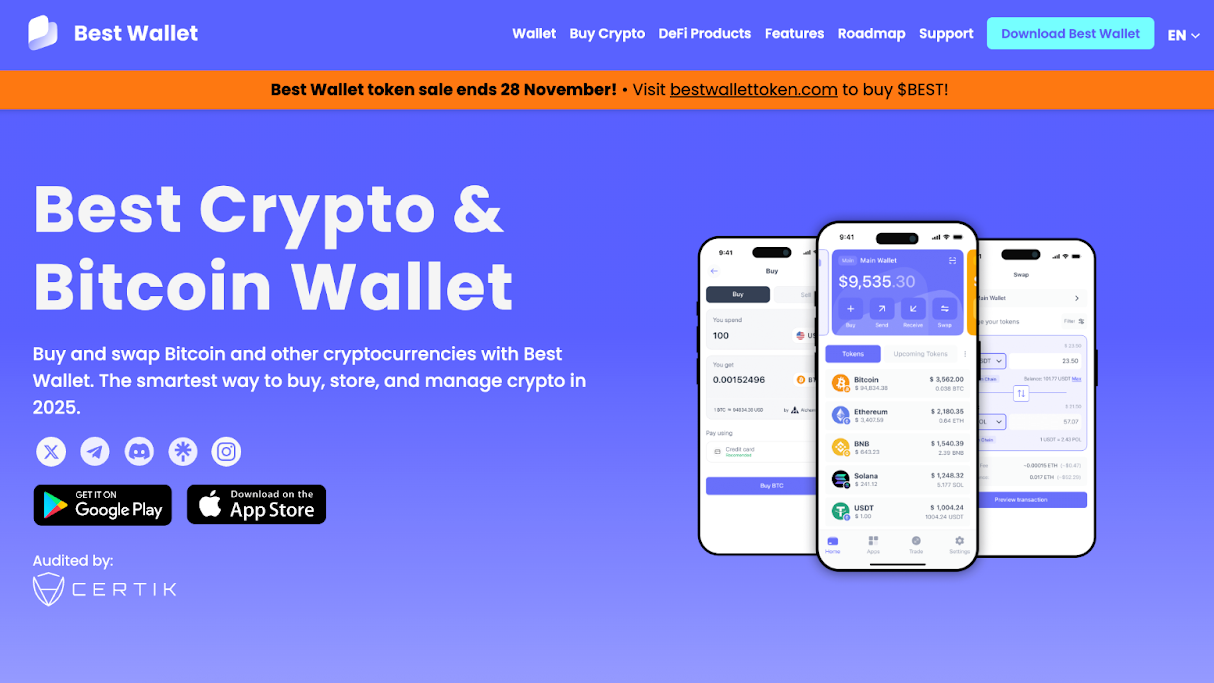
Visit the Best Wallet website, download the app, and enter your email address. Confirm the verification code that Best Wallet sends.
After choosing a login PIN, Best Wallet prompts users to upload encrypted private keys to iCloud or Google Drive. This security process ensures seamless wallet recovery should you lose access to the app.
We recommend users activate biometrics and two-factor authentication in the “Settings” tab. These features enhance the wallet’s security defenses.
Step 2: Deposit or Buy an Accepted Presale Asset
The LiquidChain presale accepts the following cryptocurrencies:
- Bitcoin (BTC)
- Ethereum (ETH)
- Tether (USDT)
- USDC (USDC)
- Solana (SOL)
- BNB (BNB)
The next step depends on whether you hold one of these assets in another wallet or exchange account. If you do, select the crypto you want to deposit, and transfer assets to the provided wallet address.
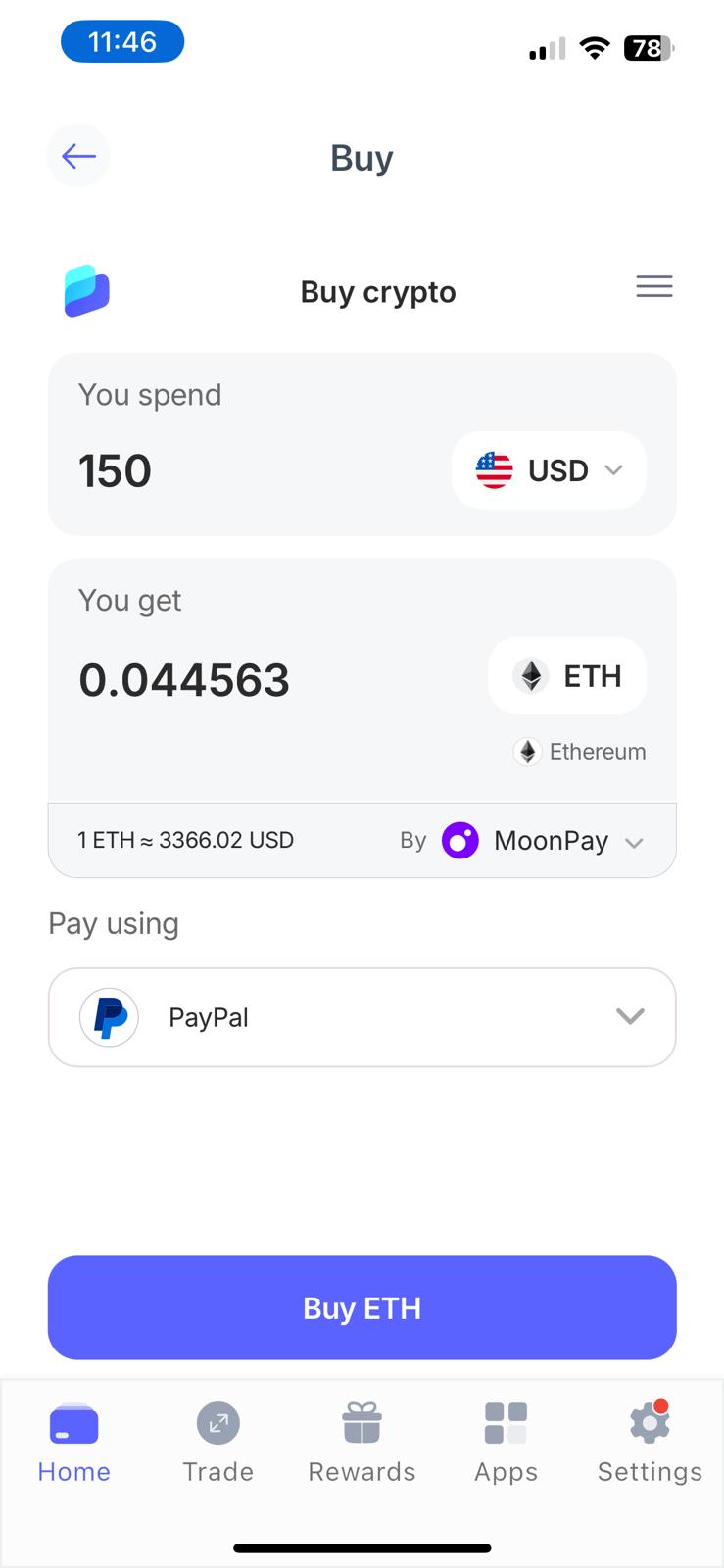
The other option is to buy cryptocurrencies on the Best Wallet app. Tap the “Trade” and “Buy” buttons to access the on-ramp tool. We recommend purchasing ETH for the LiquidChain presale, as LIQUID is an ERC-20 token.
Input the trade parameters, such as the fiat currency, purchase amount, and payment method, then review the quoted prices. Enter the payment details, and once the gateway processes the transaction, it transfers ETH to your wallet balance.
Step 3: Connect Wallet to the Presale Dashboard
This step requires you to connect Best Wallet to the LiquidChain presale, as participation requires a crypto transfer. The process is safe because Best Wallet approves transfers only when the user authorizes them from the registered device.
Visit the LiquidChain website to access the presale widget. Click the “Buy With Crypto” button followed by “EVM”. A list of wallet providers appears: select Best Wallet.
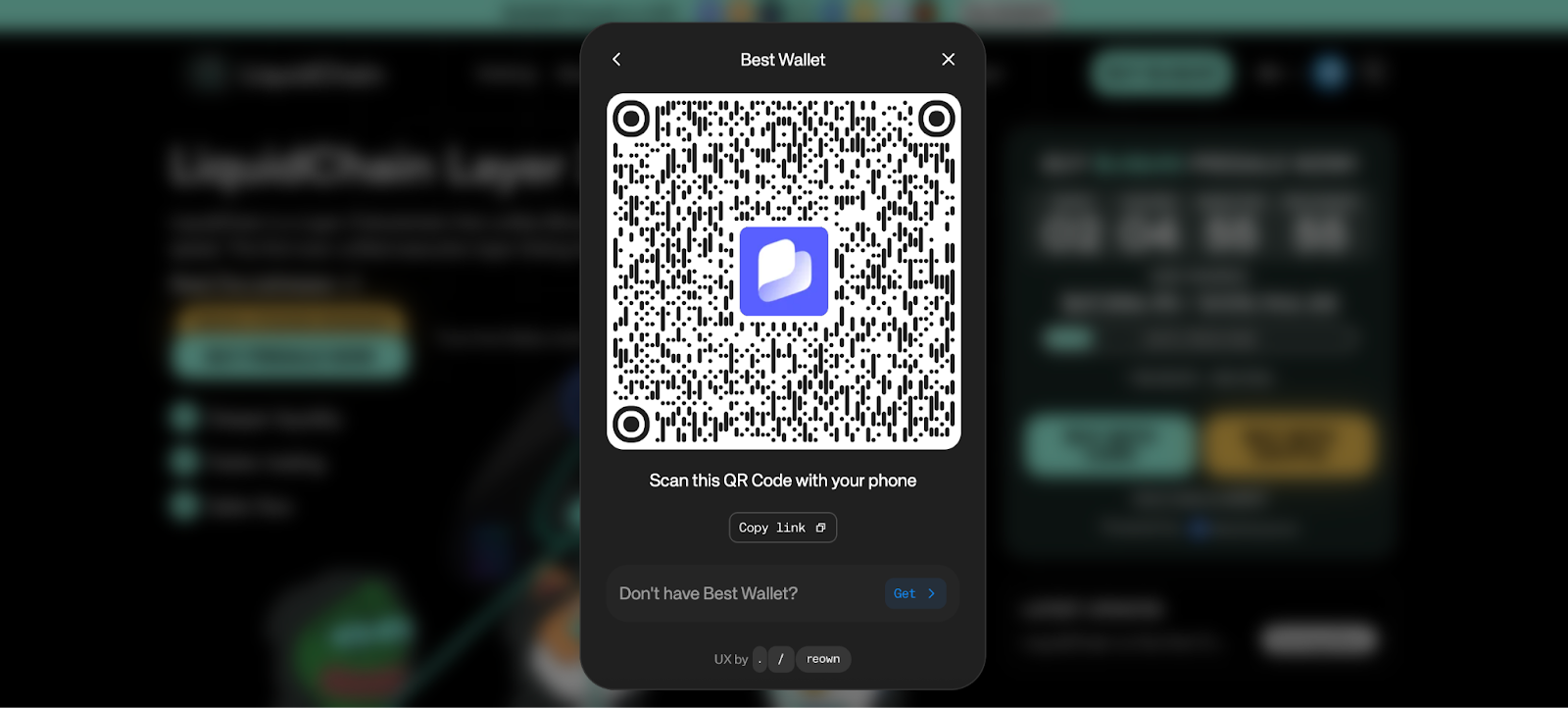
Smartphone users must reopen the Best Wallet app, review the connection request (it should state LiquidChain), and approve it.
Those on a desktop device scan the on-screen QR code via Best Wallet’s camera feature and manually approve the connection.
Step 4: Fill Out the Presale Purchase Form
LiquidChain offers a simple presale that simply requires the payment asset and the investment size. Enter the purchase quantity in crypto terms, based on the coins or tokens held in the wallet balance. For example, the screenshot below shows a 0.4 ETH purchase, which equates to 100,489 LIQUID tokens.
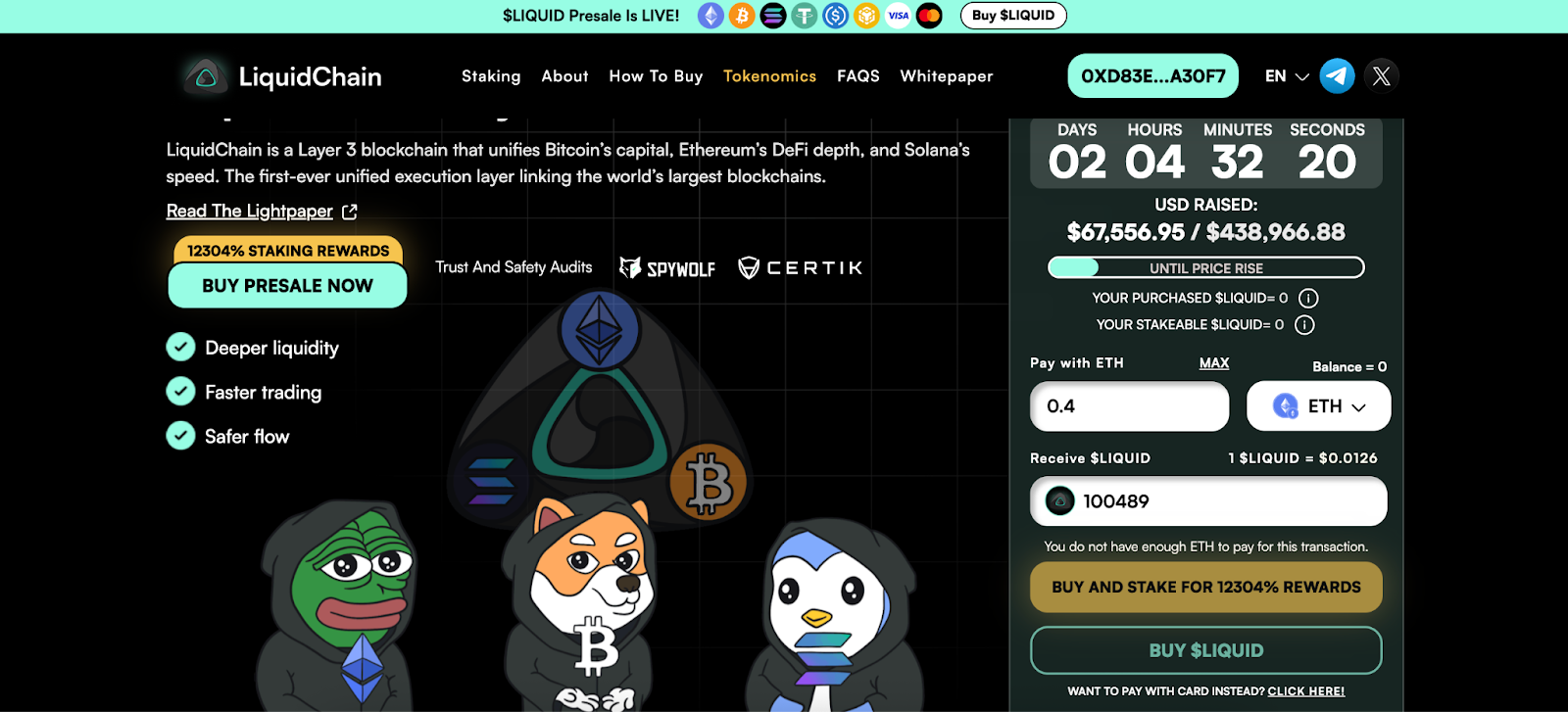
The widget lets you choose whether they want to stake LIQUID during the presale event. The staking feature offers the highest interest rates to early backers, as dynamically adjusted APYs reduce as more people join. You will receive those staking rewards in addition to the original purchase amount.
Step 5: Confirm Order to Buy LiquidChain Token
Click the “Buy $Liquid” or “Buy and Stake” button, and open the Best Wallet app to review the smart contract request. Check the transfer amount and ensure it displays LiquidChain as the merchant.
Once you approve the request, the app sends the exact amount of cryptocurrencies to LiquidChain’s wallet, which confirms the presale investment.
The team lets investors claim their purchased tokens when the presale ends. Scheduled for 2026, the claim process requires participants to reconnect the same wallet. A smart contract then transfers LIQUID to the user’s Ethereum address.
LiquidChain Features
LiquidChain develops a proprietary Layer 3 network with revolutionary use cases. It allows platform users to bridge to the Bitcoin, Ethereum, and Solana blockchains through a unified ecosystem.
Current blockchain limitations prevent these blockchains from exchanging value, as each protocol uses independent code. For example, BTC holders cannot access Ethereum applications, while SOL restricts investors to the Solana blockchain.
LiquidChain’s solution relies on cross-chain proofs, where stakeholders access all three blockchains while retaining control of their private keys and assets. This distinction is essential, as existing cross-chain platforms use centralized bridges that serve as custodians. Yet, history shows that hackers breached multiple bridges in recent years, which led to significant asset losses.
Built on a high-performance virtual machine, the Layer 3 platform handles transactions within a highly scalable environment. It processes asset transfers almost instantly with near-zero fees. It also supports native dApps, so developers can deploy decentralized exchanges (DEXs), staking protocols, prediction markets, and other Web 3.0 concepts.
Summary:
✅ LiquidChain connects Bitcoin, Ethereum, and Solana through a decentralized Layer 3 solution. It creates a global unified liquidity pool for the world’s most important blockchains.
✅ The technology enables BTC, ETH, and SOL holders to engage with competing ecosystems without relinquishing control of their assets. LIQUID serves as the native ecosystem token.
LiquidChain Tokenomics
Evaluate the tokenomics of LiquidChain before purchasing, as they determine the demand and supply dynamics. In this case, the team proposes a sustainable token distribution upon the end of the presale.
Auditors confirm that LiquidChain has created 11,800,000,100 tokens. The capped supply ensures no additional tokens enter the market, which creates scarcity over time. Tokens operate on the Ethereum blockchain for seamless accessibility, so LIQUID uses the ERC-20 standard.
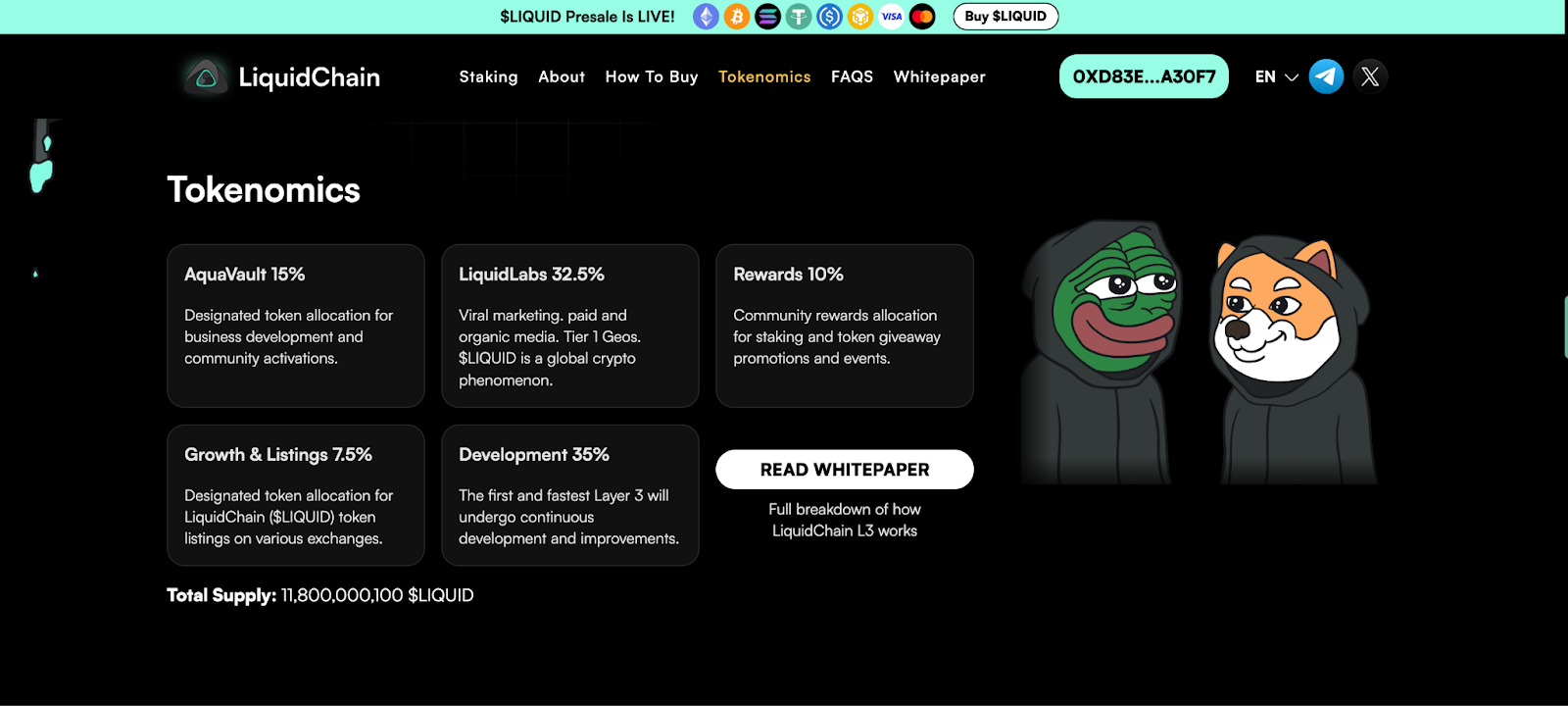
➡️ The project initially allocates up to 7.5% for exchange liquidity, which creates public trading markets for those who missed the presale event. Liquidity pools ensure anyone can trade LIQUID tokens on Ethereum-based DEXs like Uniswap. We anticipate no more than 2.5% for the first listing, as LiquidChain plans partnerships with multiple exchanges.
➡️ As an early-stage startup, LiquidChain uses 35% of the token supply for protocol development. The tokens help fund roadmap objectives, including the testnet Layer 3 infrastructure, cross-chain functionality, multi-chain swaps, and the eventual mainnet launch. Ongoing development requirements include protocol upgrades, security maintenance, and governance.
➡️ AquaVault, the department responsible for business developments and institutional onboarding, receives 15% of the supply.
➡️ At 32.5%, a substantial percentage of tokens is allocated to the marketing team. This large allocation helps attract presale investors, strategic partners, and ecosystem users. Therefore, it helps drive awareness and LIQUID demand.
➡️ The final 10% funds are community rewards, including token giveaways, events, and the staking program.
LiquidChain Presale & Staking Breakdown
LiquidChain raises funds from presale investors like many successful blockchain projects. Ethereum, Solana, and BNB Chain sold their native coins to early backers, who made substantial returns as the market price exploded.
The presale spans multiple stages, and each one allocates a small batch of LIQUID tokens. The price increases when the full batch sells, or the countdown timer reaches zero. This presale structure is common in crypto, as it encourages investors to join in the early stages.
Participants use popular digital assets to invest, and while the presale also accepts debit/credit cards, fiat payments incur high fees and KYC requirements.
The whitepaper offers no information about final presale prices or hard cap targets. The founders mention Q3 2026 for centralized exchange (CEXs) partnerships, yet the initial DEX listing likely arrives much sooner.
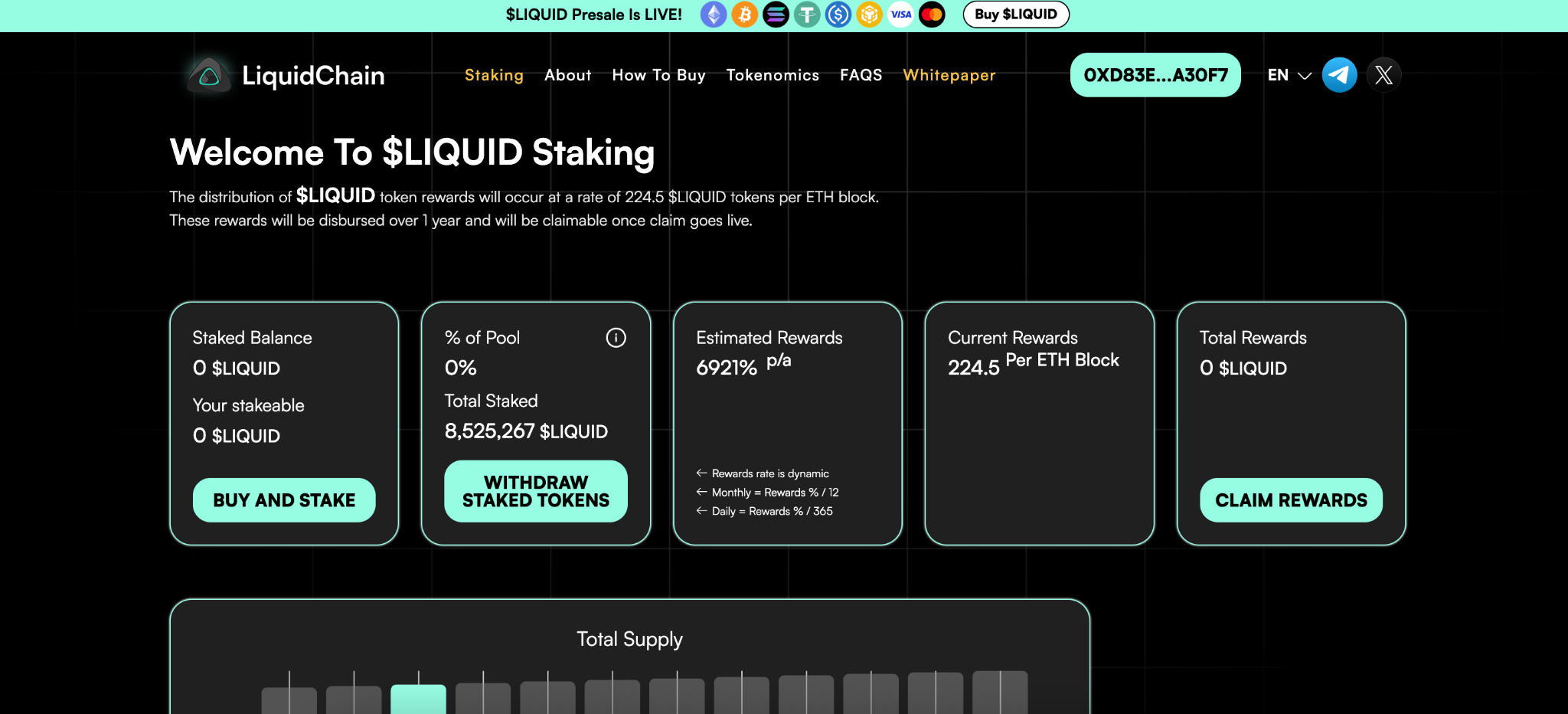
Regarding the staking program, presale investors earn passive rewards on their purchases. It uses a dynamic mechanism to determine APYs, which reduces the interest rate as more people stake tokens.
Currently, participants earn 6921% APYs because the presale recently launched. As the campaign progresses, expect that APY to decline considerably. Stakers avoid lock-up terms, so they can withdraw tokens at any time.
The system unlocks the presale staking allocation before the token generation event (TGE), which includes both the principal and the accumulated rewards.
LiquidChain Utility & Roadmap
As LIQUID is a utility token, it unlocks real ecosystem benefits that drive long-term adoption. The utility framework resembles existing Layer 1 and 2 blockchains because it serves as a transaction currency. When users send or receive LIQUID, or they engage with smart contracts and dApps, they pay network gas fees in the native token.
The Layer 3 blockchain rewards liquidity providers with LIQUID, too. This economic strategy incentivizes BTC, ETH, and SOL holders to deploy capital to the LiquidChain ecosystem. Without liquidity, the cross-chain concept lacks functionality.
As with other utility cryptocurrencies, some people buy LIQUID for speculative reasons. The LIQUID price rises and falls after the TGE, so early investors hope for long-term appreciation.
The roadmap confirms that many LiquidChain use cases arrive later in 2026. Here is an overview of the project’s key roadmap goals:
Phase 1: LiquidChain launched its presale event in the first roadmap phase. It also initiated its Layer 3 testnet infrastructure and SDK/API beta release.
Phase 2: The project launches LIQUID tokens on public exchanges with unified liquidity pools. This operational goal suggests that LIQUID could feature on multiple blockchain DEXs, such as Uniswap (Ethereum) and Raydium (Solana). Technical objectives include multi-chain swaps and settlements, and early dApp partnerships.
Phase 3: The mainnet Layer-3 network launches, and LiquidChain offers developer grants to incentivize dApp development. Key ecosystem products include lending modules and cross-chain derivatives.
Phase 4: To complete the roadmap journey, LiquidChain integrates emerging Layer 1 blockchains and existing Layer 2 rollups. The final roadmap phase also features DeFi protocol partnerships and CEX listings.
Follow the LiquidChain X page for roadmap updates. The LiquidChain Telegram channel shares project news.
Is LiquidChain Legit?
Investors must exercise caution when they invest in early-stage presales. Projects often promote new and innovative technologies, yet some fail to deliver on these promises.
LiquidChain releases its mainnet product in 206, so presale buyers risk capital before testing the infrastructure. The whitepaper and website content outline key technical specifications, including how the underlying Layer 3 works.
LiquidChain hired CertiK and SpyWolf to audit its native smart contract, which suggests the project is a transparent and legitimate startup. Audits have shown that the contract poses no cybersecurity threats and that the founders cannot amend the terms.
When Will LiquidChain Claiming & Launch Commence?
LiquidChain follows the same claim process as most presale events. When the presale closes, investors claim their tokens on the LiquidChain website. The presale system transfers LIQUID to the same wallet address that participants used to invest.
Those who contributed a non-ERC-20 asset, such as BTC or SOL, must provide an Ethereum wallet address during the claim process.
Although the team announces the exact TGE dates nearer to the time, most projects launch on exchanges several days after the claim event. No vesting terms apply to presale purchases, including staking rewards. As such, LIQUID holders can sell tokens any time after the initial exchange listing.
Is LiquidChain a Good Investment?
LiquidChain is a high-risk investment because the Layer 3 mainnet launches after the presale process. To offset these risks, the project sells LIQUID tokens to presale investors at the lowest valuation. Read on to evaluate whether LiquidChain represents a good investment.
Utility-Driven Token
LIQUID tokens offer widespread use cases within the Layer 3 ecosystem. As people purchase LIQUID to access unified liquidity pools across Bitcoin, Ethereum, and Solana, it increases demand and drives the token price. This model promotes organic growth, unlike meme coins, which rely on hype and FOMO.
Innovative Web 3.0 Solutions
Bitcoin, Ethereum, and Solana each operate unique blockchain infrastructures, and stakeholders have varying reasons to engage with each platform. BTC remains the de facto digital asset for long-term store of value. It lacks smart contract capabilities, so BTC holders cannot access dApps.
In contrast, DappRadar data confirms that Ethereum is the leading dApp ecosystem. The blockchain hosts over 5,200 active dApps, almost 203,000 smart contracts, and a DeFi total value locked (TVL) of $122 billion.
The Solana ecosystem remains the most popular blockchain for trading meme coins. Most top-100 meme coins by market capitalization use the SPL token standard, including Bonk (BONK), dogwifhat (WIF), and OFFICIAL TRUMP (TRUMP).
So, how does this impact LiquidChain? When users connect to LiquidChain’s Layer 3, they get exposure to each ecosystem use case. From Bitcoin’s vast capital and Ethereum’s thriving dApp framework to Solana’s meme coin marketplace, unified liquidity pools unlock seamless cross-chain functionality.
Secure the Lowest Project Valuation
The LiquidChain presale lets participants invest in the Layer 3 project from the ground up. Investors get a reduced token price compared with the TGE rate, which enables them to secure the lowest valuation.
The same structure applies to traditional startup companies. Early backers risk capital to target substantial long-term upside and experience the full growth cycle.
Note that LiquidChain sells tokens at different prices depending on the presale stage. The price increases as each stage completes to reward early supporters.
Generous Presale Staking Yields
Another presale benefit is the staking feature, as investors earn passive rewards on their purchases.
The staking tool distributes LIQUID tokens daily based on the deposit amount and APY. At the TGE, stakers will hold more tokens than they originally invested, which boosts the portfolio value.
Inclusive and Fair Presale Process
An overwhelming number of successful Layer1 and 2 blockchains gave priority to institutional investors in their fundraising events. They enabled large-scale backers to invest at a much lower rate than retail clients.
LiquidChain eliminates these unfair presale practices.
The project runs no private-stage rounds, and anyone can join without investment minimums. No KYC requirements apply either. The process removes country restrictions because participants invest via wallet addresses instead of real-world identities.
LiquidChain Future Price Forecast
LiquidChain confirms exchange listing prices later in the presale timeline, which prevents accurate price projections at this stage. Based on the current presale price of $0.0135, we forecast a modest 5% increase at the TGE. This ensures token sustainability and stable price movements when public traders enter the market.
After the TGE, we predict a potential all-time high of $0.05201 before a brief correction, where some presale investors cash in their early gains. LIQUID may resume its price trajectory as the mainnet Layer 3 launch approaches, and reach $0.07981 by the end of 2026.
The roadmap suggests that full ecosystem functionality will be achieved no later than 2027, which includes cross-chain derivatives and integration with both Layer 1 and Layer 2 blockchains. Rising platform adoption could help push the LIQUID price to $0.15844 by 2028 and $0.25109 by the end of the decade.
| Year | Potential 52-Week High |
| 2026 | $0.07981 |
| 2027 | $0.11702 |
| 2028 | $0.15844 |
| 2029 | $0.20812 |
| 2030 | $0.25109 |
Things to Consider Before Investing in LiquidChain
Presale projects offer high upside potential, but they also carry significant risk. Consider these factors before you buy LIQUID tokens:
- Volatility Risks: Due to its low market capitalization, presale buyers must prepare for high price volatility in the early weeks and months. Volatility typically decreases as new cryptocurrencies achieve roadmap targets.
- Investment Losses: Carefully evaluate how much money to risk on the LIQUID presale. Experts say that retail clients should limit presale purchases to small amounts, as some projects lose relevance after they launch. Only invest amounts you can afford to lose.
- Use the Presale Staking Tool: Most presale staking programs create vesting agreements, which lock tokens after the exchange launch. Since LiquidChain offers flexible staking terms, it may make sense to stake tokens during the event.
- Monitor On-Chain Adoption: Rather than rely on project announcements, track adoption growth on independent on-chain websites. Platforms like dAppRadar provide real-time, unbiased data, such as unique active wallets (UAW) and DeFi TVL.
FAQs About How to Buy LiquidChain
What is LiquidChain?
LiquidChain is a Layer 3 network that unifies Bitcoin, Ethereum, and Solana. Decentralized liquidity pools and cross-chain interpretability unlock significant use cases across the three leading blockchains.
Is LiquidChain safe?
Comprehensive technical documents and audited smart contracts suggest that LiquidChain is safe and legitimate. However, early-stage crypto startups present substantial risk, so investors must do their own research.
Should I buy LiquidChain?
If LiquidChain delivers on its roadmap promises, the LIQUID token could deliver explosive gains over time. Independent due diligence and risk assessment should determine whether you join the presale.
How do I join the LiquidChain presale?
Get a non-custodial wallet and deposit or buy an accepted presale asset like BTC, ETH, or USDT. Connect that wallet to the LiquidChain website and exchange your crypto for LIQUID.
References
- LiquidChain whitepaper (PDF)
- An overview on cross-chain: Mechanism, platforms, challenges and advances (Computer Networks Journal via ScienceDirect)
- On-Chain data aggregation (dAppRadar)
- Utility tokens vs. security tokens: what are the differences? (Coinbase)
- An Introduction to Layer 3 in Blockchain (Chainalysis)
About Author

About Author