


Solana ($SOL) Decoded: A Quick Guide
Solana (native token: $SOL) is one of the most widely discussed blockchains in the crypto space, and for good reason. Built in 2017 by Anatoly Yakovenko to deliver high throughput at low cost, Solana processes transactions in seconds with minimal fees, making it attractive to developers, traders, and everyday users alike. Some see it as a serious challenger to Ethereum, while others view it as an ambitious but still maturing experiment in scalability and decentralization.
Tech, Price Signals, and Getting Started
At its core, Solana represents a bold bet: that a single, highly optimized blockchain layer can handle global-scale adoption. This design has powered its rise in popularity, giving Solana unmatched speed and efficiency, but also raising questions about reliability, decentralization, and long-term sustainability.
This guide will help you understand exactly what Solana is, what SOL tokens represent, and why the Solana price often reacts sharply to shifts in market sentiment and adoption trends. You’ll also learn how to buy and store SOL securely, the risks worth considering before investing, and what the future may hold for this fast-moving blockchain. For more resources, check our insights on which blockchains perform best across speed, security, and scalability.
Price Pulse: Live Snapshot & Trend Context
As of 17 October 2025, Solana (SOL) trades at $181.43 USD, down 7.8% over the last 24 hours and 4.5% across the past seven days. This puts its market cap at $98.1 billion on $12 billion in daily volume.
SOL’s 52-week range spans $95.28 (low) to $294.43 (high), placing the current price close to the middle, 90% above the low but 38% below the peak. It’s 30% off the 2021 cycle high at $259.44 (despite briefly surpassing it with an ATH of $293.31 in January 2025), yet over 411x the 2020 ATL of $0.50.
| Metric | Value (Live) | 24h Change | 7d Change | 52-Week Range |
| SOL Price | 181.43 USD | -7.8% | -4.5% | $95.28 – $294.43 |
Check out the current Solana (SOL) price on Coinnews
On-chain activity and fees have declined recently, contributing to some caution in a stabilizing broader market.
Key price drivers include:
- Market Correlation: Solana’s price exhibits a strong positive correlation with major cryptocurrencies, maintaining a one-year rolling coefficient of approximately +0.7 with both Bitcoin and Ethereum. This alignment means SOL tends to follow BTC and ETH during market-wide rallies or corrections, amplifying its responsiveness to sector sentiment.
- Network Activity: Metrics such as daily active addresses, transaction volume, and DeFi TVL provide insights into network health. As of 17 October 2025, Solana recorded 2.6 million active addresses and 69.1 million transactions in the last 24 hours. TVL stands at $12.5 billion, down 4.3% daily but supported by a 0.83% rise in stablecoin market cap over seven days. DEX volume reached $5.9 billion in the past day, reflecting ongoing but variable usage levels.
- Ecosystem Growth: Developments within Solana’s ecosystem, including protocol launches and NFT activity, contribute to adoption trends. In August 2025, the Metaplex Core protocol was introduced, reducing NFT creation costs by over 80% to about $0.70 per asset. September saw increased developer engagement, with upcoming airdrops for projects like Bonk, Orca, and Jupiter, alongside cross-platform integrations for NFTs that enhance interoperability.
- Macro & Regulatory News: Economic policies and regulatory updates impact the crypto sector broadly, affecting SOL through sentiment and liquidity flows. In September 2025, the SEC streamlined ETF approvals, with analysts assigning 100% odds for Solana ETF launches in Q4, signaling a shift toward clearer frameworks. However, risks like a potential U.S. government shutdown could delay related legislation, while neutral market sentiment reflects cautious optimism amid these changes.
Solana in 60 Seconds: What Is Solana? What is SOL?
Solana is a high-performance, open-source blockchain designed to support smart contracts and host decentralized applications and Web3 platforms at internet scale. The Solana Foundation, based in Switzerland, stewards ecosystem growth and decentralization, while Solana Labs develops the core network software. Solana combines Proof of History (PoH) — a verifiable cryptographic clock that orders events in time – with Proof of Stake (PoS) for consensus, enabling validators to process transactions efficiently and securely.
SOL, the network’s native token, is used to pay transaction fees, participate in staking (by delegating to validators), and align economic incentives that secure the blockchain. Through a Proof-of-Stake (PoS) consensus model, token holders play a direct role in maintaining Solana’s decentralized and immutable ledger. By staking SOL, participants help validate transactions, strengthen the network’s security, and earn rewards in return.
Solana belongs to the same category as other Layer-1 smart-contract platforms (like Ethereum, Avalanche, and BNB Chain), but it takes a different path. Where others scale by adding rollups or sidechains, Solana focuses on making the base layer as fast and efficient as possible — the monolithic approach.
For users and developers, this design often translates to low transaction fees and near-instant confirmations, though network congestion or outages can affect performance. The trade-off is clear: by chasing maximum throughput at the base layer, Solana stands out for speed and cost while also sparking debate about sustainability and decentralization.
Deconstructing (SOL) Speed
Solana’s reputation as a “high-performance blockchain” comes from its unique engineering approach. Rather than throttling throughput to preserve simplicity, Solana utilizes multiple innovations to maximize parallelism, minimize coordination, and squeeze latency out of the system.
At the core is Proof of History (PoH), a cryptographic clock that timestamps events before consensus. This eliminates the constant back-and-forth messaging other blockchains require to establish order, letting validators process transactions in parallel with confidence. On top of PoH runs Tower BFT, Solana’s optimized Proof-of-Stake (PoS) consensus, which leverages the shared clock to finalize transactions in a matter of milliseconds.
Execution is equally reimagined. The Sealevel runtime enables parallel smart contract processing, so independent transactions can run simultaneously instead of one by one. Supporting systems like Turbine, a block-propagation protocol that breaks data into packets for efficient global distribution; Gulf Stream, which pushes unconfirmed transactions to the network’s edge so validators can pre-fetch and reduce mempool delays; and Cloudbreak, which scales account access, work together with pipelining techniques to sustain throughput measured in tens of thousands of transactions per second.
Scalability of Solana
More recently, state compression has emerged as a key scalability enhancement. By storing only proofs of large data sets, instead of the data itself, Solana significantly reduces on-chain storage requirements. This technology underpins compressed NFTs and DePIN use cases, where millions of low-cost data points or digital assets must be verified efficiently without overwhelming the ledger.
The implications are twofold. On the one hand, this architecture delivers enormous throughput capacity, while on the other hand, it demands more from hardware, leading to higher validator requirements and faster-growing state data.
These trade-offs have been visible in practice. Solana experienced multiple network outages in 2021–2022 as spam transactions and validator overloads pushed the system to its limits. However, subsequent upgrades, including stake-weighted quality-of-service, localized fee markets, QUIC networking, and state compression, have substantially improved reliability.
In short, Solana’s architecture delivers raw performance unmatched among major blockchains while continuing to evolve toward greater resilience and decentralization. Its combination of Proof of History, parallel execution, and compressed state storage defines not only how fast Solana operates but also how it scales real-world applications across DeFi, NFTs, and DePIN.
Origin, Story & People Behind SOL
Solana’s roots trace back to Anatoly Yakovenko, a former Qualcomm engineer who specialized in distributed systems and wireless technologies. In 2017, he published a whitepaper outlining Proof of History (PoH), a novel way to keep time in decentralized networks. His background in optimizing hardware systems for scale strongly influenced Solana’s design philosophy: push the limits of modern processors and bandwidth to achieve maximum throughput at the base layer.
Yakovenko teamed up with Greg Fitzgerald and Raj Gokal, co-founding Solana Labs in 2018. Together, they built a protocol around PoH, layering in developments like Tower BFT, Sealevel, and Gulf Stream. By 2020, Solana launched its mainnet, supported by the Solana Foundation, a nonprofit based in Switzerland tasked with ecosystem growth and decentralization.
Key inflection points have shaped Solana’s trajectory:
- 2021 NFT Boom: Platforms like Degenerate Ape Academy and Magic Eden showcased Solana’s low-cost advantage, fueling rapid user adoption and surging interest in SOL.
- 2022–2023 Network Outages: A series of high-profile downtime events raised questions about stability, forcing engineers to refine consensus and implement safeguards.
- FTX Fallout (late 2022): The collapse of Solana’s largest institutional backer triggered steep declines in the Solana price and dented confidence but the network’s community-driven recovery in 2023–24 proved its resilience.
- Ongoing Evolution: With new validator clients (like Firedancer) and ecosystem diversification, Solana is positioning itself to be more robust and decentralized than in its early years.
Today, Solana’s story is inseparable from its people: engineers driven by performance, founders adapting to crises, and a community that continues to test whether the network’s ambitious design can fulfill its long-term promise.
Market Standing: Capitalization, Volume & Liquidity
As of today, Solana (SOL) consistently ranks among the top cryptocurrencies by market capitalization, placing it firmly in the upper tier of the crypto ecosystem. But raw market cap only tells part of the story. To truly understand Solana’s market standing, we need to look at the quality of its liquidity, its trading activity, and its decentralization profile.
Capitalization & Trading Activity
- Solana’s market cap reflects both strong investor interest and its role as a core smart contract platform.
- Trading volumes regularly run into the billions across major centralized exchanges, with deep liquidity on Solana-native decentralized exchanges like Jupiter and Raydium.
Liquidity Depth
- High liquidity makes it easier for large trades to be executed without significant slippage, an important factor for institutional and professional investors.
- Liquidity on DeFi protocols within Solana’s ecosystem, measured via Total Value Locked (TVL), has become a bellwether for network confidence and adoption cycles.
Decentralization & Network Health
Market strength also depends on how secure and decentralized the network is:
- Validator Participation: Thousands of validators help secure Solana, but hardware requirements mean participation skews toward well-capitalized operators.
- Nakamoto Coefficient: This measure of decentralization, which is how many validators it would take to compromise the network, remains one of the most watched health metrics for Solana.
- Staking Participation: A large percentage of SOL tokens are staked, aligning incentives between users and network security while offering holders yield opportunities.
Quick Market Snapshot (as of October 17, 2025)
| Metric | Value | Why It Matters |
| Market Cap | ~$98B | Reflects network value & investor confidence |
| 24h Trading Volume | ~$12B | Indicates liquidity and trading activity |
| Circulating Supply | ~546M SOL | Key input to market cap & price stability |
| Max Supply | No fixed cap (inflationary) | Impacts long-term tokenomics |
| Market Dominance | ~3.% | Share of total crypto market |
| Staking Ratio | ~67% of supply staked | Strengthens network security & yield dynamics |
NOTE: Figures are updated frequently. For real-time Solana market data, check our live dashboard on Coinnews.
In short, the Solana price is only the surface. Underneath, liquidity depth, validator distribution, and ecosystem activity provide the real indicators of how durable Solana’s market position is and how it stacks up against rivals like Ethereum, Avalanche, or BNB Chain.
Tokenomics & Staking
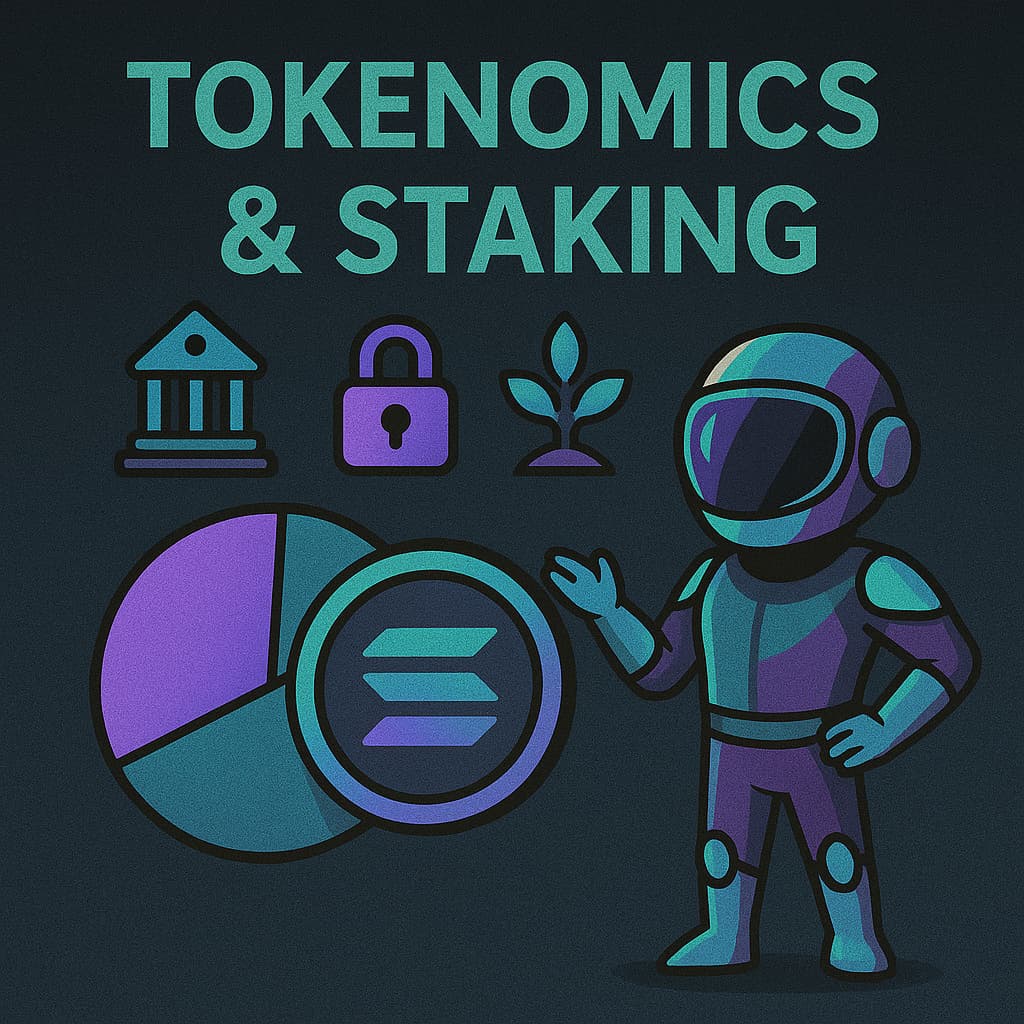
Understanding Solana’s tokenomics is crucial for comprehending how value flows within the ecosystem and what long-term holders can anticipate. Unlike fixed-supply assets like Bitcoin, SOL is designed with a dynamic supply model that balances inflationary issuance with deflationary mechanisms.
SOL Supply Model
- Initial Distribution: At launch, SOL was allocated across seed investors, team members, and community sales. Over time, these tokens have vested, with most now circulating.
- Inflationary Issuance: Solana issues new SOL annually for staking rewards, with an initial rate of 8% that decreases by 15% per year until stabilizing at 1.5%. As of October 2025, the annual inflation rate is approximately 4.26%. This steady decline encourages early validator participation while aiming for long-term sustainability.
- Deflationary Burn: A portion of every transaction fee is permanently removed from circulation. This helps counteract the network’s inflationary token issuance (used for staking rewards) and can make SOL net deflationary during periods of high network activity.
- No Fixed Maximum Supply: Unlike Bitcoin’s hard cap, Solana’s supply expands gradually, though the declining inflation curve keeps growth modest.
Staking Mechanics
SOL staking is central to both network security and token holder yield.
- Delegated Proof-of-Stake (DPoS): Users don’t need to run their own validator to participate. Instead, they can delegate SOL to professional validators.
- Validator Incentives: Validators earn block rewards and transaction fees, passing a share of rewards back to delegators.
- Rewards Dynamics: Typical staking yields range between 6 and 8% annually, depending on validator performance, network conditions, and inflation rate.
- Slashing: Poor validator performance (downtime or malicious activity) can result in reduced rewards—choosing reliable validators is crucial.
Token Utility
SOL isn’t just a passive investment. It powers nearly every network function:
- Transaction Fees: Paid in SOL, though usually fractions of a cent.
- Smart Contract Execution: Every program call consumes SOL.
- Governance (Emerging): While not fully formalized, governance features are expected to evolve, giving SOL holders a voice in protocol upgrades.
- Staking for Security: Ensures validators are economically aligned with network health.
Why Tokenomics Matters
For investors tracking Solana, supply dynamics and staking economics provide context beyond short-term charts. Inflation controls, fee burns, and staking participation all feed into long-term sustainability. As Solana adoption grows, these mechanics could turn SOL from a high-speed gas token into a yield-bearing, governance-aligned asset with real staying power.
Getting SOL: Buy, Store & Stay Safe
For anyone new to the ecosystem, knowing how to get Solana (SOL) safely is just as important as understanding what it is. SOL functions as both the gas that powers the network and the stake that secures it, making safe acquisition and storage essential.
Buy Flow: Step-by-Step
- Choose a Platform – Select a reputable crypto exchange:
- Centralized (CEX): Coinbase, Binance, Kraken (fiat on-ramps, higher convenience). Read more on how to use a CEX.
- Decentralized (DEX): Jupiter, Raydium (wallet-to-wallet swaps, more control). Read more on how to use a DEX.
- Account Setup (CEX only) – Complete KYC verification if required by your exchange.
- Fund Your Account – Deposit via fiat (bank card, transfer) or crypto (e.g., USDC).
- Trade for SOL – Execute a buy order or swap into SOL.
- Withdraw to Your Crypto Wallet – For maximum security, move funds off the exchange into a non-custodial wallet.
Where to Store SOL
- Non-Custodial Wallets: Phantom, Solflare, Backpack—user-friendly, DeFi-ready. Get full information about non-custodial wallets here.
- Hardware Wallets: Ledger—best for long-term or large holdings.
- Custodial Options: Exchange wallets—convenient but less secure.
Safety Best Practices
- Secure Seed Phrase: Keep your recovery phrase offline; never share it.
- Use Hardware for Sizeable Holdings: Treat large amounts like savings, not checking. Store on hardware wallets like Ledger or Trezor.
- Enable Two-Factor Authentication (2FA): When using centralized exchanges (CEXs) for custody or trading, always enable 2FA with an authenticator app, not SMS.
- Confirm Details Before Sending: Double-check addresses, amounts, and fees before sending. Solana transactions finalize instantly and cannot be reversed.
- Manage Custody Risks: If you keep SOL on exchanges, remember you don’t control the private keys. Withdraw to a personal wallet whenever possible for true ownership.
- Maintain Wallet Safety: Download wallets only from official sources like Phantom or Solflare. Fake apps and phishing sites are common.
- Beware of Scams: Avoid unsolicited airdrops, counterfeit tokens, or links sent via social media. Stick to verified channels and communities.
Compliance Note: This content is for educational purposes only and does not constitute investment advice.
Builders, Users & the Solana Stack
What sets Solana apart isn’t just its technology but the people and projects building on top of it. The network has cultivated a vibrant ecosystem that spans DeFi, NFTs, infrastructure, and consumer apps, each leveraging Solana’s speed and low costs to push boundaries.
Developer Experience
- Languages & Tooling: Developers build primarily in Rust, with frameworks like Anchor simplifying smart contract creation. The Sealevel runtime allows parallel transaction execution, but it requires a different mindset than Ethereum’s serial execution model.
- Strong On-Ramps: Tools like Solana Playground (browser-based IDE) and documentation from the Solana Foundation lower the barrier to entry for new coders.
- Mobile Push: Solana is unique in targeting mainstream adoption through hardware like the Saga phone, preloaded with Solana-native dApps and a secure wallet.
User Communities
- Retail Users: Drawn to Solana’s low fees and vibrant NFT markets. Projects like Mad Lads and platforms like Tensor have built strong communities.
- Institutions & Enterprises: Exploring Solana for payments, settlement, and micropayments, especially via Solana Pay.
- DePIN Movement: Decentralized physical infrastructure projects like Helium (5G/IoT) and Hivemapper (maps) use compressed NFTs and Solana payments to scale real-world data and reward systems efficiently
Key Ecosystem Categories & Flagship Projects
- DeFi:
- Jupiter – liquidity routing and aggregation across Solana DEXs
- Orca – automated market maker (AMM) for swaps and yield
- Marinade / Jito – liquid staking (LST) and liquid restaking (LRT) solutions
- Mango Markets – perpetual futures, lending, and margin trading
- NFTs & Culture:
- Tensor – leading NFT marketplace and aggregator
- Mad Lads – blue-chip collection introducing a social identity layer
- Infrastructure & Compute:
- Helium – decentralized wireless IoT and 5G networks
- Hivemapper – decentralized mapping network using compressed NFTs for data rewards
- Render Network – GPU compute marketplace
- Payments & Consumer Apps:
- Solana Pay – merchant and peer-to-peer payment rails
- Dialect – on-chain messaging and payments
The Solana Stack: From Base Layer to Apps
- Base Layer: Solana blockchain (monolithic, Proof-of-History + Proof-of-Stake).
- Middleware: Protocols like Jupiter, Orca, and Marinade provide liquidity, staking, and routing.
- Applications: Consumer-facing DeFi dashboards, NFT markets, and wallets.
- Hardware & Integration: Saga phone, validator hardware ecosystem, and potential integration with IoT.
In short, Solana’s ecosystem is broad, experimental, and increasingly practical. From DeFi power users to consumers buying coffee with Solana Pay, the stack is evolving beyond infrastructure into a scalable application layer for the internet itself.
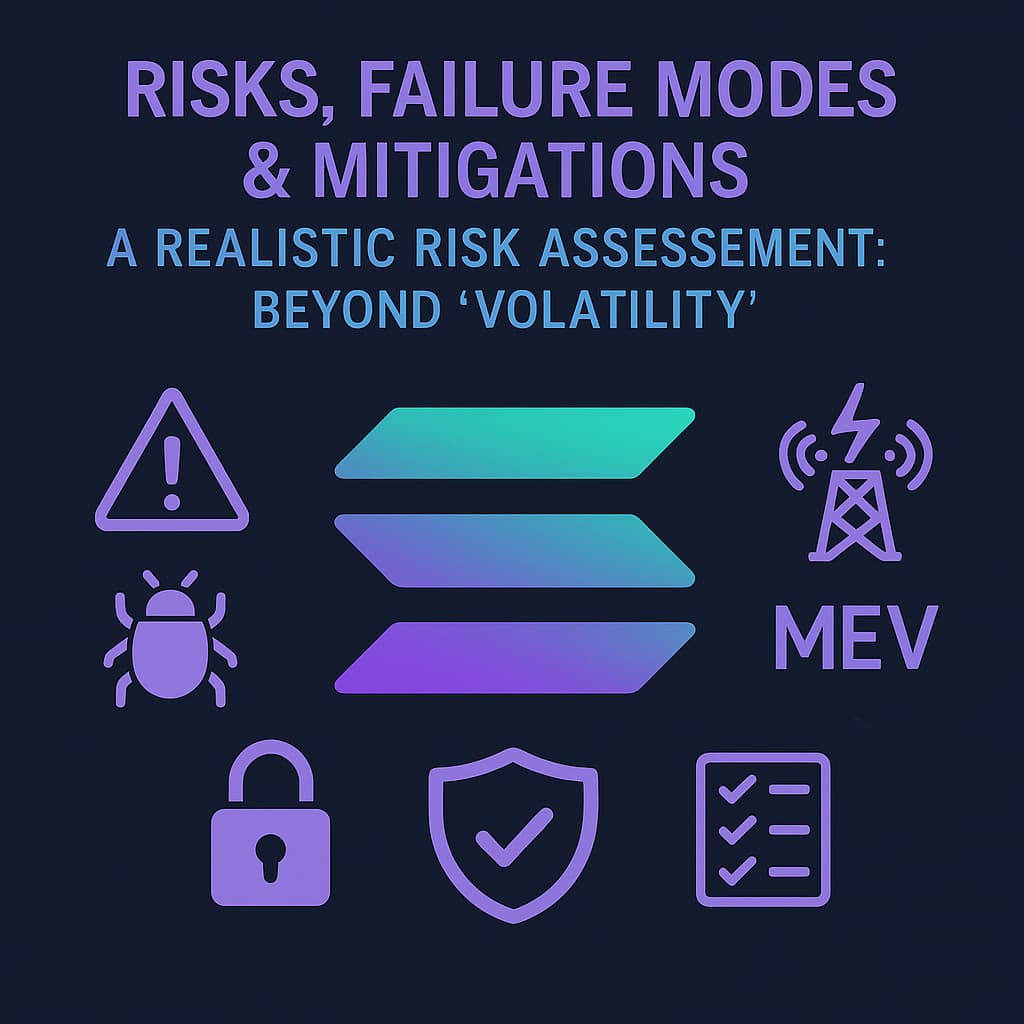
Risks, Failure Modes & Mitigations or A Realistic Risk Assessment: Beyond “Volatility”
Every blockchain makes trade-offs, but Solana’s pursuit of maximum throughput creates unique fragilities. Evaluating these openly is essential to understanding both the opportunity and the risk profile behind the Solana price.
Technical Risks
- Network Stability: Solana has experienced multiple full or partial outages—often triggered by resource exhaustion or spam-like traffic (e.g., during hyped NFT mints). These incidents undermine reliability, particularly for institutional use.
- Validator Centralization: Running a Solana validator requires high-performance hardware (multi-core CPUs, NVMe storage, and high bandwidth). This creates higher barriers to entry than lighter blockchains, concentrating validation power among well-capitalized operators. The risk: fewer independent validators means weaker decentralization compared to Ethereum.
- State Bloat: With millions of transactions processed daily, Solana’s ledger grows rapidly, raising concerns about long-term storage, data pruning, and validator synchronization.
Economic & Competitive Risks
- Inflation Schedule: SOL has no fixed maximum supply. While inflation is declining from ~8% toward a long-term target of ~1.5%, issuance can still pressure the Solana price unless offset by network demand and fee-burning.
- Concentration of Value: Much of Solana’s activity is concentrated in a handful of DeFi and NFT apps. A downturn in these sectors—or regulatory restrictions on them—could erode demand for SOL.
Competition:
- Ethereum & L2s: Ethereum’s robust security, institutional trust, and rapidly scaling Layer-2 ecosystem present a direct challenge.
- Other L1s: Avalanche, BNB Chain, and Aptos compete for developer mindshare, liquidity, and user adoption. Solana must continue innovating to differentiate itself.
Regulatory & Policy Risks
- SEC’s Security vs. Commodity Debate:
The SEC has not clarified whether SOL should be treated as a security. Unlike Bitcoin and Ethereum, which have commodity-like treatment in U.S. policy circles, SOL’s origin and the role of Solana Labs and the Foundation make it vulnerable to security classification arguments. A prolonged security label would complicate exchange listings, custody services, and, critically, the possibility of a Solana ETF, limiting institutional participation. - Compliance Burdens (KYC/AML & the Travel Rule):
On-ramps to SOL often flow through centralized exchanges that must enforce Know-Your-Customer (KYC) and Anti-Money Laundering (AML) checks. The FATF Travel Rule—requiring exchanges to share sender and receiver information for transfers above regulatory thresholds—adds additional friction for cross-border use of Solana. These compliance obligations can restrict liquidity, slow onboarding, and create uneven accessibility across regions.
Policy shifts amplify these vulnerabilities across listings, staking yields, and product availability. ETF greenlights could enable NYSE/Nasdaq listings and staking-enabled funds, potentially elevating yields through institutional staking, while introducing retail products like yield-bearing SOL in 401(k)s. Yet, delays might suppress validator incentives, cap yields, and confine products to offshore venues, mirroring Ethereum’s pre-ETF constraints.
Mitigations in Motion
Solana’s community and developers are actively addressing these risks:
- For Network Stability: Deployment of QUIC protocol, localized fee markets, and transaction priority fees; hardened validator clients.
- For Validator Centralization: Firedancer, a second independent validator client built by Jump Crypto, is designed to increase efficiency, reduce hardware demands, and diversify implementation risk.
- For State Bloat: State compression (especially for NFTs) reduces data footprints, while pruning and snapshot tools help keep validators synchronized.
- For Inflationary Pressure: The fee-burn mechanism offsets issuance as usage scales, while staking locks up a large portion of supply, reducing circulating liquidity.
- For Competitive Edge: Solana is leaning into DePIN (Helium, Hivemapper), consumer-facing products (Solana Pay, Saga phone), and compressed NFTs—areas less developed on rival chains.
- For Regulatory Risk: The Solana Foundation is publishing decentralization metrics (e.g., Nakamoto coefficient) and engaging regulators to argue for SOL’s role as a utility token powering a decentralized network.
- Pre-ETF Workaround: Growing global demand (especially in Europe and Asia, where crypto ETPs are expanding) could provide non-U.S. onramps for institutional SOL exposure.
Understanding Crypto Exchange Fees
Solana positions itself as the throughput-first, monolithic chain, best suited for high-volume, consumer-scale applications like payments, DeFi aggregation, and real-time gaming. Competing chains such as Ethereum, BNB Chain, and Avalanche are designed for different priorities. The diversity highlighted reiterates that no single blockchain dominates across all dimensions.
Solana vs. Ethereum
Ethereum Strengths
- Largest developer ecosystem with the deepest liquidity and most proven DeFi/NFT infrastructure.
- Clearer institutional positioning with broader regulatory acceptance and emerging ETF pathways.
- Resilient Layer-2 scaling ecosystem (Optimism, Arbitrum, zk-rollups) that distributes risk and increases throughput.
Trade-offs vs. Solana
- Higher base-layer costs and slower settlement make consumer-grade applications (payments, games) harder to scale.
- The complexity of managing Layer-2s can fragment user and developer experience compared to Solana’s single layer.
Solana vs. BNB Chain
BNB Chain Strengths
- Exchange-native integration through Binance, offering deep liquidity and fiat on-ramps in emerging markets.
- Extremely wide user funnel—BNB Chain consistently ranks high in active addresses due to Binance’s reach.
- Strong foothold in retail adoption and meme-token culture.
Trade-offs vs. Solana
- Centralization concerns: validator set and governance are heavily tied to Binance.
- Less innovation in core technology compared to Solana’s runtime and execution model.
- Western developer mindshare is thinner, limiting cutting-edge ecosystem growth.
Solana vs. Avalanche
Avalanche Strengths
- Flexible subnet architecture allows projects to spin up their own customizable blockchains.
- Strong traction in enterprise pilots and projects requiring compliance-friendly, isolated environments.
- Competitive time-to-finality and tooling for sovereign applications.
Trade-offs vs. Solana
- Subnet adoption adds complexity for developers, as liquidity and users fragment across multiple chains.
- Lower base-layer throughput compared to Solana’s parallel runtime.
- The ecosystem is smaller and has fewer consumer-facing apps gaining mass traction.
FAQs
As of 16 October 2025, 1 SOL = 184.19 USD; price snapshot from CoinMarketCap.
Solana can be considered safe if users take proper precautions, but risks exist. Custody on exchanges exposes you to counterparty risks, while DeFi apps can have vulnerabilities. The network itself has faced outages, though stability has improved.
SOL is Solana’s native token with four primary functions: paying for transaction fees, staking to secure the network, providing collateral and liquidity in DeFi, and powering ecosystem apps like NFTs and payments. Beyond speculation, SOL is essential for the chain’s operation. Owning and using SOL allows participation in governance, rewards systems, and emerging use cases across the Solana ecosystem.
Solana is engineered for speed, often settling transactions within 400–800 milliseconds under normal conditions. Blocks are produced roughly every 400ms, making it among the fastest major blockchains. However, real-world performance depends on validator responsiveness and network load. During congestion or upgrades, finality can take longer. Despite this, Solana consistently outpaces most competitors in real transaction throughput and user-facing latency.
Yes. SOL supports delegated staking, where holders assign tokens to validators who help secure the network.
References
- Solana Documentation (Solana Foundation)
Solana Whitepaper (Solana Labs)
SOL Market Data and Historical Charts (CoinMarketCap)
Solana TVL Dashboard (DefiLlama)
FATF Travel Rule Supervision (The Financial Action Task Force)
Phantom Wallet (Official Page)
Solflare Wallet (Official Page)