

Ambitious Plan to Unite Chains: Is LiquidChain the Best Crypto to Buy?

The blockchain industry has built itself a bit of a problem. Layer 1s like Bitcoin and Ethereum have laid the foundation – security, decentralization, settlement – but they were never designed to talk to each other.
Layer 2s came next, addressing speed and cost complaints and compressing transactions while reducing fees for users operating within a single ecosystem. But, again, it didn’t solve the gaps between them: billions in capital sitting in isolated chains, unable to move without bridges, wrapped tokens, and multi-step workarounds that introduce delay, cost, and risk at every turn.
So while the global crypto market cap sits at nearly $2.6T, a significant portion of that capital remains fragmented across ecosystems that cannot natively communicate. That is the problem that Layer 3 protocols are now being designed to fix.
The question increasingly being asked is what comes after L2, and whether the next phase of infrastructure spending is on cross-chain execution layers.
That is the context in which LiquidChain (LIQUID) has gained traction, as a cross-chain Layer 3 liquidity protocol with over $708,000 raised, a price of $0.01454, and a staking APY of 1,535%.
For a presale-stage project, those numbers are drawing serious interest from investors who believe the L3 narrative is where 2026’s infrastructure money is heading.
How LiquidChain Works as a Cross-Chain Execution Layer
LIQUID operates as a Layer 3 that interoperates natively with Bitcoin, Ethereum, and Solana – not through bridges or synthetic wrappers, but through a Proof-of-State Validation Layer that verifies and settles cross-chain transactions.
To make that simpler, the protocol is capable of executing transactions that reference multiple underlying blockchains simultaneously. The practical effect, once live, is a single execution environment where liquidity from three separate ecosystems pools together.
That means a user on Bitcoin can interact with a DeFi protocol built on Ethereum without manually bridging assets, and on the developer side, a project can deploy once and reach users across all three networks.
The whitepaper frames this as a “deploy-once architecture” and leads to a significant reduction in the engineering overhead that currently forces teams to maintain separate codebases and liquidity integrations for each chain they want to support.
Transaction fees on the L3 are designed to be minimal and dynamically adjusted by network load, with liquidity providers earning proportional rewards from the unified pools.
Security is handled through on-chain cross-chain proofs, removing reliance on centralized custodians or synthetic tokens, a class of assets that have historically been most exposed to bridge exploits.
Audits have already been completed by both SpyWolf and CertiK, and the LIQUID token serves three roles within the ecosystem: liquidity staking, transaction fuel, and developer grants.
Why LIQUID Could Have a Bullish Second Half of 2026
The roadmap is built in four phases. The project is currently in Phase 1 (presale), with testnet L3 infrastructure and a cross-chain VM deployment underway alongside a Developer SDK and API beta.
Phase 2 brings the LiquidChain token launch and unified liquidity pools, with multi-chain swaps and early dApp partnerships.
The mainnet launch follows in Phase 3, including cross-chain derivatives and lending modules.
Phase 4 targets governance and global scaling, integrating Layer 2 rollups and exploring partnerships with major DeFi protocols and exchanges.
That’s followed by centralized exchange listings, expected before the end of the year.
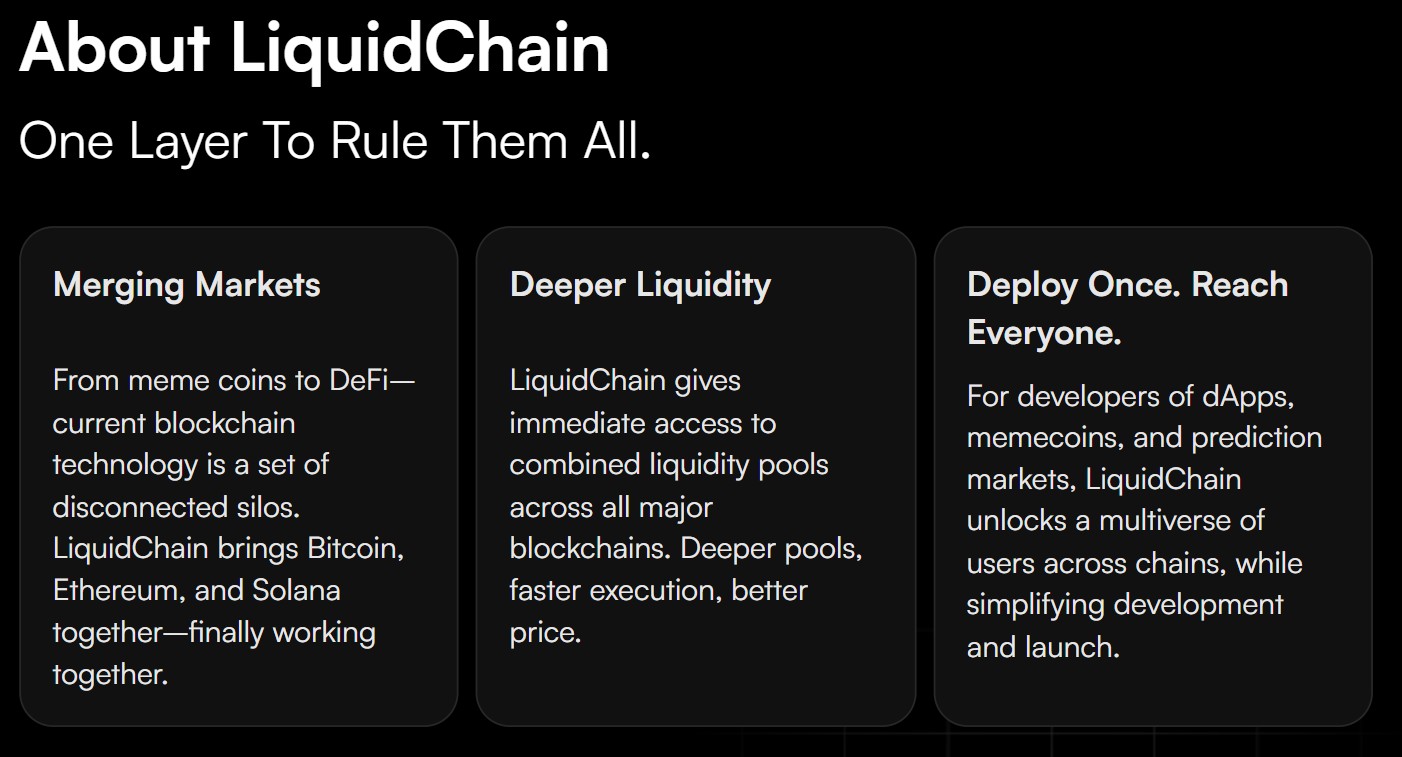
The presale price of $0.01453 puts LIQUID in early-entry territory, and the $708,000 already raised indicates meaningful conviction at this stage for investors hunting the best crypto to buy in the L3 narrative.
The 1,535% staking APY is aggressive, designed to reward early participants who lock tokens while the mainnet infrastructure is built out.
The broader L3 narrative has legs regardless of short-term market noise. As long as Bitcoin, Ethereum, and Solana remain dominant but separate, the friction between them is a commercial opportunity.
That’s what LiquidChain is aiming for: not as a competitor to existing chains, but as the layer that makes them interoperable at scale.
Early Entry, Clear Architecture: Timing Is the Question
LiquidChain’s ambition is not modest, and fusing the three largest blockchain ecosystems into a single liquidity layer is a technically demanding goal.
What separates it from the wider noise at this stage is the specificity of the architecture – atomic cross-chain settlement, a unified VM, and a phased roadmap with concrete milestones – backed by dual audits.
Whether the $708,000 raised becomes a footnote or a founding data point depends on execution. But as L3 infrastructure becomes one of the defining stories of 2026, projects like LiquidChain are getting looked at earlier and harder than they would have been a cycle ago.
About Author

About Author