


Next Crypto to Explode: Why Analysts Are Going HYPER for New Payments Layer
Bitcoin was invented as electronic cash, yet its greatest success has come from being held rather than spent. The network now secures more than $1.2 trillion in value, but its base layer still processes only around seven transactions per second. It is a restraint that protects Bitcoin’s simplicity and security – but leaves payments, trading, and decentralized applications to faster networks.
The total cryptocurrency market is valued at approximately $2.18 trillion, while Bitcoin still commands 58.63% of it. So while Capital remains concentrated in BTC, much of crypto’s practical activity takes place elsewhere.
Can Bitcoin get some utility added to the mix? It’s a $33 million question being answered by Bitcoin Hyper (HYPER), which is bringing a Layer 2 with the speed of Solana to the original cryptocurrency.
Its presale has raised $32.9 million, with HYPER currently available for $0.01368. Buyers can also stake HYPER for an APY of 36%.
How Bitcoin Hyper Turns BTC Into Working Capital
Bitcoin Hyper is not seeking to rewrite Bitcoin’s base chain, but building a Layer 2 designed to handle the work that Bitcoin itself was never built to perform at scale.
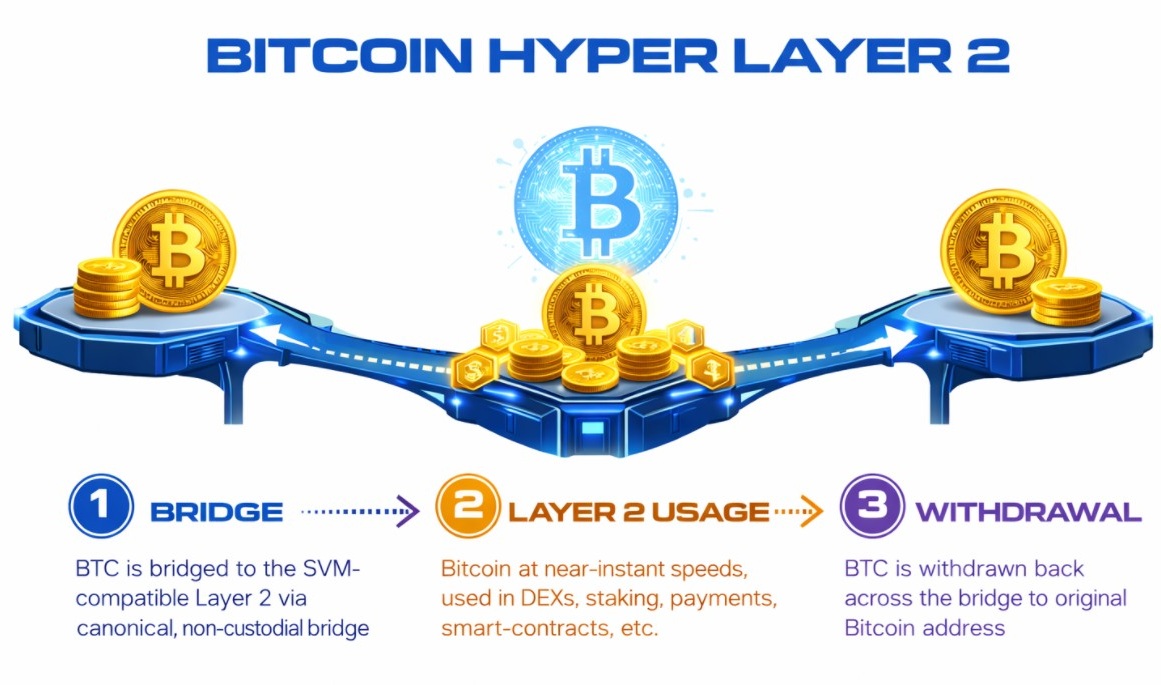
The unusual component is the Solana Virtual Machine, or SVM, which Bitcoin Hyper uses as its execution engine – bringing an established environment – allowing thousands of transaction pr second – into a network ultimately centered on BTC.
That BTC can move through the faster network without requiring every payment or application interaction to compete for space on Bitcoin’s chain itself. Transactions are then bundled, compressed, and periodically committed back to the base chain, with used to demonstrate that the Layer 2 state is valid.
That choice gives developers access to a framework suited to payments, decentralized exchanges, lending apps, and other services that need more speed than Bitcoin’s base layer’s seven transactions per second can comfortably supply. It also makes the project easier to understand. Bitcoin provides the scarce asset and settlement foundation; the Layer 2 provides the speed and low fees so that people can actually use it.
HYPER is used for network fees and staking, along with a few other utilities such as governance, making it a focal point of the ecosystem, rather than a bolt-on.
Could HYPER Be the Next Crypto to Explode in 2026?
Let’s begin the bullish argument with Bitcoin’s size: Ethereum and Solana have produced extensive Layer 2, decentralized finance and application ecosystems, but builders targeting Bitcoin can address a far larger pool of dormant capital, crying out to be used.
Bitcoin does not need another reason to be held – but it could do with more uses. A payments layer changes the economic character of BTC without compromising the deliberate conservatism of the original network. Rather than forcing Bitcoin to become faster at the base level, execution happens on the L2, before the results are returned for settlement. This division of labor has already become central to blockchain scaling in other parts of crypto.
Bitcoin Hyper enters that market with $32.9 million raised before an exchange listing, showing the scale of early demand. Investors are backing the idea that the largest cryptocurrency can support a larger, more productive economy.
Bitcoin dominance remains close to 59%, showing that value has not abandoned the original network, yet Ethereum and Solana continue to define what users expect from programmable blockchains: quick settlement, low-cost transactions and applications that feel responsive.
Bitcoin Hyper’s opportunity lies between those two realities – preserving Bitcoin as the monetary foundation while borrowing the execution speed needed to make BTC useful in ordinary digital activity.
Bitcoin’s Second Act Could Be About Movement
Bitcoin’s first achievement was proving that digital scarcity could exist without a central issuer. The next challenge is less philosophical and more practical: turning that scarcity into usable economic infrastructure.
Bitcoin Hyper is built around the idea that security and speed do not have to exist on the same layer. Bitcoin can remain slow, careful and difficult to change and payments and applications can move at a pace suited to the people using them.
HYPER still has to convert presale interest into functioning network activity, but the ambition is clear: Bitcoin can become a currency once again.
About Author

About Author