


Best Altcoins to Buy: Bitcoin Hyper vs $2 XRP and $0.3 Cardano
We believe in full transparency with our readers. Some of our content includes affiliate links, and we may earn a commission through these partnerships. However, this potential compensation never influences our analysis, opinions, or reviews. Our editorial content is created independently of our marketing partnerships, and our ratings are based solely on our established evaluation criteria.

The crypto market in early 2026 can broadly be divided into three markets: legacy giants consolidating at massive valuations, meme coins, and new infrastructure plays.
While majors like XRP and Cardano are old favorites in many portfolios, their price action has become a test of patience. XRP is currently trading around $1.93, down since last July, while Cardano (ADA) is at approximately $0.37, showing little momentum amid broader market activity.
For traders seeking aggressive returns, the math on these large-cap assets is becoming difficult to justify. A 2x return for XRP would require an additional $100 billion in market cap: a heavy lift even in a bullish environment. So the best opportunities are often elsewhere, such as presales. One new area for 2026 is the Bitcoin Layer 2 sector, where technical innovation is opening new possibilities for Bitcoin to give it the scale of Ethereum and Solana.
One example is Bitcoin Hyper (HYPER), an incoming Layer 2 that has already raised an extraordinary $30.8 million in its presale. With a token price of $0.013605 and a 38% APY staking reward, the project is attracting investors looking for the next breakout asset before it hits public exchanges.
Bitcoin Hyper (HYPER): The Bitcoin L2 With SVM Speed
Bitcoin Hyper addresses Bitcoin’s primary bottleneck: scalability. While Bitcoin remains the crypto’s favorite store of value, its utility for decentralized applications (dApps) and high-frequency trading has been limited by slow block times and high fees.
Bitcoin Hyper is aiming to solve this by integrating the Solana Virtual Machine (SVM) as a Layer 2 on top of Bitcoin. This lets the network process transactions with the speed and low costs of Solana while anchoring final settlement to the security of the Bitcoin blockchain.
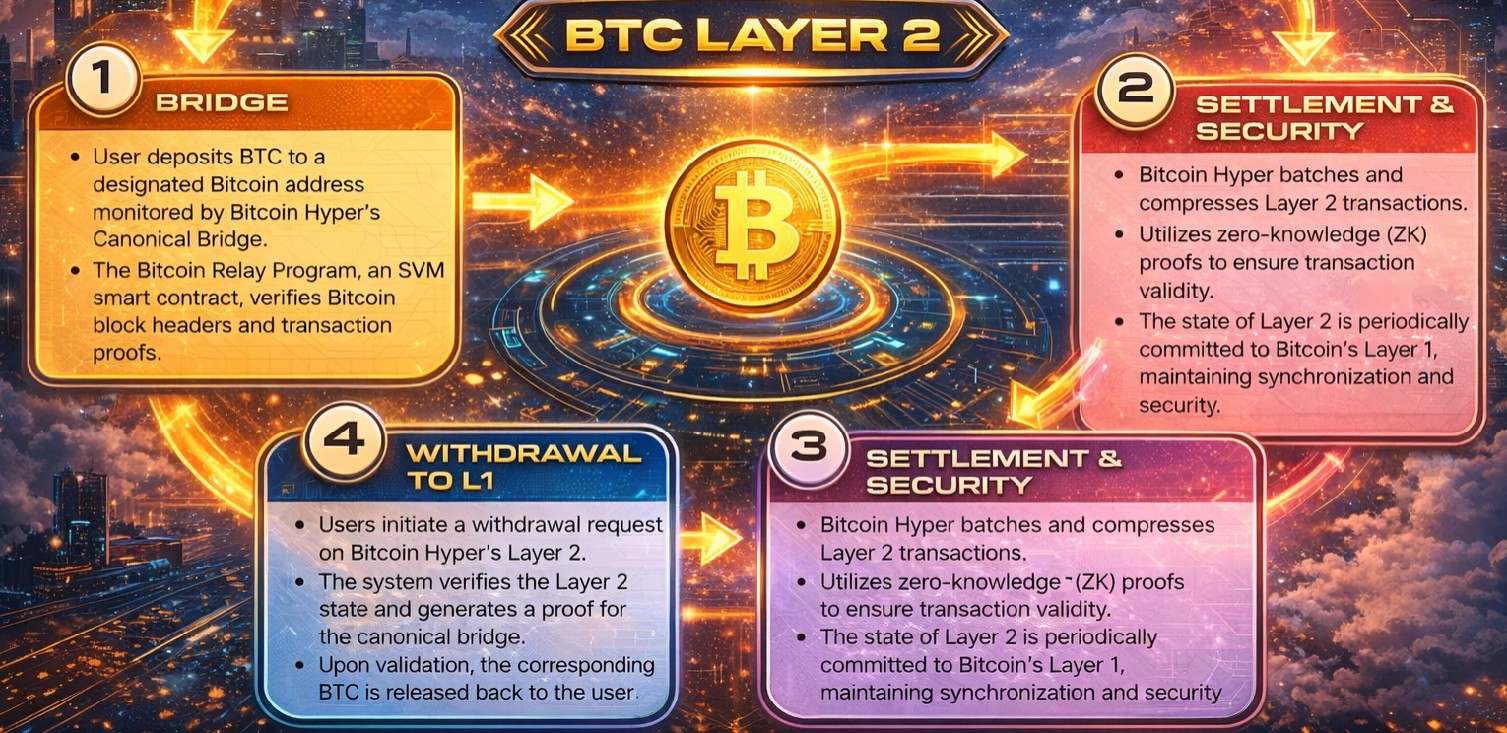
It sounds simple in practice, but if successful can absolutely return the payment narrative back to Bitcoin, with a feature set built for performance.
HYPER includes a canonical bridge for asset transfers and a high-throughput execution environment that supports complex near-instant payments, DeFi applications, and meme coin trading.
By using the SVM, Bitcoin Hyper can also enable developers to port existing Solana-based applications to the Bitcoin ecosystem with minimal friction. This technical approach seems to have landed well with traders, driving the presale to $30.8 million as traders bet on the convergence of Bitcoin’s liquidity and Solana’s speed.
Tokenomics are structured to incentivize long-term participation. The native token, HYPER, serves as the network’s gas token and governance instrument. During the presale phase, the project offers a staking protocol with a 38% APY, allowing early buyers to compound their holdings before the token generation event.
Security is also a priority, with the smart contracts having undergone full audits to ensure protocol integrity.
Why the Risk-Reward Profile Favors HYPER
Comparing Bitcoin Hyper to established assets like XRP and Cardano highlights the difference between mature market caps and early-stage growth potential. XRP, with a market cap exceeding $110 billion, has become a low-volatility asset. Its price hovers near $1.93, reacting sluggishly to news that would have sent it parabolic in previous cycles. The “banker’s coin” has utility, but its sheer size acts as an anchor on rapid price appreciation.
Cardano faces a similar challenge. Trading at $0.37, ADA has struggled to reclaim its former highs, with network activity lagging behind newer, faster chains. The narrative has shifted away from general-purpose L1s toward specialized L2s that leverage Bitcoin’s dominance. Investors holding ADA are effectively betting on a reversal of multi-year trends, whereas Bitcoin Hyper aligns with the current market demand for Bitcoin-native DeFi.
As analyst Borch Crypto explained to nearly 100,000 YouTube followers, HYPER will be “huge” if it starts bringing near-instant payment options, among other features, back to Bitcoin.
The bullish case for HYPER rests on its entry valuation and sector momentum. At a price of $0.013605, the project is valued at a fraction of its legacy competitors. If Bitcoin Hyper achieves even a modest portion of the transaction volume seen on other major L2s, the price discovery upon listing could be substantial. The Bitcoin L2 ecosystem is currently one of the most active – and yet underdeveloped – sectors in crypto, and projects that successfully deliver scalable infrastructure are seeing rapid adoption.
Conclusion
While XRP and Cardano offer stability, their potential for exponential gains is limited by their massive existing market caps.
Bitcoin Hyper provides a focused alternative: a technically sound project solving a critical infrastructure problem, backed by a $30.8 million raise, a 38% staking yield, and, for the moment, still in presale.
For those looking to maximize upside in 2026, it is worth looking beyond the top 10 and checking out protocols building the future of Bitcoin.
About Author

About Author