


Best Crypto Presales: Bitcoin Hyper Hits $32.8M As Dream Of Instant BTC Payments Moves Closer

Bitcoin is still the center of gravity in crypto, but it no longer feels like the place where the fastest ideas live. It may be the largest asset in the market, with a $1.2 trillion market cap, and Bitcoin dominance at around 58.3% – but the wider market keeps looking elsewhere for speed, payments, apps, and yield.
That is the strange quandary now facing the original cryptocurrency – it has the brand, liquidity, security, and cultural weight, but Ethereum and Solana have taken much of the developer imagination.
Bitcoin Hyper is getting attention because it speaks directly to that gap. The original Bitcoin dream was not just digital gold sitting cold in a wallet; it was about peer-to-peer electronic cash that was fast, global, and usable without asking permission.
Bitcoin’s base chain just was not built for the transaction load that modern crypto users expect – seven transactions per second doesn’t do it. Bitcoin Hyper (HYPER) wants to change the story without asking Bitcoin to become something else.
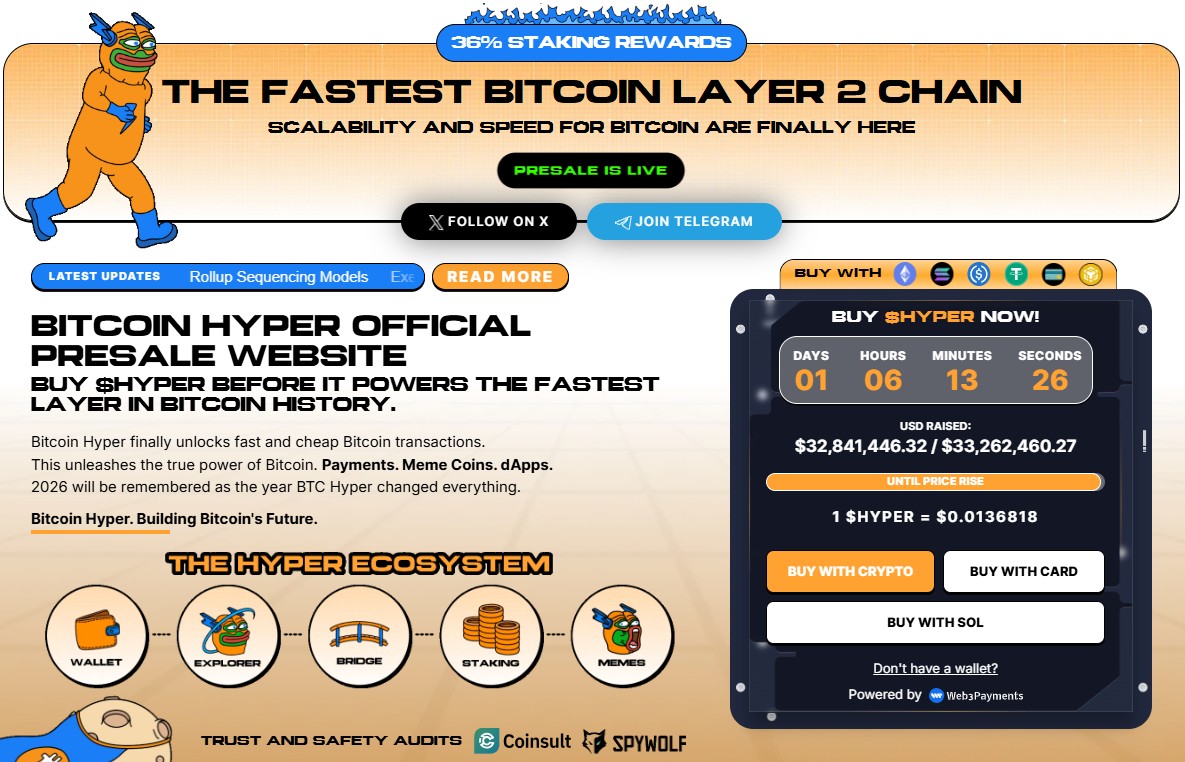
That is why the project became one of the more closely watched Layer 2 presales of the year. It has now raised $32.8 million, with HYPER priced at $0.01368 and staking currently offering 36% APY. The biggest asset in crypto still has unfinished work to do, and that’s what HYPER is here to do.
How Bitcoin Hyper Works
Bitcoin Hyper is designed as a Layer 2 network for Bitcoin, built to move activity away from the slow base chain while still anchoring back to Bitcoin Layer 1. The whitepaper and project materials describe a system built around a canonical bridge, a high-throughput execution layer, and settlement back to Bitcoin.
The bridge is the entry point where a user deposits BTC to a designated Bitcoin address monitored by Bitcoin Hyper’s Canonical Bridge, which verifies Bitcoin block headers and transaction proofs. Once the deposit is verified, an equivalent amount of BTC is minted on Bitcoin Hyper’s Layer 2.
That is where the payments case starts to become clearer. On the Layer 2 network, users can send and receive BTC with near-instant finality, rather than waiting on the base chain. The project also plans to support smart contract-based activity, including staking, decentralized trading, and other on-chain applications. This is where the Solana Virtual Machine makes the difference – bringing 2026 speed to the OG crypto.
Importantly, the settlement layer remains Bitcoin: Layer 2 transactions are batched and compressed, then periodically committed back to Bitcoin Layer 1. In plain English, Bitcoin Hyper aims to give Bitcoin the user experience people associate with newer chains, while keeping Bitcoin as the final anchor.
Withdrawals reverse the process: when a user initiates a withdrawal from Layer 2, the system generates a proof for the canonical bridge, and BTC is released back to the user’s Bitcoin address on Layer 1 once validated.
It is a smooth idea because it does not require Bitcoin to win by outright copying Ethereum or Solana. It asks a different question: what happens if Bitcoin keeps its settlement role, but gains a faster layer above it that ordinary users and builders can actually touch?
Why Bitcoin Hyper Could Lead The Best Crypto Presales In 2026
Let’s start with market size: Ethereum and Solana already have crowded Layer 2, DeFi, and app ecosystems. Bitcoin has far more value, far more recognition, and far less competition at the execution layer.
A working Bitcoin Layer 2 aimed at fast payments and applications does not have to win every corner of crypto. It only has to make Bitcoin feel usable again. If it can make BTC cheaper and faster to move, while also opening space for staking, wallets, dApps, meme coins, and decentralized exchanges, then Bitcoin Hyper would be tapping into demand that already exists but has been forced onto other chains.
Bitcoin has spent years being described as a store of value, and that story has been successful – but it should not be the whole story. Satoshi’s original idea was more active, more rebellious, and more practical: money that could move between people without the old machinery in the middle.
So Bitcoin Hyper is selling a return to that version of Bitcoin, but with infrastructure that fits 2026.
The presale has already reached $32.8 million before exchange listings, giving HYPER a stronger base than many early-stage tokens seeking attention after launch. The current 36% staking APY also gives holders a reason to stay engaged while the network moves toward broader use.
The bigger question is whether Bitcoin payments can become exciting again. For years, the answer looked like no. Bitcoin became too valuable, too slow, and too important to use casually. The irony is that this made it stronger as a reserve asset but weaker as money. Bitcoin Hyper is trying to reunite those two ideas: Bitcoin as the asset people trust and BTC as something that can move quickly enough for daily crypto life.
If that lands, 2026 could be the year Bitcoin Layer 2 stops being a technical niche and becomes a mainstream sector. HYPER would not need to persuade the market that Bitcoin is important. That argument is over. It only needs to show that Bitcoin can still evolve.
The Oldest Crypto Story Is Not Finished
The most powerful thing about Bitcoin Hyper is that it does not treat Bitcoin as a museum piece. It treats it as unfinished infrastructure.
Bitcoin has survived every cycle because people keep returning to the same idea: a monetary network outside the control of governments, banks, and gatekeepers. But survival is not the same as progress. If Bitcoin is going to remain the moral and financial center of crypto, it needs a path back to use.
Bitcoin Hyper is making that bet at the right moment. The market is tired, but not dead. Bitcoin dominance is still high. Capital is still watching for the next credible infrastructure story. HYPER’s $32.8 million presale raise shows that traders are not just buying another token; they are buying into the possibility that Bitcoin’s next chapter may look more like its first promise than its recent past.
About Author

About Author