


Best Crypto Presales: LiquidChain Pushes $850K as Dream of Unifying Blockchains Moves Closer to Reality

After an uncomfortable weekend, Bitcoin (BTC) is trading at $63,075.46, up 0.96% on the day but down 13.14% over the week. Ethereum (ETH) sits at $1,663.26, up 1.88% in 24 hours but still bruised from a 16.02% seven-day loss.
The Fear & Greed Index reads 16 out of 100 – the market, right now, is scared and cautious.
That said, it is often when the most important ideas get to be heard, such as how to fix the fragmentation that is quite literally dividing crypto. Bitcoin, Ethereum, and Solana – the three largest ecosystems in crypto – have grown into distinct continents of capital, each largely inaccessible to the others without bridges, wrapped assets, and the constant threat of a security exploit.
Layer 3s represent the emerging argument that, as more chains emerge, there has to be a better idea than building more walls.
That’s the ambition behind LiquidChain (LIQUID), a cross-chain Layer 3 currently in presale at $0.0146 per token, with over $830,000 raised and a staking APY of 1,332% for early participants. It’s an early projct, but one solving one of the oldest problems.
How LiquidChain’s Cross-Chain Architecture Works
The instinct, when hearing cross-chain, is to picture a bridge – a mechanism that moves an asset from one chain to another, usually slowly, and always with some degree of trust needed. LiquidChain is not that. The whitepaper describes it as a cross-chain liquidity layer – an L3 that doesn’t move assets between chains so much as it creates a shared execution environment above them.
The Cross-Chain Virtual Machine (VM), built for Solana-class throughput, simultaneously checks the states on Bitcoin, Ethereum, and Solana, verifying the three networks in real time. The result is what the project calls single-step execution: a cross-chain transaction can be completed in a single atomic operation by leveraging liquidity across chains, with no wrapping, no custody risk, and no multi-step user journey.
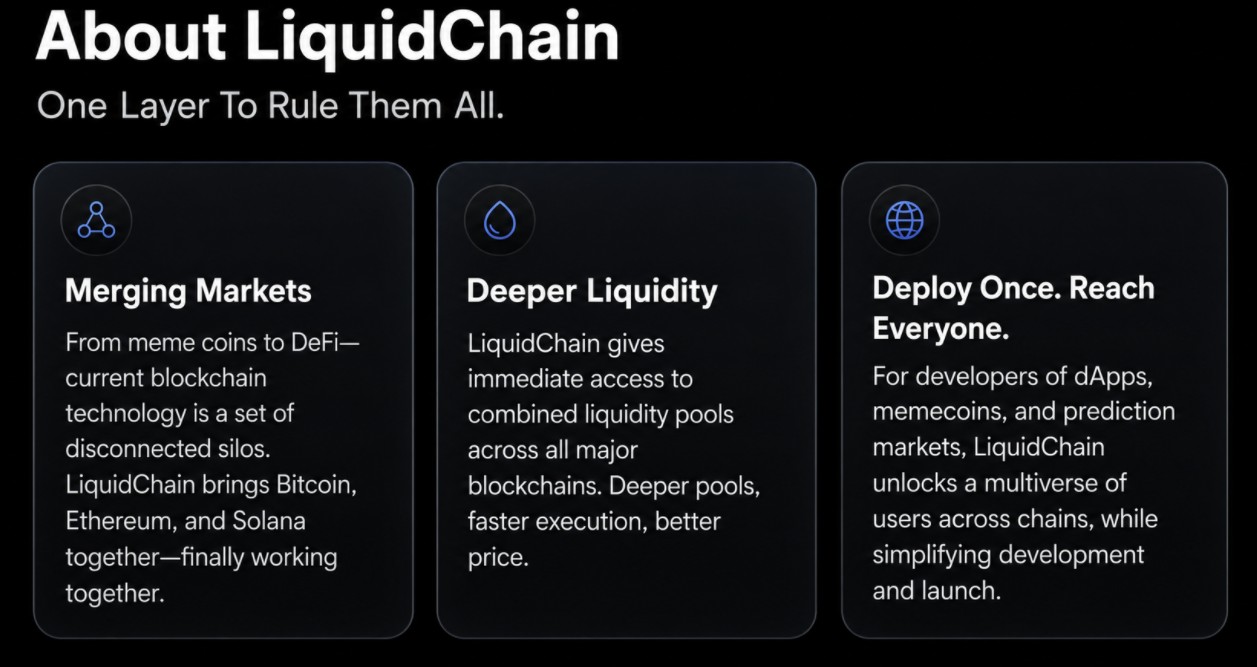
For a developer, the implication is also smoother – deploy an application once on LiquidChain and reach users across all three ecosystems (and maybe more in the future). Building separate codebases for each chain, which has been the default frustration for the last four years, becomes unnecessary.
Liquidity providers can earn proportional rewards from the unified pools, and transaction fees on the L3 are minimal, dynamically adjusted by network load. The smart contract integration layer enables existing dApps to plug in via standard SDKs, without requiring a rebuild.
Why LIQUID Earns Its Place Among the Best Crypto Presales of 2026
There is a certain logic to how crypto infrastructure evolves in cycles. Ethereum won the first era of smart contracts by being first, and then the L2s that came next were cheaper and made Ethereum accessible at scale.
What Layer 3s can do is more ambitious: they can make every chain accessible from every other chain without users ever having to think about which chain they’re on.
So after years of bridge hacks, wrapped asset disasters, and liquidity permanently stranded in protocol-specific pools, the demand for something genuinely atomic – something that settles across chains the way a traditional database settles a transaction – has been building.
LIQUID‘s roadmap reflects that urgency, with the token launch, unified liquidity pool activation, and centralized exchange listings targeted for this year. After that, “Phase 4” extends the architecture to Layer 2 rollups and emerging L1s, which would significantly expand the market for LIQUID.
The staking APY of 1,332% is aggressive and reflects where the project sits: early presale, high-risk, high-reward. That rate won’t last forever, but it is an excellent early holder incentive.
LIQUID won’t need much take-up to start locking more than a $100 million in TVL – and bullish predictions are much higher than that. Right now, the market cap is under a million.
The Market Hunts for Its Next Idea
DeFi’s next chapter probably won’t be won by the chain with the lowest fees. It’s going to be won by whoever makes chain boundaries irrelevant.
LiquidChain is making a direct claim to that area, and with $830,000 already committed, a live staking platform, and a CEX listing window approaching within months, the project is past the idea phase.
The idea is right, and LIQUID is the furthest ahead in delivering it.
About Author

About Author