


Best Crypto Presales: Will LiquidChain Chase Arbitrum to a Billion Dollar Market Cap?

The crypto market is not short of chains, but each new network also creates another border, where liquidity gets split, and developers have to keep repeating work to keep compatibility. Users have to learn to hop across bridges, wallets, chains, fees, wrappers, and waiting times.
That fragmentation hurts the market, whether it is fast or slow. Today, Bitcoin is trading at $64,091.54, down 0.05% over 24 hours and 2.44% over seven days, while Ethereum is at $1,743.81, up 0.79% on the day and 1.48% across the week. Bitcoin dominance is at roughly 58.15%. It is a market still heavily led by BTC, but not one where the rest of crypto can afford to stay divided forever.
Arbitrum’s rise to a $1.7 billion market cap has already shown how much value can be gathered around infrastructure that makes crypto cheaper, faster, and more usable. Layer 2s made Ethereum, in particular, feel faster and less congested.
The next question is whether Layer 3s can do something larger: make the multi-chain market feel like one market. That is where LiquidChain (LIQUID) is starting to draw attention, having already raised $858,000 in early presale, priced at $0.0147 and offering staking at 1,300% APY.
How LiquidChain Unites Major Chains
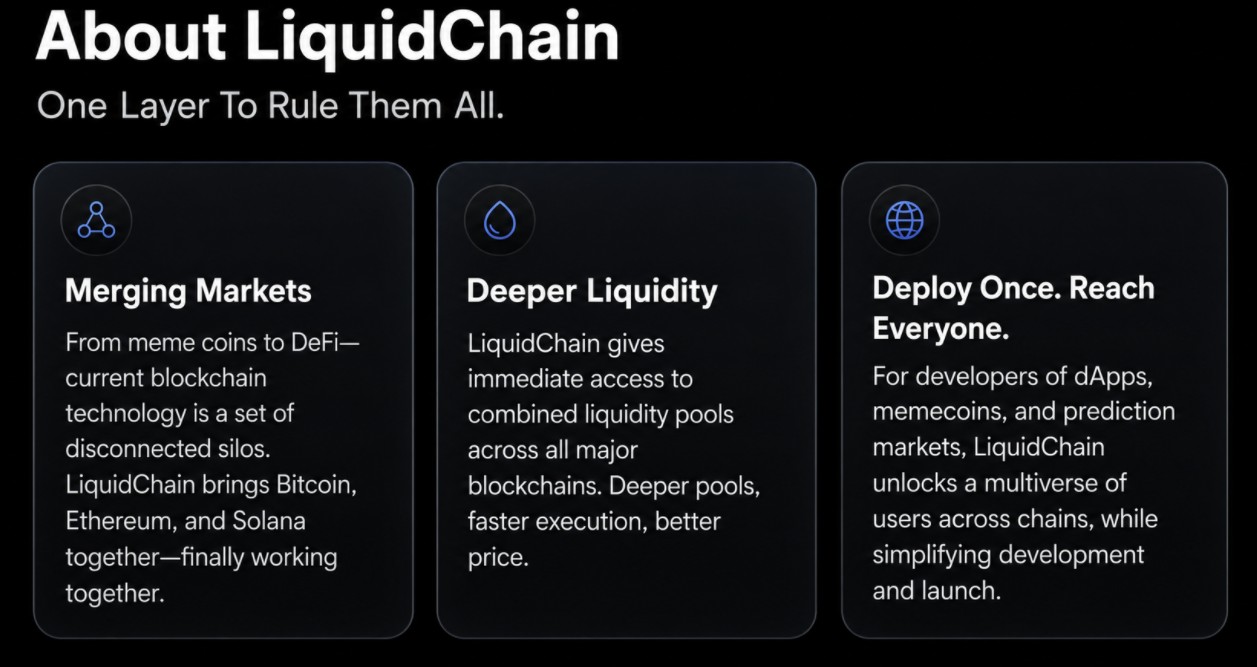
LiquidChain is built around a simple frustration: crypto has more liquidity than ever, but too much of it sits behind walls. Bitcoin, Ethereum, and Solana each have their own mass and users, capital, apps, and culture – but moving value between them can still feel like stepping out of one country and into another.
The whitepaper available on the LiquidChain site describes the project as a Layer 3 cross-chain liquidity layer. In plain English, that means it is not trying to replace Bitcoin, Ethereum, or Solana, but rather sits above them, coordinates between them, and gives users a cleaner way to access capital across ecosystems.
What that means is unified liquidity – instead of assets being trapped in isolated pools across separate chains, LiquidChain aims to represent liquidity from major networks inside one shared environment. This supports cross-chain swaps, shared order books, lending, borrowing, staking, and other DeFi activities without requiring developers to build multiple versions of the same app (one per chain).
That developer point is important – a lot of crypto infrastructure talks only about traders, but product fit often starts with builders. If a developer can deploy once and reach users across Bitcoin, Ethereum, and Solana, the allure becomes obvious.
For users and developers, you don’t need to choose one ecosystem and abandon the rest.
Technically, LiquidChain uses a cross-chain VM, cross-chain proofs and messaging, and a proof-of-state validation layer anchored to underlying networks. The ambition is to let transactions reference multiple blockchains while still settling in a verifiable way.
Infrastructure remains one of the strongest plays in crypto, especially when it becomes invisible. People do not think about TCP/IP when they open a website, or think about payment rails when a card machine works. Crypto still asks users to think about rails every day, and LiquidChain says that the next stage of DeFi will belong to projects that make those rails feel invisible.
Why LIQUID Could Become One of the Best Crypto Presales of 2026
The bullish case for LIQUID starts with the size of the problem: Liquidity fragmentation is not a niche inconvenience and is the major reason DeFi still feels harder than it should. Every time capital splits across chains, markets become thinner, and every time users bridge, they run into friction. Every time developers support another network, engineering time gets pulled away from the product itself.
Layer 2s themselves grew because they attacked a painful bottleneck – Ethereum was powerful, but expensive and congested. Chains like Arbitrum showed that users will move when infrastructure makes the same activity cheaper and faster. LiquidChain is aiming at a broader bottleneck: not just the cost of using one chain, but the cost of using many of them.
That is why the Arbitrum comparison makes sense – it is not a perfect one. Arbitrum is a mature Layer 2 with a large ecosystem, while LiquidChain is still in presale. But markets do not only reward what exists today. They also reward credible attempts to solve the next obvious problem. A Layer 3 that serves as the place where liquidity from major chains converges offers a massive market.
The early presale figure gives the project a starting signal rather than a finish line. With $858,000 raised, LiquidChain has moved beyond a cold launch, but it is still early enough for investors to view it as a speculative infrastructure bet rather than a fully priced network.
The 1,300% staking APY adds another reason for early participation – that rate will drop as more holders arrive, but is a huge early incentive – though the real long-term case will depend on whether the network can attract developers, liquidity, and actual cross-chain usage after launch.
Can the growing number of blockchains work together without making users miserable? A project that can answer that question even partially could find itself in the right conversation very quickly.
The Market Wants Fewer Walls
LiquidChain’s appeal is that crypto needs a layer that makes the chain wars less important.
If Bitcoin remains the reserve asset, Ethereum remains the settlement and DeFi engine, and Solana remains a high-speed execution venue, the winning future may belong to infrastructure that lets capital move between them without ceremony.
That is the promise LiquidChain is putting before the market. For a presale-stage project, that is a large ambition. But large markets tend to form around simple truths.
Crypto has too many walls – LiquidChain is trying to knock them down.
About Author

About Author