Best Crypto to Buy: Why LiquidChain Might Pull Off Its Plan to Unite BTC, SOL, and ETH

Bitcoin (BTC) is currently trading at $77,151, down 4.36% over seven days, while Solana (SOL) sits at $86.91, off 4.41% on the week. Ethereum (ETH) is at $2,185.35. All three chains are down price-wise for the week. But what each of those figures also represents is three separate buckets of liquidity sitting in different silos, each inaccessible to the others without friction, fees, or bridging risk.
While Layer 1s handle settlement and Layer 2s bring speed and lower costs, a user or developer wanting to access all three still has to cobble together bridges, wrapped assets, and multi-step flows that are slow and carry real custody risk. As institutions circle the blockchain, that fragmentation needs to go away.
That’s the problem that LiquidChain (LIQUID) looks to fix. Currently in presale at $0.0146, the project has raised $782,000 to date, with a staking APY of 1,400% available to early holders.
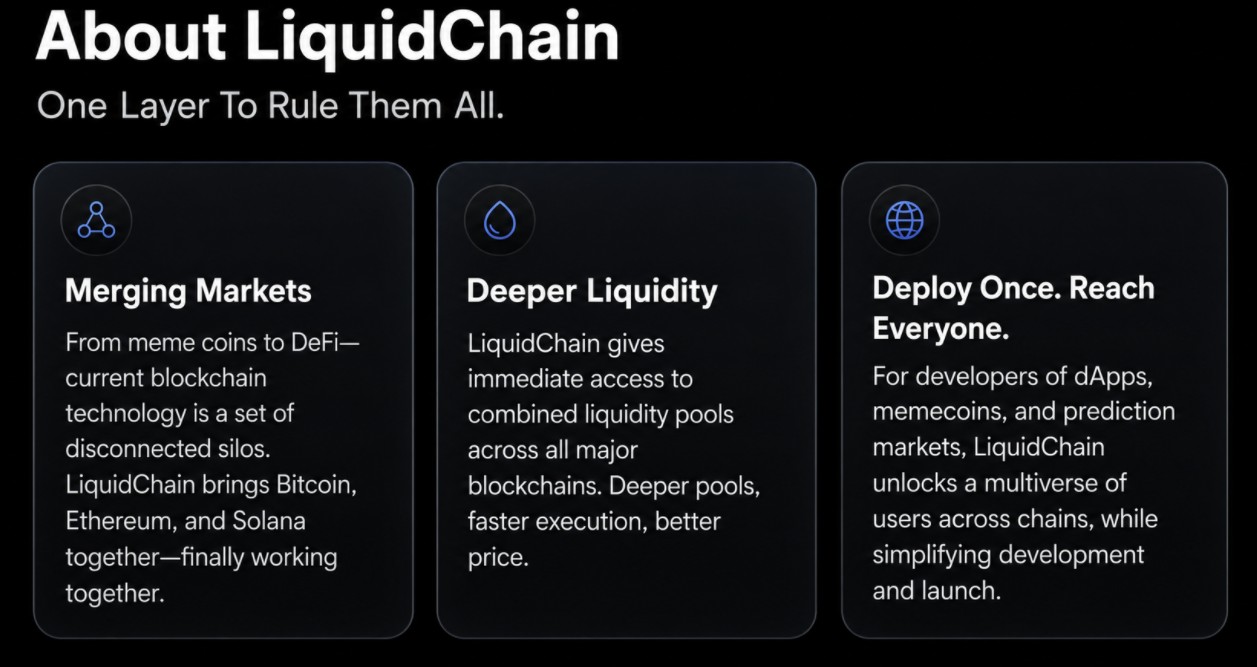
LiquidChain is building a cross-chain Layer 3 that fuses BTC, ETH, and SOL liquidity into a single unified execution environment – not a bridge, not a wrapped-token scheme, but a layer that sits above all three chains and treats them as one.
How LiquidChain’s Cross-Chain Layer 3 Actually Works
The starting point is a problem most crypto users have experienced: moving capital between Bitcoin, Ethereum, and Solana is genuinely annoying.
If you want to wrap BTC to get it onto Ethereum, you are going to pay a fee. Or if you then want to bridge it to Solana, you pay again, wait, and carry custody risk the whole way. Each hop is a new attack surface, and the most damaging exploits in DeFi history, with billions lost, have happened in those rough seas between chains.
LiquidChain‘s answer is to stop treating cross-chain movement as something that needs to be transferred, and start treating it as an execution problem. The Liquid Virtual Machine, built for Solana-class throughput, doesn’t move assets between chains so much as operate across all three simultaneously.
When a transaction references a combination of Bitcoin, Ethereum, or Solana, the Unified Proof Engine verifies all three chains in real time and either commits the full operation or cancels it if needed. Nothing gets stranded halfway, and there’s no intermediate custodian holding your wrapped tokens while confirmation windows close.
When a conventional bridge settles chain by chain, a failure mid-way leaves funds in limbo. LiquidChain’s cross-chain proofs make the entire operation a single unit of work: one transaction across three chains with a single outcome.
For a developer building a DeFi app today, the practical upshot is that deploying once on LiquidChain means your users can interact from whichever chain they’re already on, without needing to bridge before trading. The liquidity from all three ecosystems is pooled and accessible from a single entry point.
Why 2026 and 2027 Could Be the Right Window for LIQUID
Layer 3 as a sector is still early, presenting both risks and opportunities. The project’s $778,000 raise is generating attention at a moment when cross-chain infrastructure is clearly underfunded relative to demand.
The three largest chains by liquidity represent roughly $1.56T in Bitcoin market cap alone, with Ethereum’s $263B and Solana’s $50B adding depth that currently sits locked in separate silos. With LiquidChain opening the doors between them – directly, not in a bridge sense – this sub-million-dollar project is looking to build the platform that nullifies all the fragmentation. The project, according to the whitepaper, targets centralized exchange listings later in 2026, meaning presale participants who enter at $0.0146 are ahead of the catalyst.
The 1,405% staking APY grabs attention fastest, but is an APY that will drop over time as more people join the ecosystem. But for now, it is an extraordinary rate that allows you to build a position quickly.
What matters with a slightly longer timeframe is how the protocol can generate real fee revenue from unified liquidity pools post-launch. The whitepaper’s fee model is based on small fees on the L3, dynamically adjusted by network load, with liquidity providers earning proportional rewards from the unified pools. Allowing nearly two trillion dollars in TVL to operate freely makes LiquidChain the project to watch over the next few years.
The project has been audited by both SpyWolf and CertiK, suggesting the project is close to a full launch.
The Lack of Interoperability Is Getting Harder to Ignore
LiquidChain’s approach – treating L3 as the coordination layer rather than patching L1s with bridges – is a missing piece in crypto.
The project is targeting real-time multi-chain liquidity at scale, which may sound like a mouthful, but more and more holders and users are realizing the hurdle it places across crypto.
Success for LiquidChain will ripple across crypto, taking down a barrier that needs to go if crypto is to get bigger.
About Author

About Author