


LiquidChain Nears $1M Presale Mark as Layer 3 Project Pitches Unified BTC, ETH and SOL Execution
LiquidChain says its Layer 3 design will aggregate Bitcoin, Ethereum and Solana liquidity in one execution environment as its $LIQUID presale reaches toward $1 million and the token trades at $0.0447 ahead of the next increase.
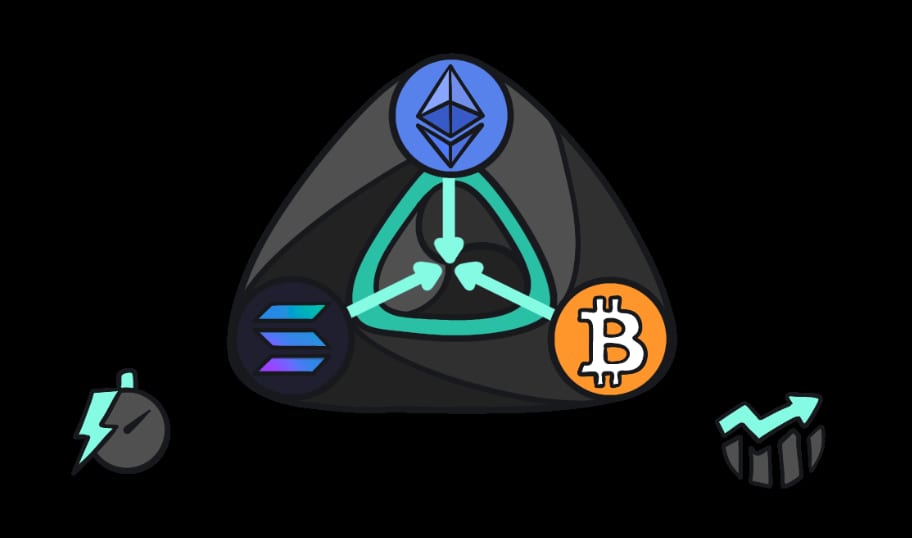
Thursday 09 April 2026 – LiquidChain ($LIQUID) is approaching the $1 million mark in its presale, a funding milestone that arrives as the project lays out a Layer 3 architecture intended to coordinate liquidity and execution across Bitcoin, Ethereum and Solana. The token is currently priced at $0.0447, with the next presale increase scheduled in a matter of hours.
The core proposition is operational rather than purely narrative: LiquidChain is building what it describes as a unified execution layer designed to let BTC, ETH and SOL liquidity interact in one environment, reducing the need for users to manually shift capital between chains or depend on conventional bridges.
For market participants, the relevant signals are the timing of the presale, the current token price, the fixed supply model, and whether the network can translate its interoperability design into measurable improvements in capital efficiency, transaction costs and execution speed.
LiquidChain’s presale is closing in on $1 million, giving the project an early funding benchmark as it develops its infrastructure. At the time of writing, LIQUID tokens are offered at $0.0447, and the project says the next price step is only hours away.
That creates a short-term timing catalyst for buyers evaluating entry points, but the larger analytical question is whether the network’s technical model can support sustainable post-launch demand once exchange trading begins and the Layer 3 goes live.
What LiquidChain Is Trying to Solve
Crypto liquidity remains structurally fragmented. Bitcoin still holds the largest share of market value, Ethereum remains the dominant DeFi settlement and smart contract venue, and Solana continues to attract activity tied to high-throughput applications. In practice, users often move between these systems through bridges, wrapped assets and separate execution environments.
LiquidChain is positioning itself as a Layer 3 above those networks rather than as another isolated Layer 2. The stated goal is to aggregate the capital depth of Bitcoin, the DeFi tooling of Ethereum, and the speed and low-fee profile of Solana into a single coordination layer.
If implemented as described, the design would allow developers and users to access the strengths of all three ecosystems without leaving the LiquidChain environment. The project says transactions are processed on the Layer 3, with finality anchored back to underlying chains where necessary.
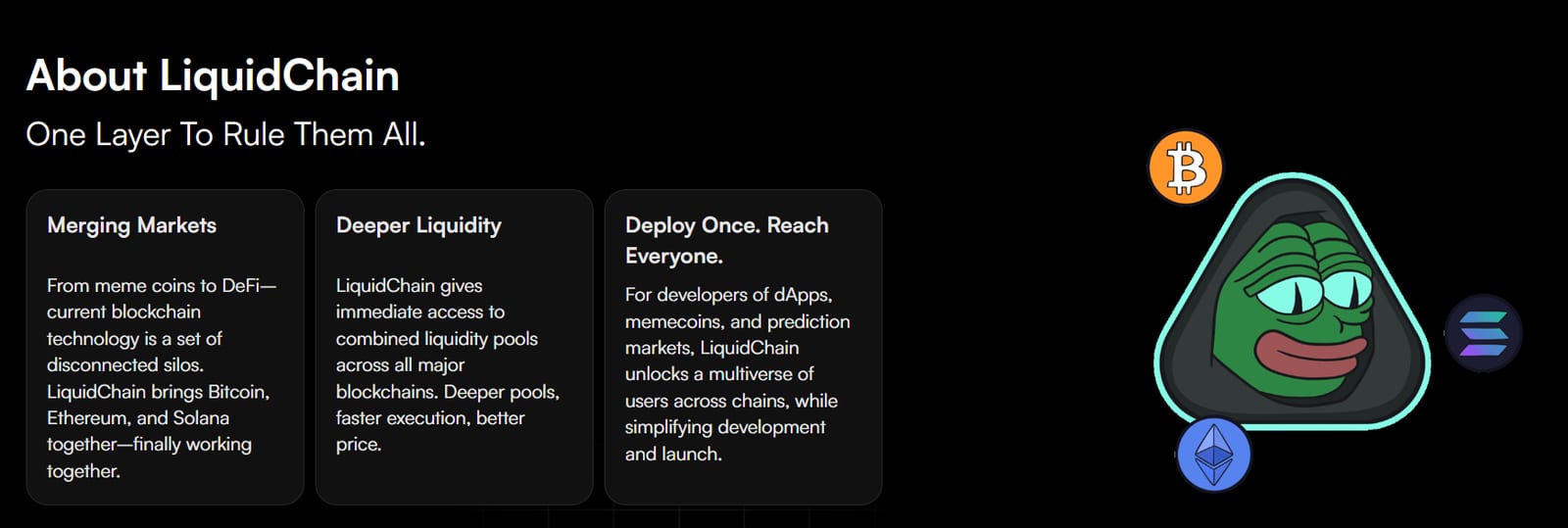
A key technical claim is that the architecture reduces dependence on wrapped tokens in many scenarios and minimizes reliance on centralized intermediaries. That matters because wrapped assets and bridge-based transfers have historically introduced additional friction, execution delays and security risk.
From a market-structure perspective, combining liquidity from BTC, ETH and SOL pools could support tighter spreads, lower slippage and more efficient routing for applications ranging from payments to DeFi and other high-throughput use cases.
Execution Model, Liquidity Flows and Use Cases
LiquidChain argues that a unified Layer 3 matters because multi-chain adoption has increased faster than interoperability infrastructure. Rather than forcing users to choose one chain’s strengths at the expense of another’s, the project’s model aims to coordinate them within one verifiable environment.
That has direct implications for application design. Developers could theoretically use Bitcoin’s capital base and security characteristics for larger-value settlement, Ethereum’s mature DeFi stack for more complex smart contract logic, and Solana’s throughput for latency-sensitive activity such as trading or gaming.
The project specifically points to native cross-chain lending, borrowing, perpetual trading and yield farming as target categories. In those markets, pooled liquidity across Bitcoin, Ethereum and Solana could improve capital efficiency relative to isolated Layer 2 systems.
Quiet moves. Higher layers. 🔥
— LiquidChain (@getliquidchain) April 3, 2026
LiquidChain L3. 👁⟁https://t.co/vqvBcdSQYC pic.twitter.com/SWWlwqlmUV
It also frames the system as suitable for more advanced strategies, including BTC-backed ETH derivatives and leveraged positions executed with Solana-like speed inside a single environment. The project says the Layer 3 is designed to preserve verifiable security and decentralization rather than dilute the guarantees of its underlying networks.
$LIQUID Token Design and Supply Breakdown
At the protocol level, the native token is intended to serve three main functions: gas fees on the Layer 3, staking tied to network security and rewards, and governance as the platform develops. At the heart of the LiquidChain ecosystem, holders can stake $LIQUID and the current expected ROI on staked tokens is 1665%.
LiquidChain says total supply is fixed at 11,800,000,100 $LIQUID, with no additional minting after deployment. For investors and analysts, the fixed-cap structure is one of the clearer measurable elements in the model.
The allocation is broken down as follows: 35% for ongoing development and ecosystem growth, 32.5% for LiquidLabs covering global marketing, media and community-building across Tier 1 regions, 15% for the AquaVault treasury focused on partnerships and community activations, 10% for staking rewards and user incentives, and 7.5% for exchange listings and ecosystem growth.
Those tokenomics are part of the project’s attempt to show long-term operating capacity while also reserving resources for network expansion, incentives and market access.
LiquidChain Access, Audit Status and Participation Steps
For those choosing to participate, the process runs through the official LiquidChain website, where users can buy $LIQUID with SOL, ETH, USDT and other supported payment methods. The project advises participants to use secure wallets during the transaction process.
LiquidChain also says early buyers can access staking during the initial phases. On the security side, the team states that its smart contracts have been audited, including a review by SpyWolf that found no malicious logic, no hidden minting capabilities, and no high-severity vulnerabilities in the core token contract.
Community updates are available through Telegram and X (Twitter). Additional project information is available here: Visit LiquidChain.