


Missed Humanity Protocol’s Run to ATH? LiquidChain May Be Next Crypto to Explode

Bitcoin is slipping. At $69,841.07 – down 4.01% on the day and 9.01% for the week – the asset is dragging the total cryptocurrency market cap down to roughly $2.41 trillion. Dogecoin is similarly sputtering at $0.099247, dropping 1.80% over the last seven days. The broader environment is decidedly risk-off. Retail traders are paralyzed. As Bitcoin dominance slides toward 58.7%, capital is actively rotating into the Layer 2 sector.
We saw this exact dynamic trigger Humanity Protocol’s massive run. Ignoring broader market hesitation, it executed a textbook ascent from 2c to 85 cents in under a year, reaching a new ATH before settling back to 80c today. It has carved out a position in the top 35 coins by helping to verify users without disclosing personal information.
Market participants are now actively scanning the horizon for the next infrastructure play capable of a similar, aggressive breakout, with LiquidChain (LIQUID) a potential play that solves the most frustrating bottleneck in digital finance: the strict isolation of our largest blockchain networks.
Early capital is pouring in, with $819,000 already secured in presale at an entry price of $0.0146. A verified 1340% staking APY is driving heavy initial attention, but the yield is secondary to the big prize. Investors are backing LiquidChain for what it unlocks.
LiquidChain is the Bundling of Fractured Capital
While cryptocurrency was built to bypass traditional borders, it ended up constructing its own, in the sense that Bitcoin, Solana, and Ethereum ecosystems operate in isolation, and deploying capital between chains forces users through a labyrinth of wrapped tokens, vulnerable third-party bridges, and unpredictable fees. It causes massive inefficiencies – betraying the original promise of a frictionless digital economy.
LiquidChain rejects this fragmentation and removes the boundaries between networks, instead of building another fragile bridge. It treats liquidity as a shared, borderless resource, pooling the massive capital reserves of BTC, SOL, and ETH into a singular omni-chain environment.
As a Layer 3, LiquidChain sits “above” Layer 1 and Layer 2 networks, observing their states in real time and using the pools of capital as they are needed. It means users no longer need to care which underlying chain a decentralized application lives on. They simply interact with the opportunity.
LiquidChain handles the plumbing beneath the surface, and LIQUID is the universal gas token to fuel the execution. It transforms a scattered scene into a single, breathing financial organism. It is a shift that makes the user experience invisible and is exactly what blockchain requires to achieve global scale.
Why the Cross-Chain Thesis Defines 2026
Narratives dictate price action – when older altcoins bleed momentum, investors hunt for projects offering undeniable, ecosystem-agnostic utility. We often find that tokens tied to a single network remain entirely vulnerable to the rise and fall of that specific chain, but a token powering a unified super-network captures the upside of the entire industry.
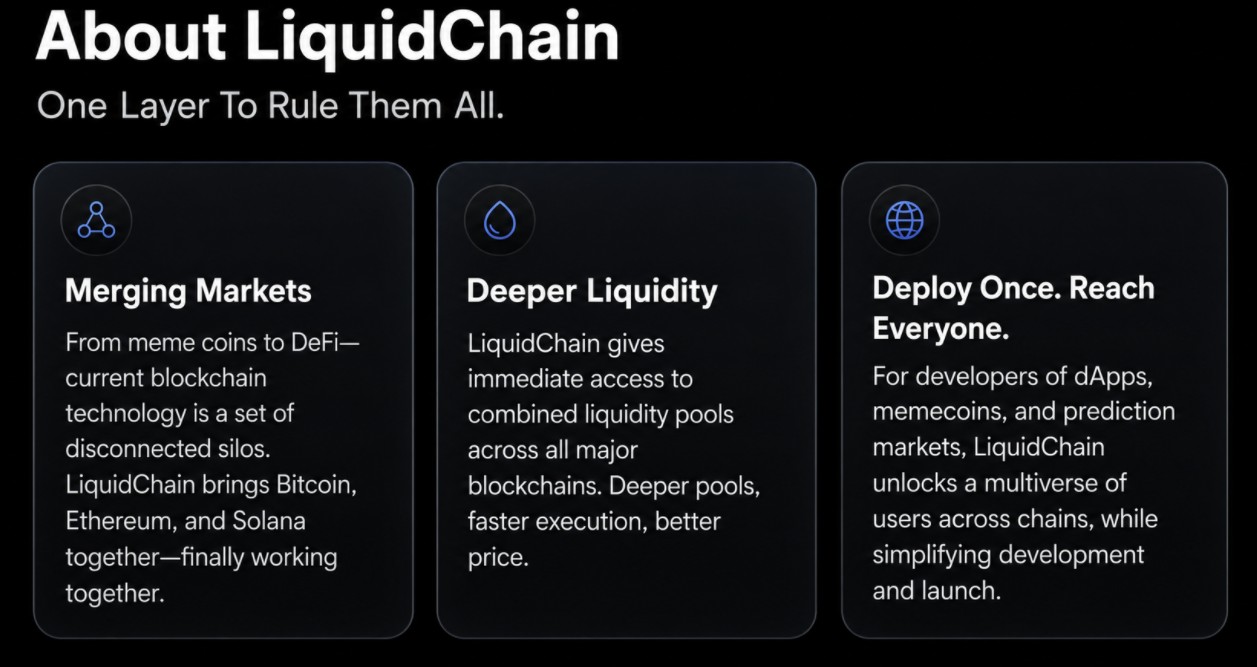
By making LIQUID the necessary fuel for every transaction across its unified liquidity pool, LiquidChain can secure constant demand. If you are swapping Ethereum-based assets for Solana-native liquidity, LIQUID is burned. Tapping into Bitcoin’s massive dormant value requires LIQUID. As adoption of this omni-chain architecture accelerates throughout 2026 and 2027, the token absorbs the sheer volume of that friction. The economic mechanics are ruthlessly geared toward scarcity and constant utility.
Humanity Protocol proved that the market aggressively rewards projects that address market flaws. Given the immense size of the economies LiquidChain is tying together, analysts are increasingly pointing to LIQUID as the next crypto to explode. It sits at the center of the industry’s three largest liquidity reservoirs and acts as the only necessary conduit between them.
The Cost of Inaction in Emerging Networks
Breakouts are defined by early conviction in infrastructure that will soon seem entirely obvious, and the belief that blockchains should remain isolated, forcing users to juggle multiple wallets, navigate bridges, and figure out native gas tokens, will shortly be viewed as a clumsy relic of early-stage crypto.
LiquidChain is raising capital quietly, rewarding early believers with severe discounts and staggering APY long before the broader market comprehends the scope of its architecture.
Unified liquidity is likely to become the standard for decentralized finance, and LiquidChain is the Layer 3 that thinks no chain should be an island.
About Author

About Author