


Next 100X Crypto? Bitcoin Hyper Eyes Success as BTC’s Payment Layer 2

Bitcoin (BTC) is trading at $74,755.37 today, up 1.34% in 24 hours and 5.28% over the past seven days, while Ethereum (ETH) sits at $2,347.46, gaining 1.28% in 24 hours and 7.59% across the week.
But there is a growing problem with Bitcoin, which isn’t measured on a chart: utility. Bitcoin holds the identity, the liquidity, and the institutional trust, but it struggles with speed, cost, and flexibility – and is unsuitable for modern decentralized finance. Ethereum and Solana have spent the past few years showing Bitcoin the advantages of programmability, DeFi, and developer activity.
Bitcoin’s architecture caps throughput at around 7 transactions per second – far below what we need for modern financial systems and global retail platforms. That is why a Bitcoin-native Layer 2 has become one of the more talked-about structural narratives of this cycle.
Bitcoin Hyper (HYPER) has so far raised $32.4 million in a stunning crypto presale. Right now, HYPER is priced at $0.0136785, and early participants can earn a 36% staking APY while the market waits for the full launch.
How Bitcoin Hyper’s Layer 2 Actually Works
Bitcoin Hyper‘s roadmap reveals an extremely high-performance, low-latency Layer 2 blockchain where transactions are executed in an optimized L2 virtual machine and later settled on Bitcoin Layer 1, allowing for high-throughput, low-cost settlement without congesting the base network.
By integrating the Solana Virtual Machine (SVM), Bitcoin Hyper allows extremely fast, low-latency execution along with decentralized applications, bringing the performance and developer experience of Solana to the Bitcoin ecosystem.
The second feature is the Canonical Bridge, where users deposit BTC to a designated Bitcoin address monitored by Bitcoin Hyper’s Canonical Bridge. Upon successful verification, an equivalent amount is minted on Bitcoin Hyper’s Layer 2 in a trustless manner.
Users can then send and receive on Bitcoin Hyper’s Layer 2 with near-instant finality, and the network also supports DeFi operations like staking and decentralized exchanges.
The result is a Bitcoin-native environment for payments, dApps, and DeFi, which doesn’t require users to leave the Bitcoin ecosystem. The L2 runs on its own Proof-of-Stake validator network, meaning the energy overhead of the scaling layer itself is a fraction of Bitcoin’s default costs.
Independent smart contract audits by SpyWolf and Coinsult have been completed, and tokenomics are public, with a fixed supply of 21 billion HYPER.
30% of the supply is allocated to development, 25% to treasury, 20% to marketing, 15% to rewards, and 10% to exchange listings. There are no private sales, insider rounds, or preferential allocations.
Why the Next 100x Crypto Conversation Is Landing Here
The comparison to L2s like Arbitrum or Mantle is useful, as they are similar L2s (albeit, Ethereum-based) that benefited from first-mover advantage on a programmable base layer.
HYPER is attempting something harder, adding programmability onto a chain that was never designed for it. From ordinals to various sidechains, many projects have tried to bolt programmability and low fees onto Bitcoin’s settlement layer.
The problem is that most proposed solutions compromise on speed or programmability. Bitcoin Hyper’s SVM integration is a direct answer to that criticism, giving users Solana’s Proof-of-Stake speed (and sub-cent fees) with Bitcoin’s Proof-of-Work security as the final settlement layer.
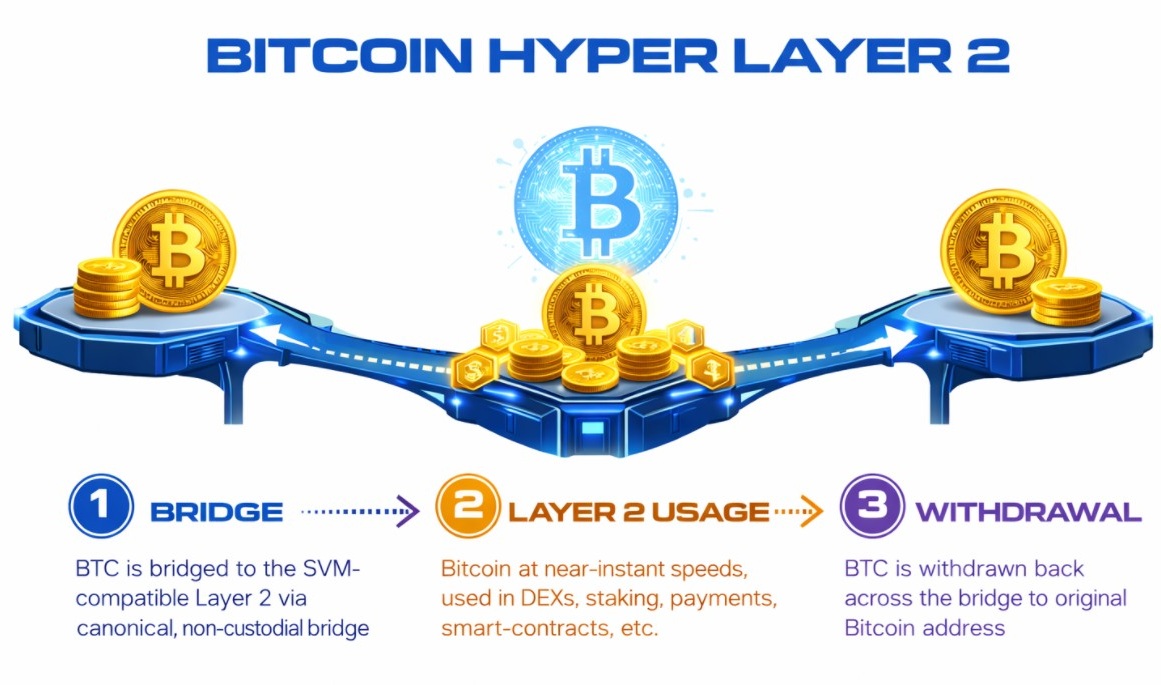
HYPER’s roadmap suggests a mainnet launch in 2026, with activation of the Canonical Bridge for BTC deposits and withdrawals, integration of the Solana Virtual Machine for dApp support, and first dApp and smart contract deployments on Layer 2.
Exchange listings – both centralized and decentralized – are scheduled to follow, with a DAO governance framework set for 2027.
For investors hunting the next 100x crypto, you can see how Bitcoin has $1.49 trillion in market cap, zero native smart contract capability, and no serious payment-layer scaling solution outside the Lightning Network. If HYPER gives Bitcoin back its payment narrative – which was BTC’s original purpose – then a valuation in the low billions of dollars is not unreasonable.
The Bitcoin Problem Has Always Had a Price Tag
Bitcoin’s limitations aren’t new, but what is new is that the infrastructure to fix them is arriving
At $0.0136785 per token, $32.4 million raised, a 36% staking APY already live, HYPER has moved past the whitepaper stage into something investors are treating as a credible infrastructure bet.
Whether the mainnet delivers on the SVM integration will define the rest. For now, the presale numbers suggest the market is watching.
About Author

About Author