


Next 100X Crypto? HYPER’s Plan To Bring Payments Back to BTC

The global crypto market cap sits at $2.52 trillion today, up $9 billion over the last 24 hours, and the Layer 2 sector is quietly becoming one of the most competitive corners of the space.
In the L2 sector, Mantle (MNT) is trading at $0.66792, up 0.65% in 24 hours, while Arbitrum (ARB) has been more active, posting a 9.99% gain in 24 hours and an 18.45% gain over the past seven days.
But there is a long-standing problem with Bitcoin, with the base chain capping throughput at around 7 transactions per second – far below the needs of modern financial systems or global consumer platforms. Unlike newer blockchains, Bitcoin lacks native support for smart contracts or decentralized applications, isolating it from the worlds of DeFi, gaming, and Web3.
So while BTC remains a store of value, it is not a platform for innovation, and Ethereum and Solana have absorbed that developer demand.
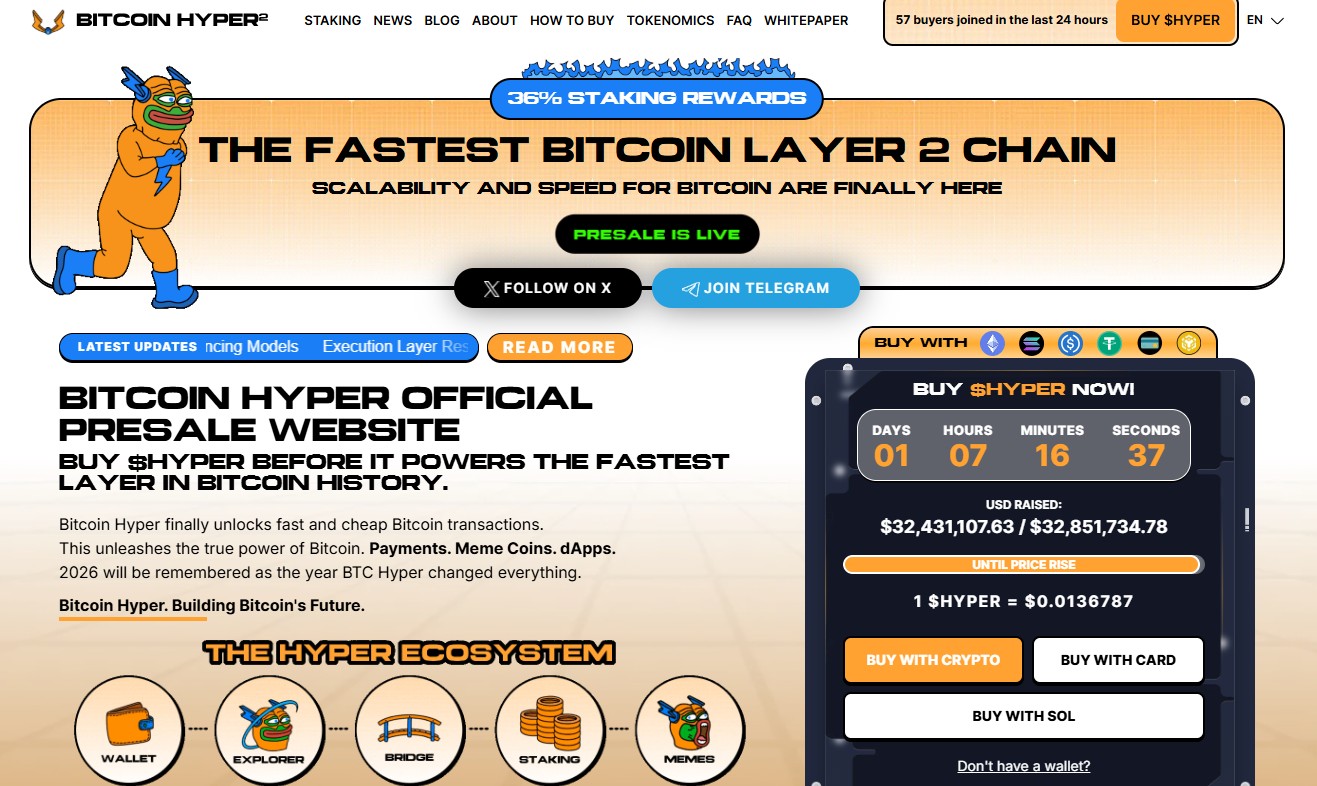
That is the exact problem Bitcoin Hyper (HYPER) is working to solve, and it has recently gained massive attention. The project’s strong fundraising momentum, with over $32.4 million raised, demonstrates significant market confidence in its plans.
The token is currently priced at $0.0136787 in presale, with staking live at 36% APY for early participants. For a project still pre-mainnet, those figures are hard to dismiss.
How Bitcoin Hyper Works
Bitcoin Hyper is designed to break through Bitcoin’s core limitations – slow transactions, high fees, and lack of programmability – by introducing a Layer 2 that can process transactions with a Solana-compatible backend, drastically improving speed and lowering costs.
Integrating the Solana Virtual Machine (SVM), Bitcoin Hyper will deliver lightning-fast, low-latency execution of smart contracts and decentralized applications, bringing Solana’s performance and developer experience straight into the Bitcoin ecosystem.
Users can then deposit BTC to a designated Bitcoin address monitored by a Bitcoin Hyper’s decentralized Canonical Bridge. Once within HYPER, the ecosystem supports high-speed payments (Solana can handle thousands of transactions per second at sub-cent fees), DeFi applications such as swaps, lending, and staking, NFT platforms, and gaming dApps.
Developers can program in languages they know, such as Rust, for building scalable smart contracts. Meanwhile, gas fees on the network are paid in HYPER, with burn mechanics tied to protocol activity that can reduce circulating supply over time.
On the tokenomics side, the total supply of HYPER is fixed at 21,000,000,000 — a supply cap that mirrors Bitcoin’s own design philosophy. The smart contracts have been independently audited by both Coinsult and SpyWolf. SpyWolf’s review found no high-, medium-, or low-risk vulnerabilities, and we expect the mainnet launch in Q3 2026.
Why HYPER Could Be the Next 100X Crypto in 2026
The market opportunity here is not subtle: Bitcoin is the largest crypto asset on earth by a significant margin – its market cap sits at $1.51 trillion. Yet it captures almost none of the DeFi, payments, or dApp developer activity that smaller chains have built over the past four years. A functional, fast, audited Layer 2 that routes that activity back through Bitcoin’s security layer is targeting a much larger addressable market than any Ethereum L2 project can claim.
The combination of Solana’s speed with Bitcoin’s global trust layer is interesting to investors seeking exposure to high-performance, Bitcoin-linked crypto assets, and Bitcoin Hyper is gaining traction by combining three high-conviction narratives: meme coin branding, Layer 2 scalability, and early-stage access. That combination has driven the presale well past the $32 million mark.
The roadmap targets mainnet deployment of the Bitcoin Hyper Layer 2 network in Q3 2026, with activation of the Canonical Bridge for BTC deposits and withdrawals and integration of the Solana Virtual Machine for dApp support to follow.
Exchange listings – both centralized and decentralized – are planned to coincide with that phase. The team cannot name specific CEX partnerships at this stage due to confidentiality agreements, though presale buyers are hoping for major tier-one listings such as Binance and Kraken.
The Satoshi Bet
Ethereum L2s like Arbitrum are competing for developer share on a chain with a $285 billion market cap. Bitcoin Hyper is going after the same developer activity, but anchored to a $1.49 trillion asset with global name recognition and sovereign-grade institutional adoption.
If HYPER can give Bitcoin superpowers such as DeFi and payments via a reliable Layer 2, the market for HYPER is orders of magnitude larger than that of most comparable projects. MANTLE sits at a $2.2 billion market cap, and might be a good first target for HYPER. If HYPER reaches a $3 billion market cap, early investors are looking at a 100x return.
Whether HYPER gets there depends entirely on mainnet delivery and adoption, but the architecture is sound on paper, and early investors have already shown their confidence. The next year will determine whether Bitcoin Hyper can rewrite the Layer 2 conversation entirely.
About Author

About Author