


Next Crypto to Explode: Bitcoin Hyper Targets $33M in Massive Layer 2 Presale

Bitcoin dominates crypto by market cap, and has done so for most of the asset class’s history, but dominance by value has not translated into dominance by utility. While Ethereum and Solana have spent years building ecosystems of DeFi applications, high-speed payments, NFT infrastructure, and developer tooling, Bitcoin has a limitation.
The base chain was never built for speed or programmability, and the gap between Bitcoin’s brand recognition and its on-chain utility has only widened as competing Layer 1s matured.
While Bitcoin was revolutionary as the first decentralized digital currency, it was never designed for speed, scalability, or programmability. Bitcoin is capped at around 7 TPS, below the needs of modern financial systems or global consumer platforms (for example, Solana allows for thousands of TPS).
It is the sole reason Bitcoin has remained a store of value rather than a payment network, and why the original Satoshi vision of peer-to-peer electronic cash has effectively been ceded to other chains.
That fix is what Bitcoin Hyper(HYPER) is building, with the project describing itself as “the first ever Bitcoin Layer 2” and having already raised $32.6 million in presale funding, with the token currently priced at $0.013679. Early stakers are earning a 36% APY, and the presale has smart contract audits from both Coinsult and SpyWolf.
How Bitcoin Hyper Works
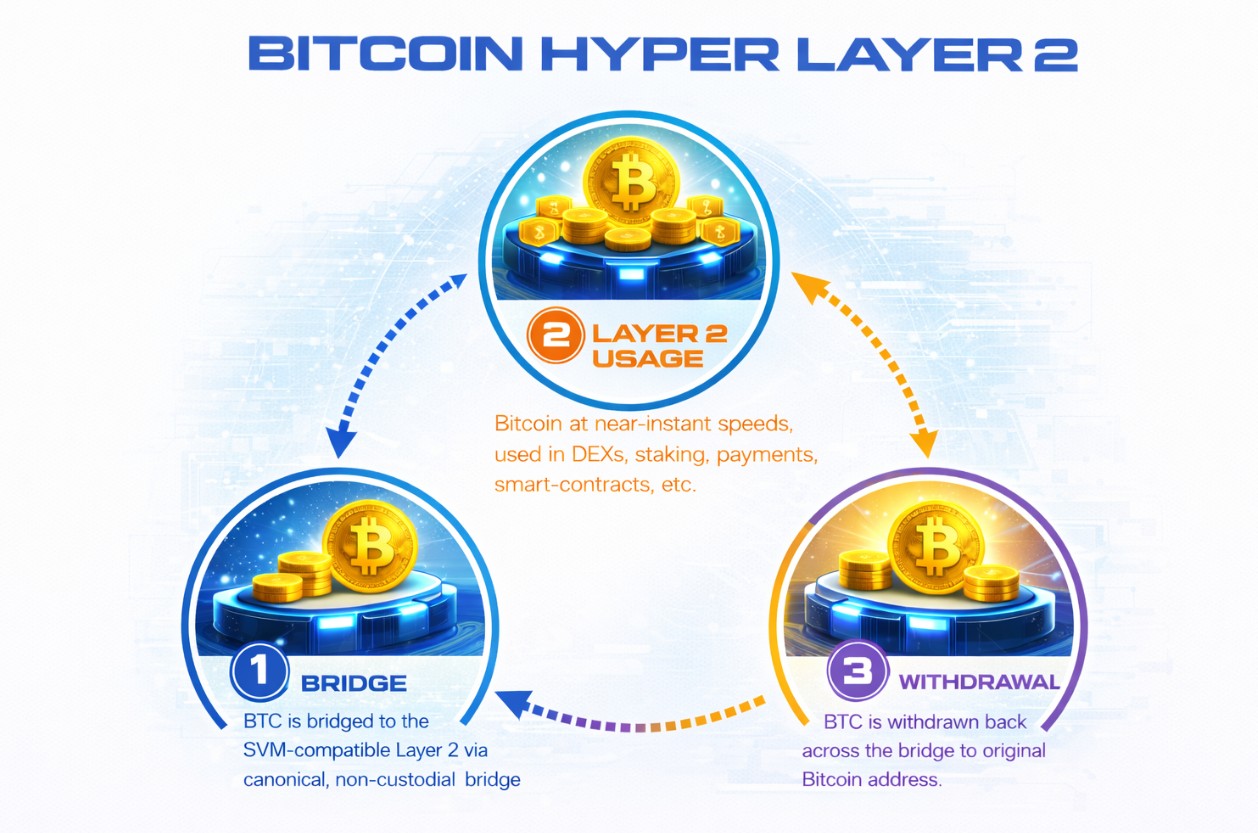
Bitcoin Hyper solves Bitcoin’s limitations with a Layer 2 solution that processes transactions with Solana-like low latency. By integrating the Solana Virtual Machine (SVM), Bitcoin can catch up.
The hybrid model uses the L2 for smart contract execution, while Layer 1 (Bitcoin) is used for settlement, and a bridging architecture that locks BTC on L1 and mints wrapped BTC on L2. The decentralized, non-custodial Canonical Bridge lets users deposit BTC into the bridge and mint equivalent tokens on Layer 2. These can be used within the Bitcoin Hyper ecosystem and later withdrawn back to native BTC at any time.
The Real-time SVM is a blazing-fast execution layer that settles final transactions on the most secure blockchain in existence.
While Bitcoin Hyper will support high-speed payments, it will also allow DeFi applications such as swaps, lending, and staking, NFT platforms, and gaming dApps.
The L2’s own validator network uses a Proof-of-Stake model, ensuring that all transaction processing and smart contract execution within the Bitcoin Hyper network remains energy-efficient.
Why HYPER Could Be the Next Crypto to Explode
The Bitcoin Layer 2 space is measurably less crowded than Ethereum’s. Ethereum has dozens of established L2 networks competing for the same developer pool and user base. Bitcoin has almost none with real traction.
Meanwhile, the addressable market, given BTC’s $1.6 trillion market cap and global brand recognition, is substantially larger – and making Bitcoin a currency again is a priceless endeavor.
The roadmap targets a mainnet launch in 2026, with deployment of the Bitcoin Hyper Layer 2 network, activation of the Canonical Bridge for BTC deposits and withdrawals, and integration of the Solana Virtual Machine for dApp support.
The next stage includes exchange listings, a developer toolkit, and onboarding partner projects across the DeFi, gaming, and NFT sectors.
The presale staking mechanism means participants are accumulating HYPER now and generating yield ahead of the token generation event (TGE).
Following the presale, HYPER will launch on decentralized exchanges such as Uniswap, with centralized exchange listings targeted for Q3 2026.
The Presale Clock Is Running
$32.6 million raised in presale is a huge statement, as is the decision to build on Bitcoin rather than compete with it. While the market has spent years rewarding Ethereum and Solana for solving programmability, Bitcoin, with its unmatched security and ten-figure liquidity base, has been left out.
The demand is there, but the infrastructure isn’t. Bitcoin Hyper is aiming to change that before anyone else does.
About Author

About Author