


Next Crypto to Explode: How LIQUID Plans to Unify The Major Layer 1 Blockchains

The crypto market is seeing signs of some cautious momentum, with a total crypto market cap of $2.52T. Bitcoin (BTC) is trading at $76,790.30, up 2.35% on the day and 3.22% over the past week.
Polygon (POL), formerly MATIC, trades at $0.093792, up 3.30% in 24 hours and 11.84% over seven days, which is a notable move for a network whose core identity is Layer 2 scaling.
The Layer 2 and Layer 3 sector is where much of that altcoin attention has been concentrated. Layer 1 blockchains – Bitcoin, Ethereum, Solana – are the foundational settlement networks. Layer 2s like Polygon sit on top of them, optimizing for speed, throughput, and lower fees by processing transactions off the main chain before settling them back onto it.
Layer 3s are a different beast, which, rather than improving a single chain’s performance, sit above multiple Layer 2s and Layer 1s simultaneously, creating a unified environment across ecosystems that would otherwise remain walled gardens.
The question the sector keeps returning to is whether anyone can actually do that at scale, and do it without the bridges, wrapped tokens, and multi-step user flows that have made cross-chain interaction so costly and risky up to now.
LiquidChain (LIQUID) is the frontrunner in this area. As a presale project, it has so far raised $690,000 and is offering staking rewards at 1,576% APY for early participants. The current price for LIQUID is $0.0145.
How LiquidChain Works as a Cross-Chain Liquidity Layer
LiquidChain is designed as a Layer 3 protocol that interoperates directly with Bitcoin, Ethereum, and Solana, the three largest liquidity pools in crypto. The problem it tackles is the billions of capital locked in isolated ecosystems, and how moving assets between them currently requires bridges, custodians, or synthetic tokens. Each of these introduces delay, fees, and security risk.
LiquidChain’s answer is a Cross-Chain Virtual Machine (VM) that executes transactions referencing multiple underlying blockchains simultaneously. Alongside this, a Unified Proof Engine verifies Bitcoin, Ethereum, and Solana states in real time, enabling what the team describes as single-step, atomic cross-chain execution. The idea is that a user – or a dApp – shouldn’t need to know which chain their capital sits on.
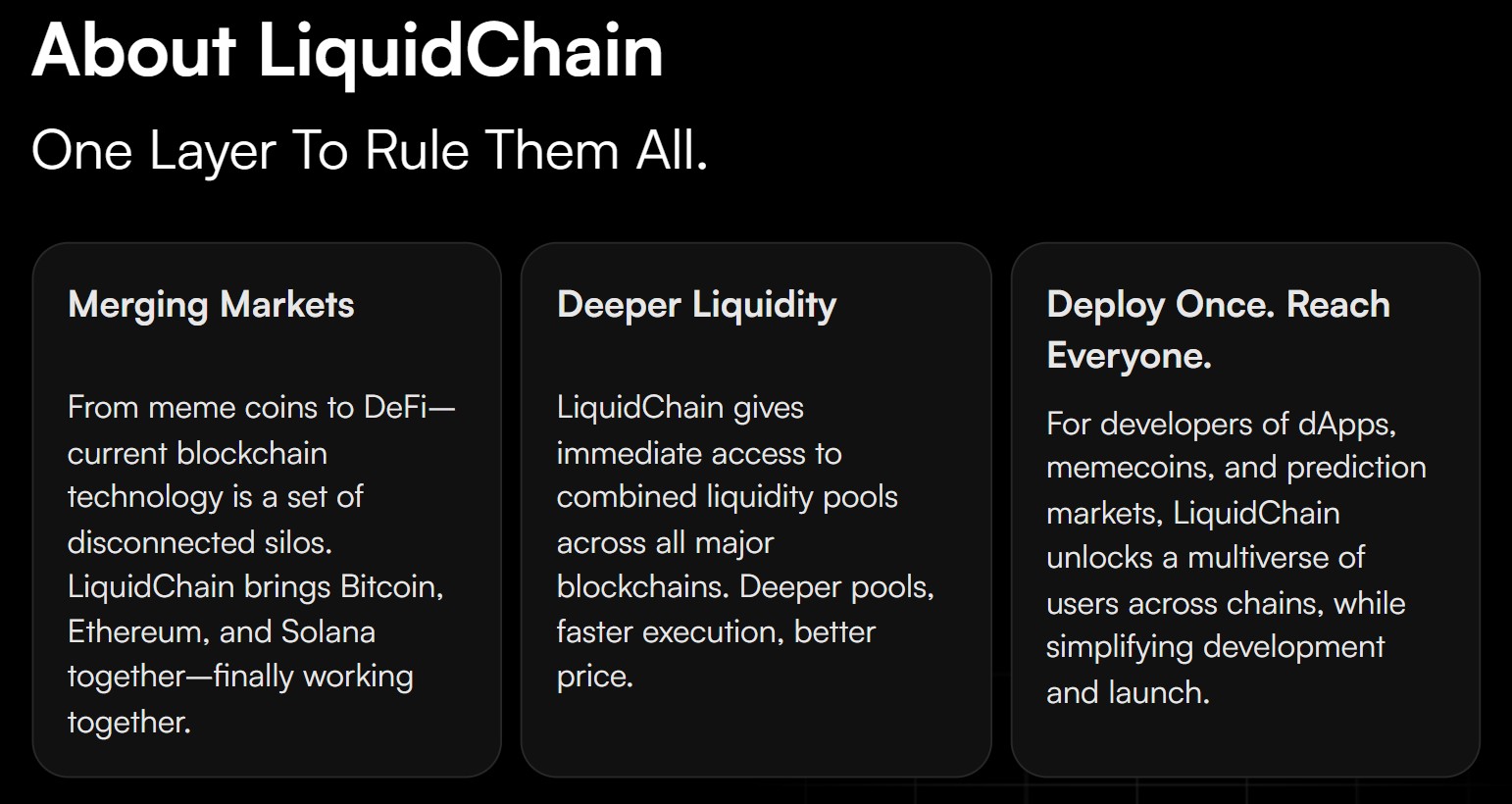
For developers, the architecture offers a deploy-once model: build once and reach users across Bitcoin, Ethereum, and Solana from a single codebase – something that has historically demanded entirely separate development tracks for each ecosystem.
The project has been audited by both SpyWolf and CertiK, and follows a four-phase roadmap that takes it from its current presale and testnet phase through token launch, mainnet deployment, and eventually governance and global scaling, including integration of Layer 2 rollups.
Why LIQUID Is Being Watched as the Next Crypto to Explode
Cross-chain infrastructure has been a recurring talking point in the sector for years, but the conversation has shifted. The failure modes of bridge-based architecture – hacks, wrapped asset exploits, cumbersome UX – are well-documented. When most large altcoins outperform Bitcoin, it signals a rotation toward higher-risk projects, and Polygon’s 11.84% seven-day performance is the kind of signal that points capital toward the L2/L3 narrative specifically.
LiquidChain’s presale price of $0.01451 gives it a low-cap entry point relative to the scope of its target: unified liquidity across three chains that collectively represent the vast majority of DeFi activity. The $689,000 raised so far indicates early conviction, and the 1,576% APY staking rate (which will drop as more holders stake) is designed to incentivize long-term holders throughout the presale and launch phases.
The roadmap targets centralized exchange listings for Q3 2026, following an initial debut on decentralized exchanges prior to mainnet. If the mainnet delivery holds, the project arrives in a market that has spent the last cycle asking whether cross-chain execution can genuinely be made atomic and trustless – not just promised.
The Infrastructure Play Beneath LIQUID
LiquidChain is not, at base, a narrative play. The underlying architecture of a single VM that can read and settle across Bitcoin, Ethereum, and Solana simultaneously is technically specific enough to stand out from the broad class of interoperability projects that have come and gone.
The problem it is aiming to solve – fragmented liquidity across the three biggest chains in crypto – isn’t going away, and the market in April 2026 is keenly watching to see who gets there first.
About Author

About Author