


Next Crypto to Explode: Investors Spot Bitcoin Hyper as the DeFi Layer That Brings BTC Into 2026

Bitcoin is still the asset that the rest of crypto measures itself against, but that does not mean Bitcoin has kept pace with the rest of the market. On CoinMarketCap, Bitcoin holds a $1.3 trillion market cap, with BTC dominance at 58%, which says something simple: capital still trusts Bitcoin first, even when the market is uncertain.
That is the opening that Bitcoin Layer 2 projects are trying to use. Ethereum built a busy rollup economy around Arbitrum, Mantle, and other scaling networks because users wanted cheaper execution, faster trades, and more block space for DeFi. Solana took a different route, making speed part of its identity.
Bitcoin, by contrast, still carries the weight of being the original chain. It is secure, scarce, and proven, but its base layer remains slow by modern crypto standards, with roughly seven transactions per second as the practical ceiling – no good for buying a coffee in your neighborhood.
The question for 2026 is whether Bitcoin can keep its monetary purity and still become useful again for payments, DeFi, and everyday on-chain movement. That is why investors are watching Bitcoin Hyper (HYPER), a Bitcoin Layer 2 project that has raised $32.8 million in presale.
HYPER is currently priced at $0.01368, with staking available at 36% APY. For a market still trying to decide where the next growth comes from, HYPER says: do not replace Bitcoin – give it the execution layer it never had.
How Bitcoin Hyper Brings Payments Back
Bitcoin Hyper is built around a simple idea with large consequences. Bitcoin should remain the settlement asset and security anchor, while a faster Layer 2 handles the parts of crypto that demand speed: payments, swaps, staking, dApps, and other DeFi activity.
Bitcoin Hyper uses the Solana Virtual Machine, or SVM, as its execution environment – with the SVM proven for high throughput and parallel processing. In plain English, it is designed to handle many operations at once rather than pushing activity through a narrow bottleneck.
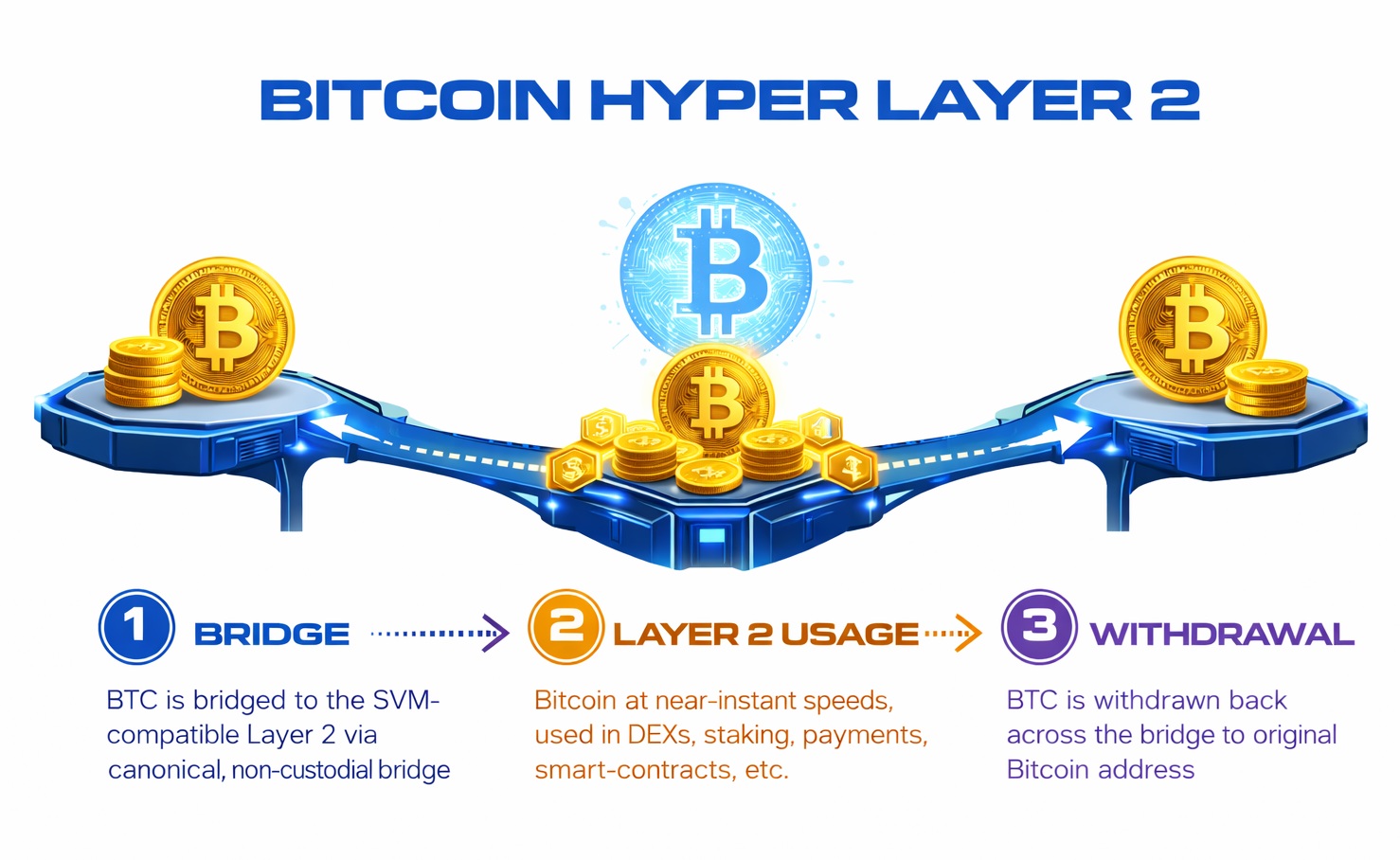
For Bitcoin users, the point is not to turn BTC into SOL, but to bring a Solana-style execution environment to Bitcoin’s economic base.
The bridge is the key piece, where users deposit BTC on Bitcoin’s Layer 1. The Bitcoin Hyper system verifies the deposit and then issues an equivalent representation on the Layer 2, where the asset can move faster and interact with applications. When users want to exit, the process works in reverse, returning value to the Bitcoin network.
That is the part that makes the project more than another payment wrapper. Bitcoin Hyper is trying to make BTC usable without asking Bitcoin itself to change. Transactions can be batched and compressed, with zero-knowledge proofs used to help validate Layer 2 activity before the state is committed back to Bitcoin’s base chain. The aim is lower cost and faster movement, while still keeping Bitcoin as the final reference point.
There is an elegance to that design. Bitcoin was born as peer-to-peer electronic cash, but its own success turned it into a reserve asset, a treasury asset, and a long-term savings instrument. That was not a failure, but it does not make a network feel alive. People need to use money, not just admire it from cold storage.
Bitcoin Hyper’s answer is to let Bitcoin stay hard while making it move again.
Why Bitcoin Hyper May Be the Next Crypto to Explode in 2026
The strongest case for Bitcoin Hyper is that the market already understands the Layer 2 trade. Ethereum’s scaling networks showed how much value can form around execution layers when the base chain becomes expensive or congested. Arbitrum and Mantle did not need to replace Ethereum. They expanded what Ethereum users could do.
Bitcoin has a larger asset base, a stronger brand, and far less developed DeFi infrastructure. If even a small part of Bitcoin’s dormant capital begins looking for yield, faster payments, or on-chain applications, the addressable market is enormous.
That is why a Bitcoin Layer 2 can feel different from another altcoin rotation. It is a bet that the world’s largest crypto asset has unfinished business.
The HYPER token is intended to support activity across the ecosystem, including staking and access to applications. The project has also implemented visible security checks, including audits by Coinsult and SpyWolf. For presale buyers, the more immediate numbers are the ones already drawing attention: $32.8 million raised, a $0.01368 token price, and 36% staking APY.
None of this means Bitcoin Hyper has an easy road, and Layer 2 infrastructure lives or dies by execution, liquidity, and developer adoption. But the market has already shown it will reward networks that make old capital more useful. Ethereum’s Layer 2 cycle proved the model, and Bitcoin may now be ready for its own version.
Bitcoin Still Has Somewhere to Go
The most interesting thing about Bitcoin Hyper is not that it tries to make Bitcoin faster. It is that it treats Bitcoin as unfinished rather than outdated.
Bitcoin does not need to become Ethereum or Solana, nor does it need to chase every crypto trend. But if Bitcoin is going to remain the center of the market, it needs more than scarcity.
It needs motion, it needs places for capital to go, things for users to do, and a way for BTC to become useful without becoming less Bitcoin.
Bitcoin Hyper is building toward that version of the network: Bitcoin as the money, Bitcoin Hyper as the road system around it. In 2026, that may be exactly the kind of story investors are willing to follow.
About Author

About Author