


Next Crypto to Explode: LiquidChain Is the Unifying Layer That Crypto Has Been Waiting For

The broader market is finding its footing this week. The global crypto market cap sits at $2.27 trillion, up 1.1% over the last 24 hours. Ethereum (ETH) is trading at $1,795.14, up 4.47% in the last 24 hours and 7.10% over a week. Arbitrum (ARB), the flagship Ethereum Layer 2, is at $0.087243, up 7.40% over the week. That divergence is worth paying attention to.
Layer 2s were the story of the 2021 bull run, but they may already have delivered what they promised. They made Ethereum cheaper and faster by solving scalability, and Layer 3 tokens look to dominate 2027 by solving fragmentation.
Bitcoin, Ethereum, and Solana are extraordinary in their own domains, but trying to move capital between them is a nightmare – bridges that break, slippage that hurts, and execution environments that don’t talk to one another. Deeply fragmented liquidity is growing every day.
That’s why LiquidChain (LIQUID) is growing rapidly during the presale. The project is currently in presale at $0.0147, has raised $842,000, and is offering a staking APY of 1,323% for early holders.
How LiquidChain’s Layer 3 Protocol Works
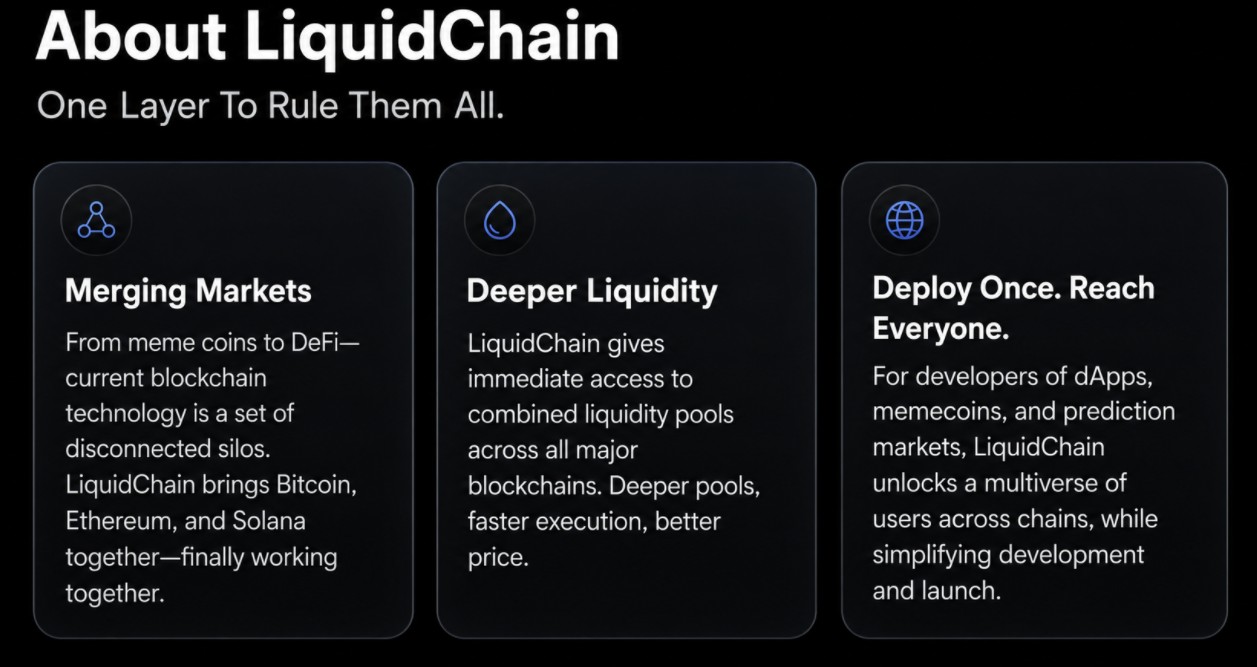
LiquidChain is a Layer 3 blockchain that unifies Bitcoin’s capital, Ethereum’s DeFi depth, and Solana’s speed – describing itself as the first-ever unified execution layer linking the world’s largest blockchains. The protocol doesn’t try to compete with the chains beneath it – it sits above them and coordinates.
By enabling cross-chain execution and settlement via a unified interface, the protocol aims to reduce slippage and MEV risks, persistent challenges in decentralized finance. Most users experience these problems every time they try to route capital from a Solana-based meme rally into an Ethereum DeFi position. Billions of dollars in daily volume slosh around tokens, but that liquidity ends up largely confined to their native chains or specific centralized exchanges (and the fees they attract).
When retail traders want to move profits from a meme coin rally on one chain into a DeFi yield farm on another, the friction is immense.
A key selling point for LIQUID is its “build-once” architecture, which means developers can build once for LIQUID and deploy to all chains – rather than coding relentlessly for three chains and updating three codebases constantly. dApps built for LiquidChain will launch with compatibility across Bitcoin, Ethereum, and Solana. Developers don’t have to choose sides.
Alongside the mainnet (expected later this year), LiquidChain introduces cross-chain derivatives and lending modules, allowing token holders to trade leveraged products in a non-custodial environment and borrow capital from their preferred ecosystem.
The LIQUID token powers the network and supports use cases such as gas fee payments, dApp access, liquidity provision incentives, and staking rewards.
The protocol has already been audited by both SpyWolf and CertiK.
Why LIQUID Could Be the Next Crypto to Explode
Timing is always a question in crypto, but trends emerge. Cross-chain activity is expected to increase through 2026 and 2027, driven by renewed institutional interest, retail re-entry, and countries gradually warming up to blockchain. With that, aggregation layers become more valuable by default. A protocol that earns fee revenue every time capital crosses chains just needs the market to keep doing what it already does, and offer them a compelling pathway.
LiquidChain will capture value every time capital moves across its Layer 3 network, based solely on multichain crypto activity, which is one of the few things in this market that reliably grow over time.
The token will debut on decentralized exchanges prior to mainnet launch, with centralized listings targeted within 2026. Right now, the early presale is approaching $1 million in funding. A successful launch and a modicum of user uptake should send the project’s market cap into the low hundreds of millions of dollars.
Post-launch, LiquidChain also aims to provide institutions with in-depth liquidity access on the L3 blockchain, bridging traditional capital into DeFi markets. That is the longer arc, and it’s the one that moves market caps higher. Institutional capital needs the kind of cross-chain reliability that no single Layer 1 or Layer 2 can provide alone – but Layer 3s can.
Cross-Chain Will Win Eventually
The history of crypto infrastructure is the history of problems that seemed permanent until someone solved them. Layer 1s gave us programmable money, and Layer 2s made that money cheap to move. Layer 3 brings the chains back together and offers everyone access to Bitcoin’s security, Ethereum’s composability, and Solana’s speed.
The fragmentation was a growing pain, not an end state. LiquidChain plans to make it end here.
About Author

About Author




