


Next Crypto to Explode: LiquidChain Prepares to Make Bridges Redundant on BTC, SOL, ETH

While the blockchain industry promised a borderless, open financial system, it has spent a decade constructing walls between its most important networks.
Bitcoin (currently at $62,865, -9.40% over 7 days) commands the store-of-value narrative. Ethereum ($1,678.39, -14.67% over 7 days) owns the smart contract layer. Solana ($66.43, -15.61%) has carved out its own speed narrative. They are the three dominant pillars of decentralized finance, yet they do not speak to one another. Not properly.
The response to this fragmentation has been bridges, which are technically complex, trust-dependent, and frequently compromised pieces of infrastructure that require users to lock assets on one chain to access a version on another.
The bridge model is, in effect, not a solution to siloed liquidity – it is a workaround. It adds steps, adds fees, and introduces new attack surfaces.
The question that has been gaining weight is whether it is possible to build something above all three chains – not beside them, not connected via fragile relays, but genuinely above them – that pulls their liquidity into a single execution environment. That is the question LiquidChain is trying to answer.
The project’s presale has raised $832,000 to date, the token is currently priced at $0.0146, and staking yield is available at 1,332% APY – figures that reflect where this sits in its lifecycle: early, active, and not yet on most radars.
How LiquidChain’s Cross-Chain Architecture Actually Works
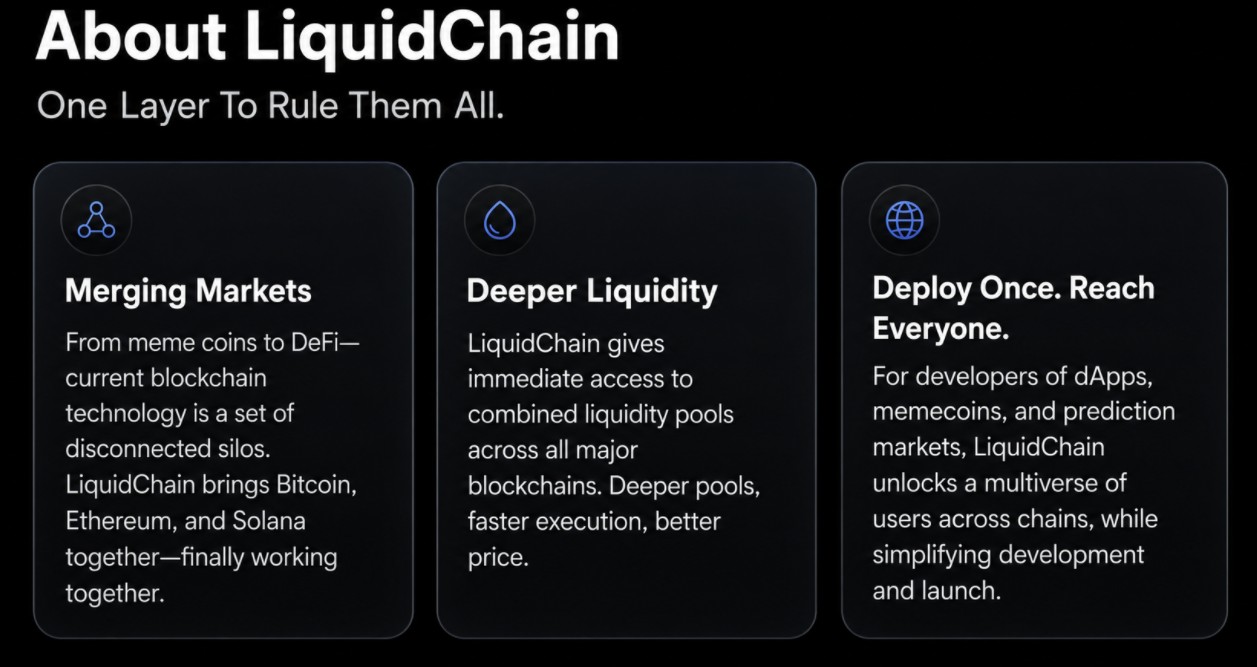
The central thrust in LiquidChain’s whitepaper is that the project is not another blockchain. It is built as a Layer 3 – a settlement and execution layer that sits above Bitcoin, Ethereum, and Solana simultaneously, rather than competing with any of them.
Instead of bridging, LIQUID executes transactions across the three main chains simultaneously, referencing multiple underlying blockchains in a single operation. A Unified Proof Engine verifies the state of Ethereum accounts, Bitcoin transactions, and Solana positions in real time.
When each chain state is proven in real time rather than represented, the wrapped-asset approach becomes unnecessary. It is a genuinely different security approach, not an incremental improvement on the bridge approach.
In short, you can operate in any chain without regard to where you are operating. And, for developers, they can build and deploy an app once, and it will work on all chains – no rewriting code necessary. The Layer 3 is built on standard SDKs, meaning existing dApps can also connect without rebuilding their entire codebase.
The token itself – LIQUID – functions as the transaction fuel, staking collateral, and the mechanism through which developer grants are allocated across the ecosystem.
Is LIQUID the Next Crypto to Explode?
The Layer 3 sector is drawing serious attention in 2026 because the previous problem – scaling – was solved by Layer 2s, but they came at a cost.
Although Layer 2s delivered on their promise of speed and reduced fees, they created fragmentation. Moving between Ethereum rollups, BTC DeFi primitives, and Solana’s ecosystem still requires navigating multiple interfaces, wrapped tokens, and bridging protocols. The problems that Layer 3s are designed to solve are visible in every transaction that multi-chain DeFi users experience.
Removing that issue makes the blockchain far more appealing to retail users and institutional players alike – and whichever project solves that reaps the rewards.
LiquidChain‘s roadmap targets centralized exchange listings later in 2026, which means the time between the current presale price and price discovery event is short in calendar terms. The market cap currently sits near $1 million – a small figure relative to the problem being addressed. With some take-up, LIQUID could quickly reach a valuation of hundreds of millions.
The project has passed independent security reviews from both SpyWolf and CertiK, putting it on a good track for launch.
The Moment Before the Solution Becomes Obvious
Some infrastructure investments only make sense in hindsight – the moment when, after years of workarounds, someone builds the thing that was always needed.
The bridge era may be approaching its end. LiquidChain is not betting on a new chain winning. It is betting that no single chain ever will, and that the real value accrues to whoever builds the layer that unites them all.
About Author

About Author