


Bank of England Proposes Regulatory Regime for Sterling Stablecoins
The Bank of England’s consultation on sterling-denominated stablecoin regulations is going to run until February 10, 2026, with final rules expected later that year.
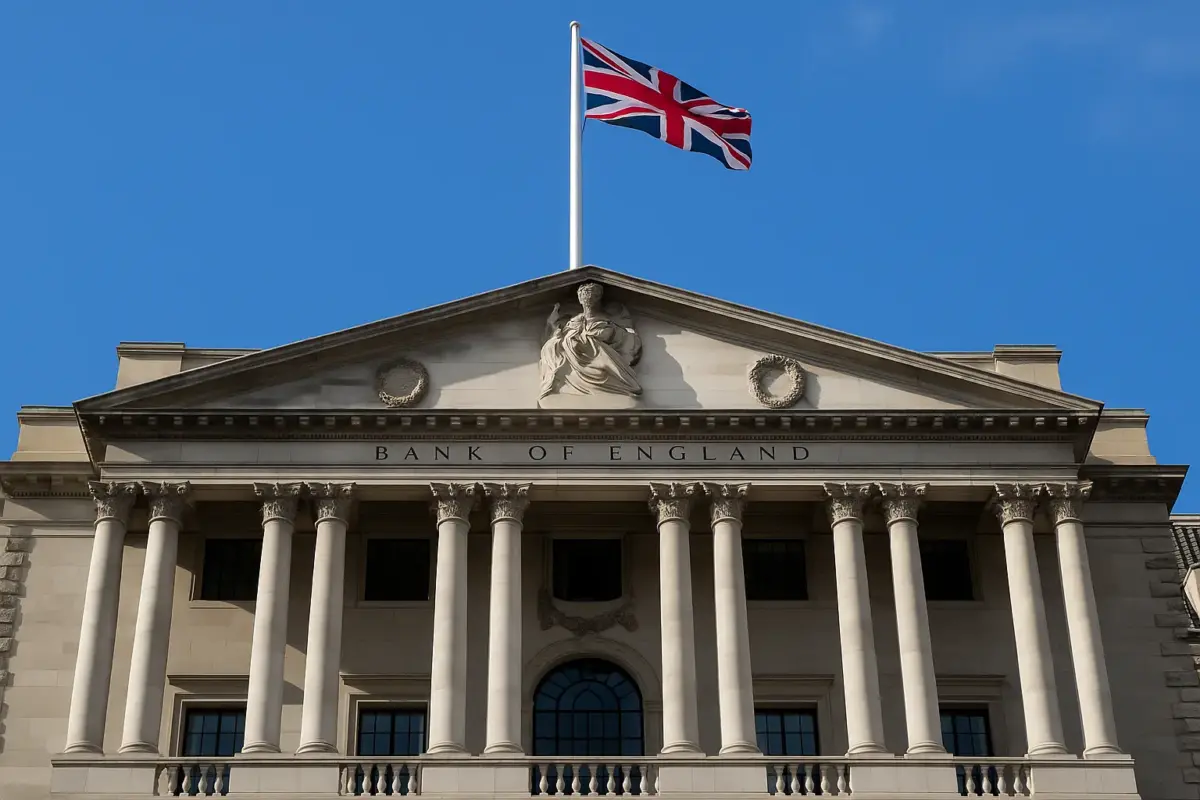
The Bank of England (BoE) has unveiled a consultation paper proposing a comprehensive regulatory framework for sterling-denominated “systemic stablecoins”, digital tokens expected to play a major role in payments across the United Kingdom.
The proposal, published on November 10, 2025, marks a major step in the UK’s ongoing effort to modernize its financial system while managing potential risks tied to digital money.
The central bank said its goal is to create a “robust and future-proof” system that supports innovation without undermining public trust in money. The consultation, which runs until February 10, 2026, is expected to shape final regulations set for release in the second half of next year.
According to the paper, the framework would apply only to stablecoins denominated in British pounds and designated as “systemic” by His Majesty’s Treasury, meaning tokens that are widely used for payments and could have implications for financial stability.
These assets would come under the joint supervision of the Bank of England for prudential and stability concerns and the Financial Conduct Authority (FCA) for consumer protection and conduct issues.
Stablecoins pegged to other currencies, such as the U.S. dollar or euro, would remain under the FCA’s supervision. The central bank made it clear that the new regime is designed for payment-focused stablecoins and does not extend to tokens mainly used for crypto trading, such as $USDT or $USDC.
Deputy Governor for Financial Stability Sarah Breeden said the proposals reflect the UK’s commitment to maintaining confidence in money while preparing for a more digital economy. “Today’s proposals mark a pivotal step toward implementing the UK’s stablecoin regime next year,” she said. “Our objective remains to support innovation and build trust in this emerging form of money.”
Holding Caps and Asset Requirements Under the Proposal
A key element of the proposal involves strict requirements for how stablecoin issuers manage their reserves. The BoE suggested that issuers back at least 40% of their liabilities with unremunerated deposits at the central bank, while the remaining 60% may be held in short-term UK government debt.
This structure, according to the bank, is designed to maintain strong liquidity while keeping issuers closely tied to safe assets. Stablecoin issuers considered systemically important could initially hold up to 95% of their reserves in government securities to support early-stage operations. Once these coins reach a scale large enough to pose risks to financial stability, the share of government debt would be reduced to 60%.
The BoE said that these backing rules aim to prevent instability during times of stress, while also allowing room for growth. It is also exploring central bank liquidity arrangements to provide a financial safety net if needed.
To prevent large-scale outflows from the banking sector, the proposal includes temporary holding caps on systemic stablecoins. Individual users would be limited to £20,000 (approximately $26,300) per token, while businesses could hold up to £10 million ($13.2 million). Retail businesses could qualify for exemptions if larger balances are needed for regular operations.
Breeden explained that these caps are a precautionary measure to prevent sudden shifts of deposits away from traditional banks. “People in the UK get their mortgages from commercial banks,” she said, “so the need for limits as we transition to a world of stablecoins is one that’s less pertinent to the U.S. regime.”
The deputy governor emphasized that the limits are temporary and will be lifted once regulators determine that the transition no longer poses a risk to financial stability. However, the consultation paper does not specify when or under what conditions these caps might be removed.
Capital requirements for issuers will follow international standards, with reserves covering either the cost of recovery from the largest plausible loss event or six months of operating expenses. Statutory reserves held in trust for coin-holders will protect against both sovereign debt risk and potential insolvency, ensuring redemption requests can be met by the end of each business day.
Industry Pushback and Broader Market Context
While the Bank of England insists that the proposal balances innovation with stability, many in the crypto industry view it as overly restrictive. Critics argue that the holding limits could discourage innovation and weaken the UK’s competitiveness compared to other jurisdictions.
“This proposal only enforces caps on holdings in the more ‘systemic’ stablecoins most likely used for payments,” one user wrote on X. “It means I will be compelled to move my on-chain funds into something further out the risk curve. It is their safety they are concerned about, not yours.”
Another crypto advocate, identified as Stani.eth, described the plan as “absurd,” arguing that stablecoins issued on blockchain networks “do not pose greater risks than traditional electronic money issued on more fragile electronic databases.” Others expressed frustration at what they see as an overly cautious approach, warning that strict limits could push innovation out of the UK.
Tom Duff Gordon, Vice President of International Policy at Coinbase, previously told the Financial Times that “imposing caps on stablecoins is bad for UK savers, bad for the City and bad for sterling,” noting that “no other major jurisdiction has deemed such limits necessary.”
Another user known as Strider called the proposal “draconian,” saying that measures like these “keep a cap on the European crypto world.” Meanwhile, a crypto trader named Grant announced his decision to leave the UK, writing, “I’m leaving the UK this Friday for good. I just don’t trust them to fix it as they’re all highly incompetent and believe taxing their way out of the problem is the only solution.”
Despite the criticism, Breeden maintained that the Bank of England’s cautious stance reflects fundamental differences between British and American financial systems. The U.S. relies heavily on government-sponsored enterprises for mortgage lending, while the UK’s credit markets depend on commercial banks. “That issue is less pertinent to the U.S. regime,” she explained, “but for us, we have to be mindful of how bank deposits move during the transition.”
The consultation also clarifies that the FCA will continue to oversee non-systemic stablecoins, while the BoE will supervise those deemed vital to payment infrastructure. The dual oversight aims to ensure that stablecoins used in everyday payments are backed by sound reserves and subject to the same prudential standards as traditional financial institutions.
As the stablecoin market continues to expand, now exceeding $305 billion globally, the UK’s role remains relatively small. According to data from DeFiLlama, sterling-pegged tokens currently account for just $1.65 million in circulation, compared to more than $511 million in euro-backed stablecoins.
The Bank of England’s move is part of a broader effort by global regulators to establish clear rules for stablecoin usage. The U.S. recently advanced its own federal framework under the GENIUS Act, which introduced regulatory oversight without imposing ownership caps.
Breeden insisted that the UK’s regulatory structure will be implemented “just as quickly as the U.S.” and is intended to foster long-term confidence in digital money. “These proposals are fit for a future where stablecoins play a meaningful role in payments,” she said. “We’ve listened carefully to feedback and amended our proposals for achieving this, including how stablecoin issuers interact with the Bank of England.”
The consultation paper signals a new era for the UK’s approach to digital finance. While it may take months for the final rules to be confirmed, the Bank of England’s message is clear, stablecoins will have a place in the UK’s financial system, but under close regulatory watch.
About Author

About Author