


Bank Of England Unveils Stablecoin Consultation, Eyes Final Rules In 2026
The Bank of England (BoE) has launched a consultation on stablecoin regulation as it moves closer to establishing a comprehensive framework for overseeing the rapidly growing crypto sector.
The central bank published its proposed regime for sterling-denominated “systemic stablecoins” earlier today and now seeks feedback on its proposed regulatory framework until Feb. 10, 2026,
The BoE plans to finalize its stablecoin regulations in the second half of next year.
BoE Wants To Support “Multi-Money” System
In its proposal, the BoE said that it is focused on stablecoin use cases in “real world payments and settlements.”
“Use of regulated stablecoins could lead to faster, cheaper retail and wholesale payments, with greater functionality, both at home and across borders,” the central bank said.
“We want to support such a role for stablecoins as part of a ‘multi-money’ system alongside commercial bank money (including tokenised bank deposits), all underpinned by the continued role of central bank money at the heart of the financial system,” it added.
Proposed BoE Framework Will Cap Some Stablecoin Holdings
It said it aims to maintain financial stability while also enabling issuers to “operate viable business models.”
To achieve this, the BoE suggested that a limit be imposed on individual stablecoin holdings so that investors can only hold £20,000 per token. The central bank also proposed capping holdings for businesses at £10 million.
It added that businesses could qualify for a higher limit if larger balances are needed in the course of normal operations.
The central bank also proposed that stablecoin issuers back at least 40% of their liabilities with unremunerated deposits at the BoE, while allowing up to 60% in short-term UK government debt.
It went on to suggest that stablecoin issuers that are considered systemically important could be allowed to hold as much as 95% of their backing in UK government debt securities when they start to scale.
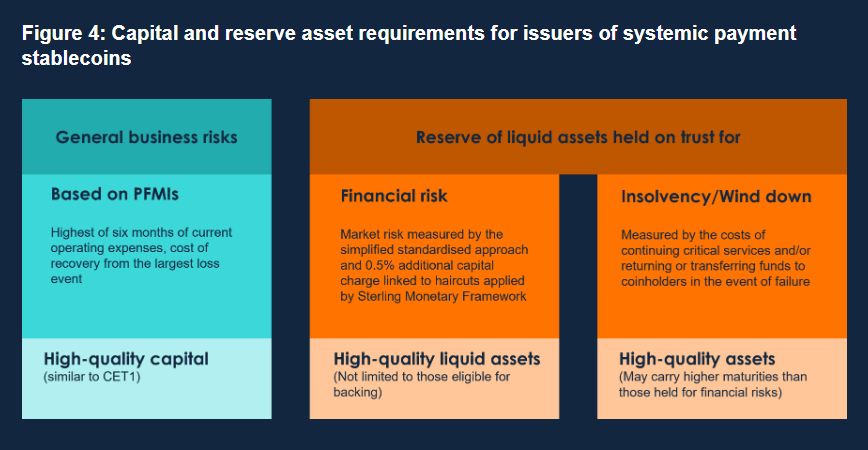
Capital and reserve asset requirements for stablecoin issuers (Source: BoE)
“The percentage would be reduced to 60% once the stablecoin reaches a scale where this is appropriate to mitigate the risks posed by the stablecoin’s systemic importance without impeding the firm’s viability,” the BoE added.
With regards to which stablecoin issuers and payment systems will be deemed systemically important, the BoE said that His Majesty’s Treasury will make the determination.
Alongside the holding restrictions and backing requirements, the BoE said it will grant issuers access to a deposit account at the central bank.
“We are also considering putting in place central bank liquidity arrangements to help backstop issuers’ ability to monetise those assets if needed,” the BoE said.
The consultation paper comes after the BoE’s Deputy Governor for Financial Stability, Sarah Breeden, said last week that the UK won’t be left behind in the global stablecoin race and pledged that the nation will move ”just as quickly as the US.”
Related Articles:
About Author

About Author