


Citadel Sparks Backlash After Urging SEC To Tighten Rules On Tokenized Equities
Market-making behomoth Citadel Securities was accused of ‘’coming for DeFi’’ after it urged the securities watchdog to enforce stricter regulation on tokenized equities.
In a letter to the Securities and Exchange Commission (SEC), Citadel said tokenized securities must operate under the same investor protections as traditional US equities, warning against broad exemptions for digital trading platforms.
The firm recommended that the SEC clearly define intermediaries trading tokenized equities as exchanges or broker-dealers and use formal rulemaking to ensure market efficiency and investor safety.
“Realizing the potential benefits of tokenization requires applying the key bedrock principles and investor protections that underpin the fairness, efficiency, and resiliency of U.S. equity markets, ” Citadel said in a letter to the SEC. “Ultimately, tokenized securities must succeed on the merits, rather than via regulatory exemptions.”
Citadel Recommends That DeFi Be Treated The Same Way As TradFi
Citadel stressed that “tens of millions of Americans” rely on the US equity market to secure their future retirements.
It said that it is “imperative that they continue to benefit from efficient and liquid markets,” while still being protected from “new risks that may emerge,” especially those associated with the trading of tokenized securities.
Citadel therefore recommended that the SEC identify the intermediaries that will be involved in the trading of tokenized US equities, which the firm believes meet the definition of an “exchange” or a “broker-dealer.”
Once those intermediaries have been identified, Citadel said the SEC should refrain from granting them “broad exemptive relief” from the “longstanding statutory definitions” of an exchange and broker-dealer.
In addition to that, Citadel said that the SEC should “pursue a path forward from a regulatory perspective that involves notice-and-comment rulemaking and a focus on improving clearing and settlement efficiency.”
Citadel Letter Draws Criticism From Crypto Community
Citadel’s recommendation drew sharp criticism from members of the crypto community.
Among them is Uniswap founder Hayden Adams, who accused Citadel’s CEO Ken Griffin of “coming for DeFi,” adding that he has made such recommendations to regulators for years.
Adams also included a snapshot of a section of Citadel’s letter that relates to fair access in the market. He said that the market-making giant has some “nerve” for trying to argue that there is “no way for DeFi protocols to provide ‘fair access’ of all things.”
“Makes sense the king of shady tradfi market makers doesn’t like open source, peer-to-peer tech that can lower the barrier to liquidity creation,’ Adams said.
Blockchain Association CEO Summer Mersinger also pushed back on the letter, urging the SEC to reject Citadel’s “overbroad and unworkable approach.”
Mersinger added that Citadel’s view that DeFi protocol developers, smart contract authors, and self-custody wallet providers should be treated as intermediaries “has no grounding in the Exchange Act, decades of Commission practice, judicial precedent, or the commonsense distinction between those who build software and those who custody assets.”
“Regulating software developers as if they were financial intermediaries would undermine US competitiveness, drive innovation offshore, and do nothing to advance investor protection,” Mersinger argued.
US Regulatory Agencies Push To Establish Crypto Framework
Citadel’s recommendation and the subsequent backlash come as the SEC works with other regulatory agencies to establish a framework for digital asset regulation in the US.
This year, both the SEC and the Commodity Futures Trading Commission (CFTC) have announced their own pro-crypto initiatives.
Senate lawmakers are also working on the CLARITY Act, which seeks to establish the role of each agency in regulating the crypto market.
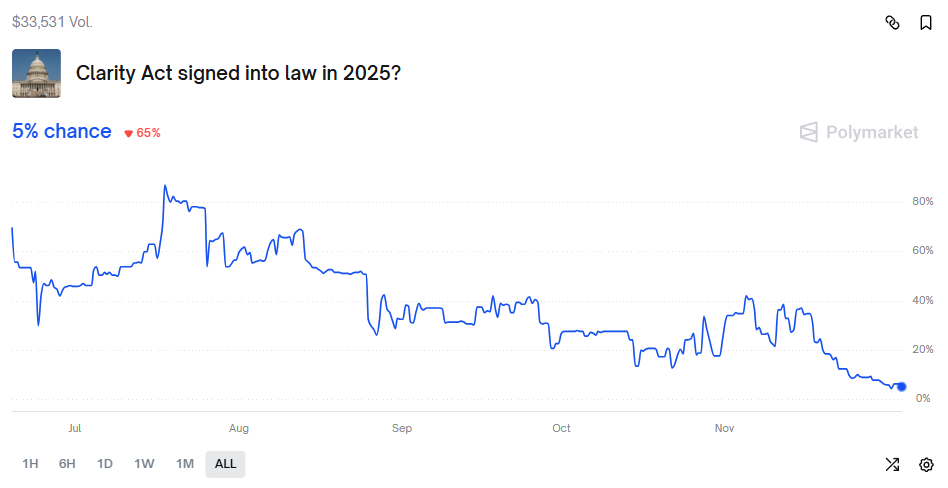
Odds that the CLARITY Act will be signed into law in 2025 (Source: Polymarket)
Recently, SEC Chair Paul Atkins said that he is advancing an “innovation exemption” for crypto firms in the US to encourage innovation while still protecting investors.
Related Articles:
About Author

About Author