


Crypto Sentiment Returns to Greed as Bitcoin Reclaims $97,000
Crypto sentiment flips to “greed” as Bitcoin reclaims $97,000. This shift marks the first major recovery in investor confidence since October’s $19 billion liquidation event rattled the market.
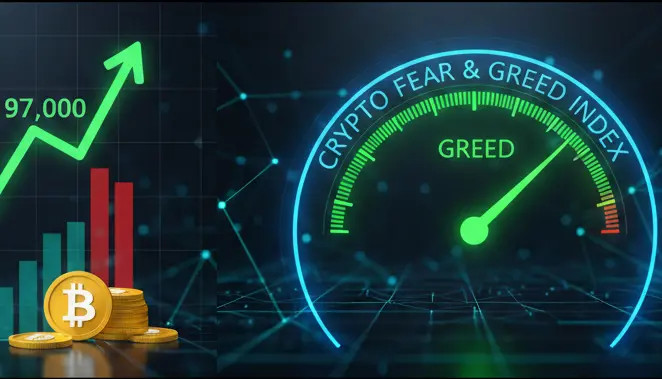
The cryptocurrency market has reached a major emotional turning point this week. For the first time since a massive $19 billion liquidation event shook investors in October, the Crypto Fear and Greed Index has moved back into “greed” territory.
This shift highlights a significant improvement in how investors feel about the market. It comes at a time when Bitcoin has staged a powerful recovery. This rally has helped erase much of the pessimism that defined the final months of last year.
In an update on Thursday, the index posted a reading of 61. This score reflects a growing sense of optimism among traders. Just a day earlier, the index stood at 48. That level placed the market in the “neutral” zone.
The jump from neutral to greed is a notable change in mood. It follows months where traders were very hesitant to take risks. The market had spent a long time stuck in “fear” or “extreme fear” levels. Now, that cloud of worry seems to be lifting.
The Crypto Fear and Greed Index is a tool that many market participants watch very closely. It acts as a barometer for the overall mood of the industry. It helps traders decide whether it is a good time to buy, sell, or wait on the sidelines.
To create this score, the index looks at several different factors. These include the price volatility of major coins and the total trading volume. It also looks at market momentum and what people are searching for on Google. Social media sentiment is another big part of the calculation. When all these things are combined, they provide a snapshot of the market’s psychology.
Recovering from the October Liquidation Crisis
The return to “greed” marks a sharp turnaround from the events of late last year. Crypto investor sentiment originally collapsed on October 11. On that specific day, $19 billion was liquidated from the digital asset market. This event caused a wave of panic.
Traders fled from altcoins as prices dropped rapidly. It led to a prolonged period of widespread pessimism. Many people were worried that the market would not recover for a very long time.
In the weeks that followed that crash, the index recorded some of its lowest readings ever. It fell into the low double digits multiple times during November and December. During those months, the market was defined by “extreme fear.”
Even as some prices tried to stabilize, investors remained very cautious. They were afraid that another big drop was just around the corner. The move to a score of 61 today shows that this deep caution is finally starting to ease. However, the market is still not at the levels of total euphoria seen during past bull runs.
This improvement in sentiment has happened at the same time as a strong Bitcoin rally. Over the past seven days, the price of Bitcoin has climbed significantly. It started the week around $89,799.
By Wednesday, it reached a two-month high of $97,704. These figures come from data provided by CoinGecko. This was a very important milestone for the market. It was the first time Bitcoin traded above the $97,000 mark since Nov. 14.
At the time of writing, Bitcoin was trading at $96,218. This represents a 1% increase over the last 24 hours. Interestingly, when Bitcoin was at these same prices in November, the sentiment index was in “extreme fear.” This was because the price was sliding down from its all-time highs at that time.
Today, the situation is different. The price is moving up, which has helped to stabilize confidence. Traders are still being careful, but they are much more hopeful than they were a few weeks ago.
Retail Investors and Exchange Data Show New Trends
While the “greed” reading shows growing optimism, it is not yet at a level of excessive risk-taking. Some data from inside the blockchain suggests that smaller investors are still being careful.
Analysts at the market intelligence platform Santiment shared some interesting findings on Wednesday. They posted on X that many Bitcoin holders have actually been reducing their exposure lately. This is happening even as the price of the coin goes up.
According to Santiment, there has been a net drop of 47,244 Bitcoin holders over the last three days. This suggests that some people are selling their coins. The analysts believe this is because “retail had been dropping out due to FUD & impatience.”
FUD stands for fear, uncertainty, and doubt. It seems that after months of waiting, some smaller investors are choosing to exit now that they can break even or make a small profit.
However, the analysts do not think this is a bad sign for the market. In fact, they view it as a positive signal. They stated, “When non-empty wallets drop, it’s a sign that the crowd is dropping out, a good sign.
Similarly, less supply on exchanges decreases the risk of a selloff.” This means that when the “crowd” leaves, the market often becomes more stable. The analysts also pointed out that there is currently a seven-month low of 1.18 million Bitcoin on exchanges.
When less Bitcoin is held on exchanges, it is usually considered a bullish indicator. It suggests that investors are moving their assets into private, long-term storage. They are less likely to sell their coins quickly if the coins are not sitting on an exchange ready to be traded.
This trend, combined with the rising price, points to a much better outlook for the market. Even though retail investors are leaving, the overall structure of the market seems to be getting stronger.
Stability Returns to the Broader Crypto Market
The total crypto market cap is now hovering near $3.26 trillion. This information comes from CoinMarketCap data. The market is showing modest daily gains after a recent period where prices pulled back.
Bitcoin is still the main asset setting the tone for everyone else. It is holding onto weekly gains of more than 6%. This is true even if the price movement on a minute-to-minute basis seems a bit slow right now.
Bitcoin’s dominance in the market has edged above 59%. This tells us that most of the money is still flowing into the biggest asset. It shows that capital is not yet rotating aggressively into smaller altcoins. Investors are feeling better, but they are still putting their money into the safest options available in the crypto world.
Ethereum has also done well, keeping pace with Bitcoin. It has climbed past $3,300 and has seen a weekly gain of over 6%. This shows that there is still plenty of confidence in major smart contract platforms.
Outside of the top two coins, the performance of the market is a bit mixed. Solana has been one of the strongest performers in the top ten list. It has seen its weekly advance grow to nearly 7%. Binance Coin has also held onto its gains quite well.
On the other hand, XRP has continued to lag behind the rest of the market. It has posted losses on both daily and weekly timeframes. This shows that not every coin is benefiting equally from the return of “greed.”
The overall sentiment indicators support a more balanced view of the market. While the Fear and Greed Index is at 61, the average crypto Relative Strength Index (RSI) is around 50. These numbers suggest that the market is not yet “overheated.” It is also not “oversold.”
This kind of middle-ground condition often leads to a consolidation phase. This is a time when prices stay in a specific range before making their next big move. For now, the market looks healthy but restrained. Bitcoin’s ability to stay at these high levels is the most important factor to watch next.
The recent shift highlights how quickly the mood can change in the world of digital assets. We have moved from a total washout in October to a state of greed in January. Traders are now watching to see if this momentum can be sustained.
If Bitcoin stays strong, the rest of the market may eventually follow. For now, the return of greed is a sign that the worst of the recent downturn may be behind us.
About Author

About Author