


Elixir Halts deUSD Stablecoin After Stream Finance’s $93M Collapse Sparks Market Turmoil
This has sparked a massive DeFi fallout and exposed risks in synthetic stablecoins.
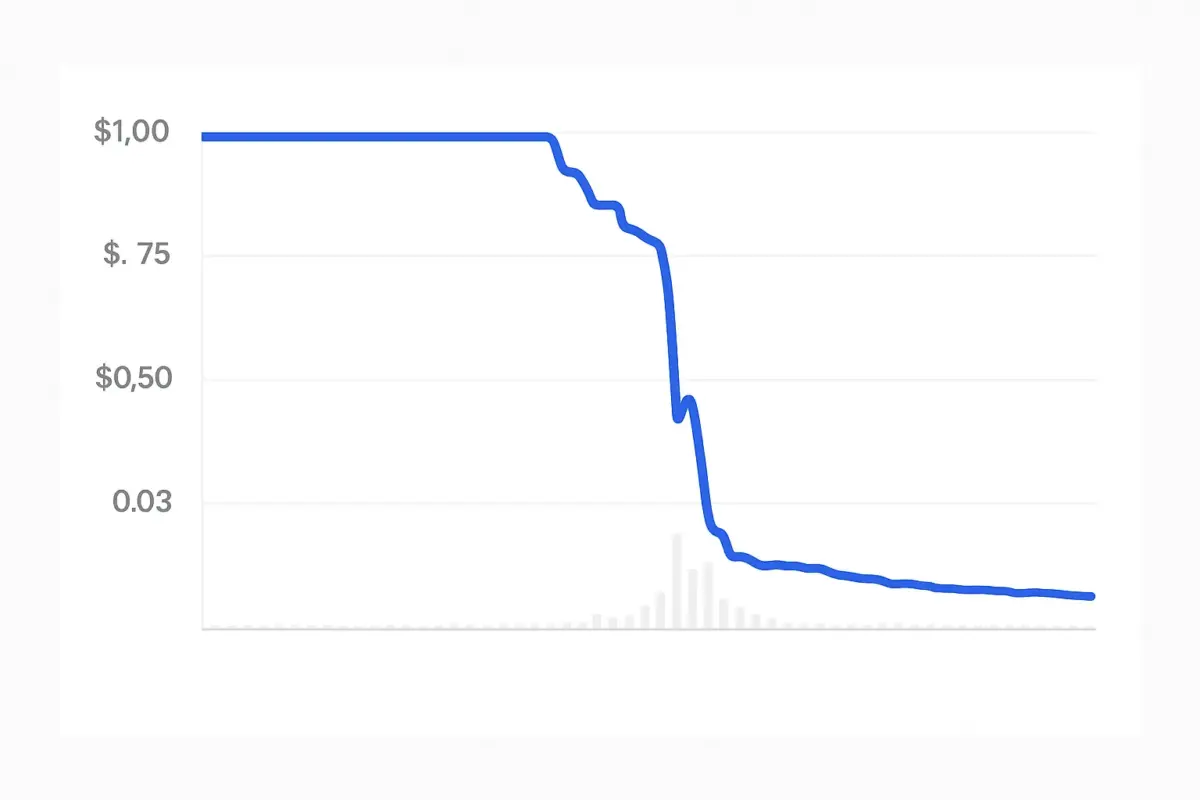
Decentralized finance liquidity provider Elixir has suspended its synthetic stablecoin deUSD after devastating losses at Stream Finance triggered a chain reaction across the DeFi ecosystem.
Earlier this week, Stream disclosed a $93 million loss tied to one of its external fund managers, an event that left it with an estimated $285 million in debt, including $68 million owed to Elixir.
In a post on X, Elixir confirmed it had already processed redemptions for 80% of all deUSD holders, but the stablecoin still lost its peg to the U.S. dollar, crashing to just 1.5 cents according to CoinGecko. The firm attributed the collapse primarily to Stream’s failure to settle debts and repay loans used to back its own stablecoin, Staked Stream USD ($XUSD).
Stream halted withdrawals on Tuesday, announcing that all deposits and redemptions were suspended while lawyers from Perkins Coie LLP investigated the fund manager’s loss. “Until we are able to fully assess the scope and causes of the loss, all withdrawals and deposits will be temporarily suspended,” Stream said in a statement posted on X.
The disruption caused XUSD to depeg as well, tumbling as low as $0.10, while Elixir’s deUSD lost nearly 98% of its market value. Data from PeckShield shows deUSD fell to $0.03 early Friday morning. Analysts said the sudden collapse underscores how interconnected DeFi projects remain vulnerable to cascading failures.
Elixir’s deUSD had launched in July 2024, aiming to rival Ethena Labs’ USDe as a leading synthetic stablecoin. Before the crash, its market capitalization hovered around $150 million.
Elixir explained that Stream held roughly 90% of the remaining deUSD supply, worth about $75 million. The company accused Stream of refusing to close its loan positions, forcing Elixir to coordinate with decentralized lenders such as Euler, Morpho and Compound to help redeem users. “We still believe this will be honored 1 for 1,” Elixir stated, though it also confirmed disabling withdrawals to “remove any risk of Stream liquidating deUSD before repaying their loan.”
How a Vulnerability in Balancer Triggered the Domino Effect
Investigations have since revealed that a vulnerability in Balancer, a DeFi protocol integrated into Stream’s liquidity strategy, may have contributed to the disaster. According to security firm Decurity, the bug exploited Balancer’s internal swap logic and rounding-down error in the batchSwap function. The flaw enabled attackers to drain funds through a UserBalanceOpKind.WITHDRAW_INTERNAL operation.
PeckShield and Decurity both confirmed that a faulty access control mechanism in Balancer’s manageUserBalancefunction failed to verify message senders properly. This allowed unauthorized withdrawals directly from Balancer’s vaults.
The result was catastrophic. Staked Stream USD (xUSD), another asset linked to Stream, lost its peg and plunged to $0.50, then $0.14 within a day, data from CoinGecko shows.
According to the DeFi research group Yields and More (YAM), Stream’s exposure spanned multiple protocols, including Euler, Morpho, Silo, and Gearbox. YAM’s analysis estimated nearly $285 million in debt owed to these lenders. Among the hardest hit were TelosC, Elixir, MEV Capital, and Varlamore, all of which had collateral positions tied to Stream’s operations.
Blockchain analytics firm Nansen AI found that around 65% of deUSD’s collateral was allocated to Stream Finance, representing two-thirds of its total reserves. When Stream froze withdrawals, Elixir effectively lost access to most of its backing, leaving it unable to maintain the stablecoin’s dollar peg.
On-chain data reviewed by PeckShield showed Stream’s wallets dumping large quantities of deUSD on decentralized exchanges in a last-ditch effort to liquidate holdings. One wallet, 0xcb4a7b790edb7fa3e2731efd7ed85275f92fc74a, was observed selling deUSD for USDT on Curve Finance.
This selling spree pushed deUSD’s price from $1 to $0.40, before briefly rebounding to $0.99. It then collapsed again, bottoming out at $0.03.
“Curve-based dumping looks like a desperate attempt to liquidate before insolvency proceedings begin,” said Param.eth, a contributor to zKPass and Ethereum smart contract developer.
Amid the chaos, Elixir reassured users that it had taken a snapshot of all deUSD and sdeUSD holder balances and would open a claim page for compensation. “To protect the interest of these holders, a snapshot has been taken, and a claim page will go live later today,” the company wrote in its Thursday statement.
Despite the turmoil, Elixir reiterated its commitment to working with other DeFi protocols to reimburse users. “Coordination with affected parties is underway to address shortfalls,” it said. However, no timeline has been given for when full redemption might be possible.
Total Value Locked (TVL) on Elixir fell by more than $200 million in the aftermath. The event also rattled confidence across the broader stablecoin market, raising new questions about the sustainability of synthetic dollar-backed assets in decentralized finance.
Regulatory Moves and Stablecoin Ambitions in a Changing Landscape
While Elixir and Stream battle the fallout, stablecoin regulation has entered a new phase in Washington. Earlier this year, President Donald Trump signed the GENIUS Act, a landmark law designed to establish a comprehensive regulatory framework for payment stablecoins in the United States. The act aims to ensure that all stablecoins are “fully backed with cash and high-quality liquid assets.”
As U.S. agencies draft enforcement guidelines, Circle, the issuer of $USDC, has urged the Treasury Department to maintain “equal regulatory treatment for banks, nonbanks, and stablecoin issuers.” In a letter submitted during the Treasury’s consultation process, Circle emphasized that “regulatory standards must apply uniformly across all types of issuers – bank, nonbank, domestic and foreign – to prevent regulatory arbitrage.”
Circle also called for coordinated supervision with international regulators, arguing that a consistent framework would “promote competition and preserve market integrity.”
Coinbase weighed in as well, asking regulators to limit the ban on interest-bearing stablecoins to issuers only, allowing exchanges to keep offering yield products. The exchange argued that such a distinction would preserve innovation while ensuring consumer protection.
Although the GENIUS Act has been enacted, it won’t take effect until either 18 months after its passage or 120 days following the final regulatory approval. Lawmakers are still debating enforcement details as part of the Treasury’s second round of public comments.
In Europe, major banks have reportedly begun exploring their own stablecoin initiatives, encouraged by the U.S. government’s forward stance. Analysts say the move reflects both admiration and concern over the dollar’s growing digital dominance.
As global institutions prepare to issue stablecoins, many see this as a pivotal moment in the race for financial influence. Federal Reserve Governor Christopher Waller noted, “If regulators allow these things to go out, this will only strengthen the dollar as a reserve currency.” Secretary Scott Bessent echoed this view, adding, “We are going to keep the U.S. dollar the dominant reserve currency in the world, and we will use stablecoins to do that.”
For developing economies, stablecoins offer more than just access to the dollar, they offer access to opportunity. Across Africa and Asia, millions of unbanked citizens are using dollar-backed stablecoins for remittances, savings, and trade. In Kenya, one pilot project reduced cross-border payment fees from 28.8% to just 2%, proving that digital dollars can deliver tangible economic benefits.
Even as central banks experiment with their own CBDCs, adoption has been lukewarm. Nigeria’s eNaira, for instance, has seen minimal user engagement, while stablecoins like USDT and USDC remain widely used.
The rise of stablecoins underscores a global shift in finance, one that merges technology, monetary power and inclusion. For the U.S., this could mean reinforcing its currency’s global status. For emerging markets, it could mean access to a more stable economic lifeline.
But for Elixir, the message is simpler: the DeFi world remains fragile. When one major player falls, even the most promising digital dollars can crumble overnight.
About Author

About Author