


Next Crypto to Explode? LiquidChain Targets Fragmentation as BlackRock Moves More Funds On-Chain

BlackRock is widening its push into blockchain-based finance, with the asset manager introducing two new tokenized money-market offerings designed to hold short-term government debt and potentially serve as reserve assets for permitted US stablecoin issuers, according to CoinDesk. The move puts another slice of traditional finance onto digital rails.
However, more assets moving on-chain does not automatically create one connected market. Tokenized funds can still sit inside separate systems, just as liquidity remains divided across Bitcoin, Ethereum, Solana, and their respective applications. Issuance is advancing faster than interoperability.
Which is why there is a need for interoperability standards, as mooted by new presale LiquidChain (LIQUID), a Layer 3 project designed to connect activity across BTC, ETH, and SOL.
LIQUID, priced at $0.0148, has quickly raised $920,000+, with early holders earning 1,215% APY through early doors staking. The rate will drop over time, but the more durable appeal lies in making several large crypto economies easier to use together.
Tokenization Creates More Assets – and More Silos
BlackRock’s new offerings add to the surge of funds, deposits, bonds, and other financial products onto blockchain infrastructure. But the risk is that finance simply recreates its old divisions in a new format.
A tokenized product available through one network or platform may remain difficult to use elsewhere. Capital can technically be on-chain while still sitting inside a closed pool, unable to reach the applications, buyers, or collateral markets where it could become more useful.
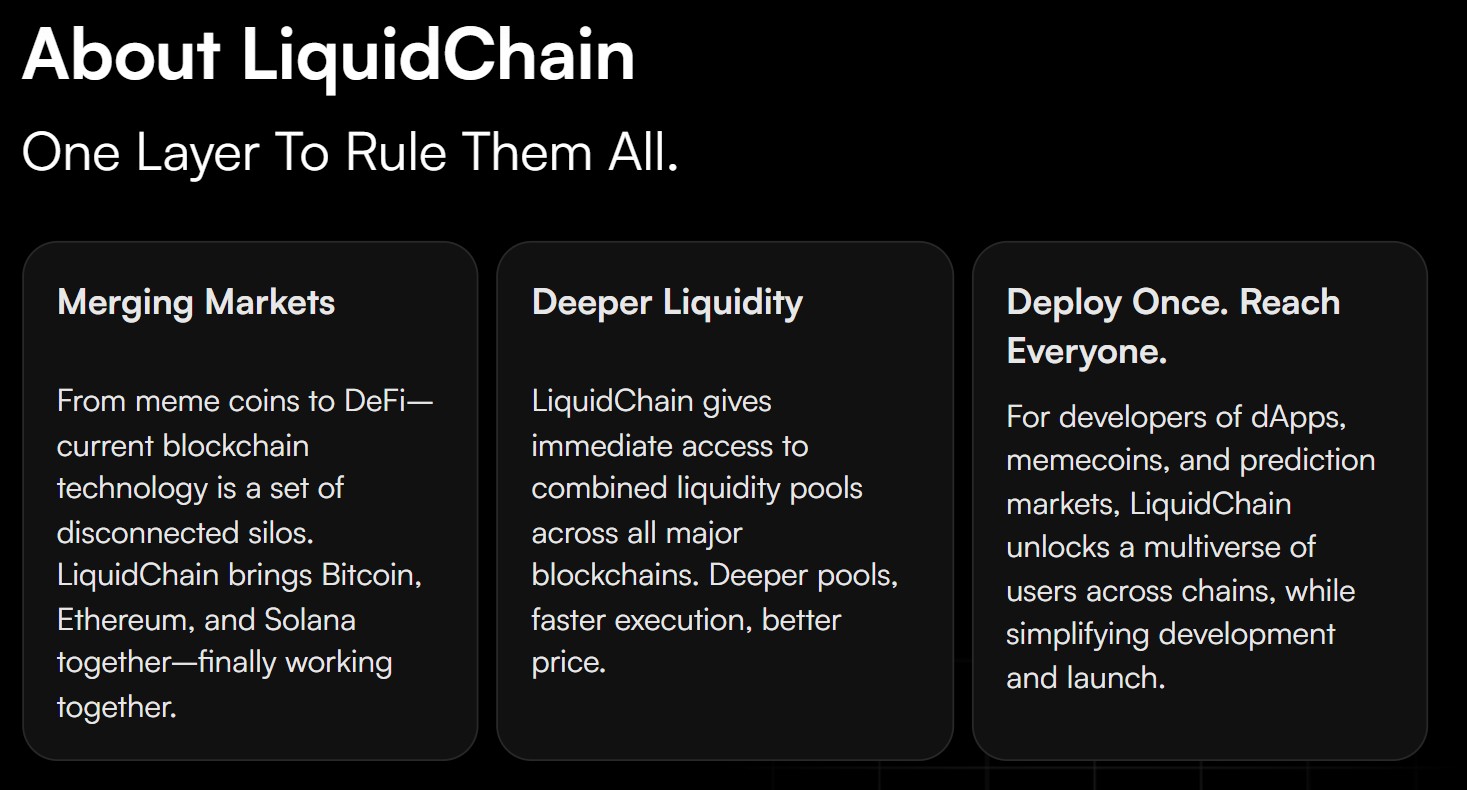
LiquidChain’s proposition is easier to understand through what it removes – barriers. Today, someone trying to use assets across Bitcoin, Ethereum, and Solana may need several wallets, bridge transactions, wrapped tokens, and separate applications. Developers often have to build and maintain different versions of the same product for each network.
LiquidChain plans to place a common execution layer above the three ecosystems: It verifies activity on their underlying networks, then lets applications use that information in one place. The whitepaper describes unified pools where assets associated with BTC, ETH, and SOL can contribute to the same cross-chain markets.
A decentralized exchange can therefore reach liquidity from several ecosystems instead of relying on one isolated pool. A lending application can connect borrowers and collateral that currently sit on different chains. And a developer can deploy one product with access to users across all three blockchains, without continually supporting different codebases and standards.
Transactions involving multiple networks are designed to settle as one complete operation – every linked step succeeds, or nothing is finalized. Users don’t need to care about the underlying chain, and neither do the devlopers.
Why LIQUID Could Benefit From the On-Chain Finance Race
BlackRock’s move to offer tokenized access to a European money-market-fund range holding roughly $311 billion show how rapidly the range of blockchain-based assets could grow. As banks and asset managers create more tokenized products, the value of infrastructure capable of connecting separate markets will rise alongside them.
LiquidChain begins with public crypto networks: Bitcoin contributes capital, Ethereum brings established financial applications, and Solana supplies high-speed execution. A Layer 3 unites them into the equivalent of one chain.
LIQUID, as a token, is used for networks and execution fees, liquidity staking, and shared yield strategies once the network is live.
That gives the token a route to demand through usage – more users produce more transactions, and more transactions increase the need for network fees and liquidity. The commercial challenge is getting enough developers and capital into the system for those effects to reinforce one another, but the early presale start, and audited contracts, suggests demand is there and LiquidChain is on the right path.
The current 1,215% staking APY is likely to fall as participation grows, so it is better viewed as an early-stage incentive than a permanent return. The project’s $929,000 raise also leaves LiquidChain at an earlier point than presales valued in the tens of millions.
That combination brings risk, but it gives LIQUID room to gain attention through 2026 and 2027 if cross-chain infrastructure moves closer to the center of the market.
The Next Stage Is About Connection
Putting conventional assets on-chain is a major change. Making those assets usable across a broader digital economy could be the harder – and more valuable – step.
Crypto lacks a natural way to treat capital as parts of one market, and LiquidChain looks to solve that without asking Bitcoin, Ethereum, or Solana to surrender the qualities that make each one useful.
That is the case for LIQUID as the next crypto to explode: it is connective infrastructure for a financial system that is becoming more tokenized and more fragmented at the same time.
About Author

About Author