


Ethereum Price Plunges 10% As BitMine’s Tom Lee Blames Market Makers For Rout

The Ethereum price plunged 10% over the past 24 hours to trade at $2,681 as of 4.59 a.m. EST on trading volume that jumped 37% to $51 billion.
Tom Lee, chairman of ETH treasury firm BitMine Immersion Technologies and co-founder of Fundstrat Global Advisors, has pinned the blame for the selloff squarely on beleaguered market makers.
Speaking on CNBC, Lee described the recent market slump as a temporary “quantitative tightening” effect in crypto, stemming from a liquidity squeeze rather than economic headwinds such as the Federal Reserve’s stance on interest rates.
Ethereum, the second-largest crypto by market cap, has plummeted over 25% since its early October peak to trade below $3,000 amid heightened volatility.
Lee attributes this to the aftermath of a massive liquidation event on October 10, which inflicted deep “holes” in the balance sheets of major market makers.
“When a market maker has a hole on their balance sheet, they seek to raise capital and reduce liquidity functions,” Lee said. “This QT effect dampens prices similar to 2022, when it lasted 6-8 weeks. We’re only six weeks in.”
Despite the pain, Lee remains bullish on ETH’s long-term trajectory. He envisions it as the backbone of a “supercycle” fueled by stablecoins, prediction markets, and asset tokenization of equities, real estate, and beyond.
“Ethereum is the rails where Wall Street will build,” he said, emphasizing that the current cycle has not peaked.
Under Lee’s leadership, BitMine is voting with its wallet. The firm, originally a mining operation, is now the biggest ETH digital asset treasury.
It announced another $49 million ETH buy on November 20, boosting its holdings to nearly 3.6 million tokens, or 2.9% of ETH’s total supply.
Ethereum Price Pulls Back As Major Support Zone Retested
After rallying strongly throughout mid-2025, the ETH price began to show signs of exhaustion near the upper resistance zone between $4,800 and $4,950, forming a gradual rounded top that hinted at waning bullish momentum.
Such a shift became pronounced once the Ethereum price broke below the $4,400 support cluster, which had previously underpinned its late-summer advance. The breakdown triggered a sustained decline, with Ethereum sliding into a clear bearish retracement as volatility increased and buyers failed to regain control.
As the price of ETH continued to weaken, it was rejected from the region around the 50-day SMA, near $3,840, reinforcing the bearish sentiment. Shortly afterward, Ethereum slipped below the 200-day SMA around $3,080, deepening the correction.
Following the breakdown, the price of Ethereum descended toward a major horizontal demand zone between $2,450 and $2,650, an area that acted as a pivotal base several times over the past year.
At the same time, the Relative Strength Index (RSI) has fallen to around 29, entering oversold territory. While this reading indicates that bearish momentum remains dominant, it also suggests that ETH may be approaching an inflection point where buyers could step in.
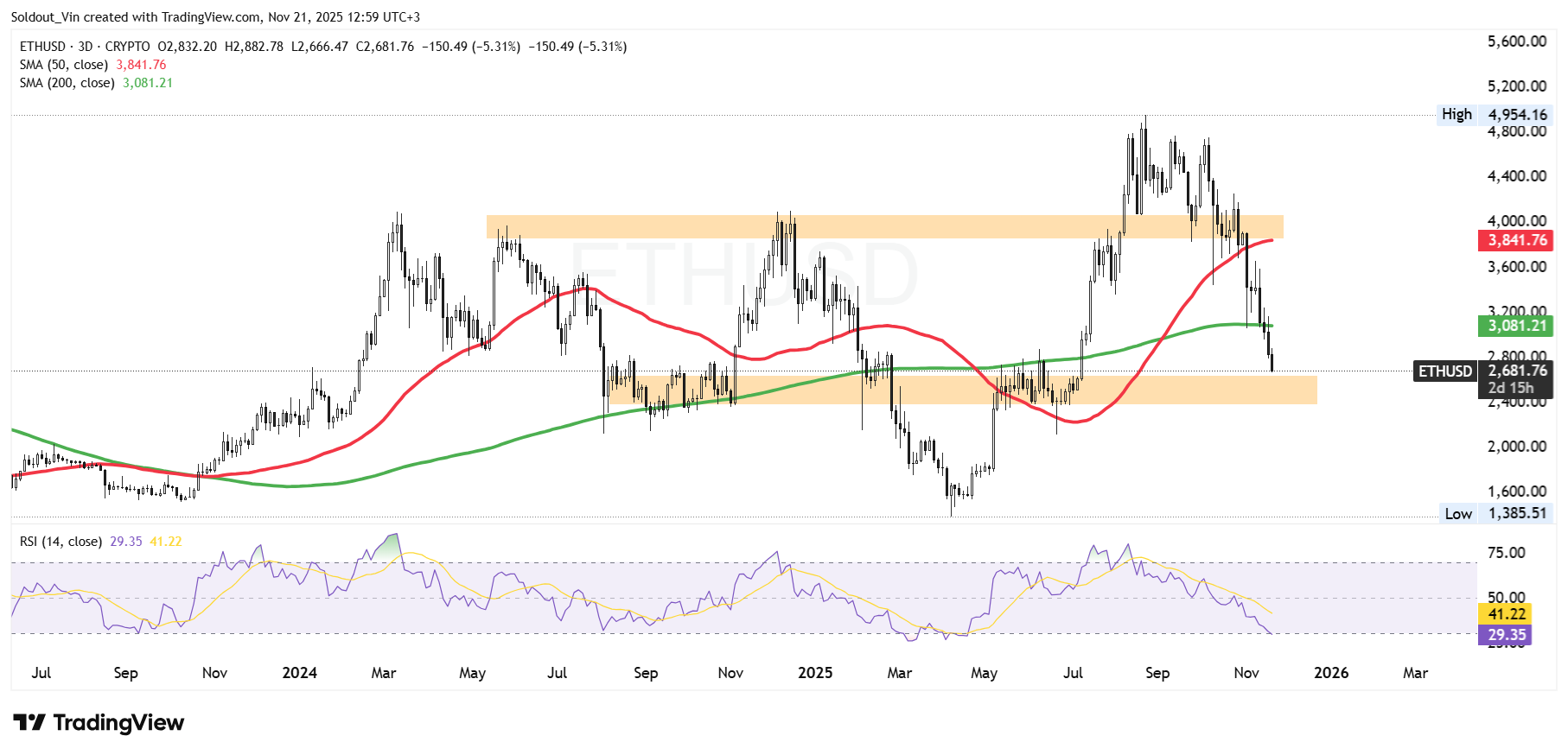
If the $2,650 support range continues to hold, ETH may attempt a relief rally toward the 200-day SMA near $3,080, with a possible extension to the 50-day SMA at $3,840. A successful reclaim of these levels would significantly improve bullish prospects.
However, failure to defend current support could expose Ethereum to a deeper correction, with potential targets near $2,300 and even $2,000 if selling pressure resumes.
About Author

About Author