


Italy Warns Crypto Firms To Meet Dec. 30 MiCA Deadline Or Shut Down
Italy’s financial regulator, Consob, has issued a reminder to crypto companies and investors of a Dec. 30 deadline to comply with Europe’s Markets in Crypto-Assets Regulation (MiCA) framework.
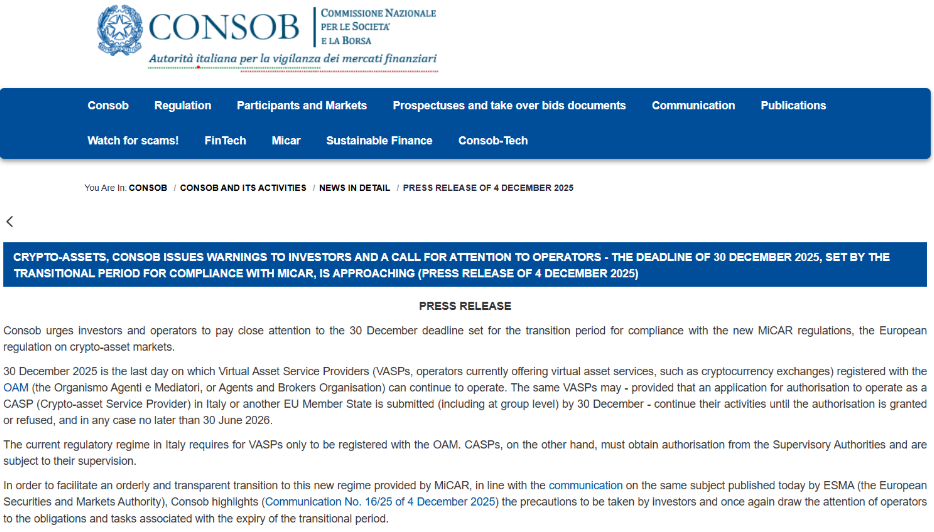
Under the current MiCA transition rules, virtual asset service providers (VASPs) are only permitted to continue operating until the cutoff date.
That is unless they file an application to become a licensed crypto-asset service provider (CASP) in Italy or any other EU member state, according to a Consob statement.
Italy sets hard stop for MiCA authorization (Source: Consob)
Crypto Firms Can Operate While They Apply For A CASP License
Under Italy’s current regime, VASPs only have to register with the Organismo Agenti e Mediatori (OAM), which is the national agents and brokers body. CASPs, on the other hand, have to obtain full authorization from supervisory authorities and are subject to ongoing oversight.
Firms that are not yet registered as CASPs and submit an application to regulators before Dec. 30 will be allowed to operate until their authorization is approved or rejected, but no later than June 30, 2026.
Companies that do not intend to comply with MiCA authorization are instructed to cease their operations by Dec. 30.
They will also need to return all crypto-assets and funds to customers, as well as discontinue any related services such as the custody and administration of crypto assets.
VASPs are required to signal their intention to customers on their website, the financial watchdog said in its statement.
Regulators Told To Pay Close Attention To Firms That Submit Last Minute Applications
Consob’s reminder comes the same day as a separate statement by the European Securities and Markets Authority (ESMA), which is coordinating the EU-wide MiCA transition.
ESMA had published a timeline for the transition on Oct. 17, 2023. On Dec. 17 last year, it published a statement on MiCA that said the non-unified approach to transitional periods foreseen by “Article 143(3) of MiCA” resulted in “different transitional periods applicable across the EU Member States.”
Given that there are different timelines across EU member states, ESMA said that market participants have “by now had time to benefit from these transitional periods” and engage with national competent authorities (NCAs) of the jurisdictions in which they operate.
It warned that local regulators treat “last minute” applications “with considerable caution and assess their compliance with MiCA.”
ESMA concluded its statement by warning investors that not all crypto firms operating in the EU after the transitional period cutoff date may be MiCA compliant. In order to “benefit from the protections afforded by MiCA,” investors can search for the firm in the ESMA Interim MiCA Register.
Crypto’s Growing Interconnections With The Financial System Pose Risks
As the Dec. 30 deadline looms and firms rush to get their applications submitted before the cutoff date, Italy’s Committee for Macroprudential Policies met earlier this week to review potential financial stability risks.
The Committee, which includes the Bank of Italy, Consob, IVASS, COVIP and the Treasury, said in a press release that vulnerabilities linked to crypto assets could be increasing due to “growing interconnections with the financial system” and a non-unified global regulatory framework for crypto.
That echoes concerns expressed by the European Central Bank relating to stablecoins. The ECB said that the growth of USD-pegged stablecoins should be monitored closely.
“Significant growth in stablecoins could cause retail deposit outflows, diminishing an important source of funding for banks and leaving them with more volatile funding overall,” the ECB said.
About Author

About Author