


PBOC To Let Commercial Banks Pay Interest On Digital Yuan Holdings Under New Framework

China’s central bank will soon let commercial banks pay interest on digital yuan holdings as part of a major overhaul of the token’s framework.
The deputy governor of the People’s Bank of China (PBOC), Lu Lei, wrote in an article published by the state newspaper Financial News that the digital yuan (e-CNY) will begin to function as a “digital deposit currency” under the new framework. This framework will come into effect on Jan. 1, 2026.
Once the new system is in place, banks will be able to pay interest on verified digital yuan wallets in line with existing self-regulator agreements on deposit pricing. Digital yuan balances will also receive the same level of protection as traditional deposits under China’s deposit insurance system.
What’s more, the new policy grants banks greater flexibility to manage digital yuan balances as part of their broader asset-liability operations.
New Digital Yuan Framework Follows A Decade Of Experimentation
The new framework for the digital yuan, which is a central bank digital currency (CBDC), comes after a decade of experimentation and pilot programs, according to the PBOC governor.
In the report, Lei said that the research and development of the digital yuan started around 2014, when the PBOC launched theoretical research and closed testing for the initiative under the unified deployment of the CPC Central Committee.
In 2016, the PBOC went on to propose a theoretical framework for a legal digital currency. During this time, the central bank also started to pilot the management system and operating mechanism of the digital yuan.
After several demonstrations and open pilots, “a preliminary ecosystem for the digital yuan has been established,” the PBOC governor said.
That has “forged a development path for digital currency with Chinese characteristics” that is led by the PBOC, relies on commercial financial institutions and existing payment systems, and integrates “the latest technological advancements,” Lei added.
Additionally, domestic and cross-border trials and promotion of the digital yuan have “achieved positive results.”
Digital Yuan Faces Tough Competition From Mobile Payment Platforms
The e-CNY is regarded as one of the most advanced CBDCs in the world.
Despite the government introducing various measures to support the digital yuan’s rollout since the official pilot started in 2019, adoption for the token has been slow.
That’s mainly due to the strong competition that the digital token faces from popular mobile payment platforms such as WeChat Pay and Alipay. Both of these applications dominate the country’s cashless transaction landscape.
As of Aug. 3, Alipay held about a 54% market share while WeChat Pay had about a 42% share of the market, according to CoinLaw.
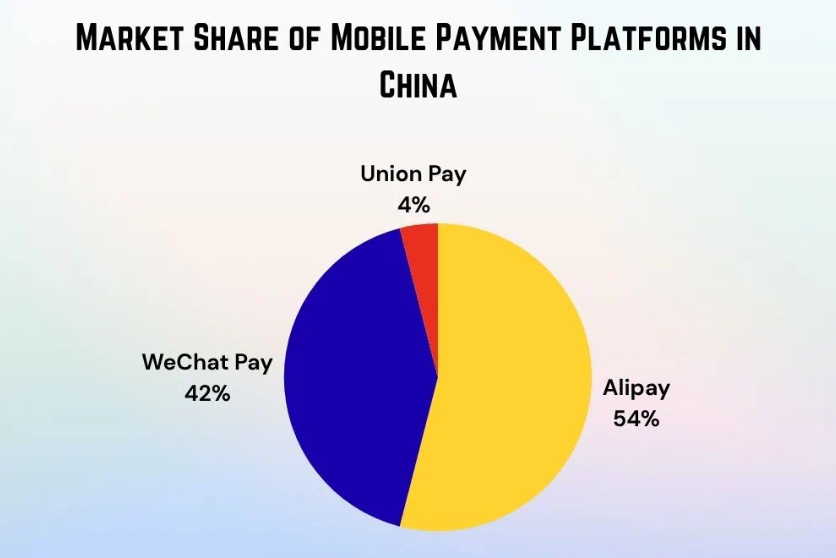
Market share of mobile payment platforms in China (Source: CoinLaw)
Despite the adoption challenges, the e-CNY has processed 3.48 billion transactions worth a cumulative 16.7 trillion yuan ($2.38 trillion) as of November 2025, Lei said. 230 million personal wallets and around 18 million corporate wallets have been opened through the digital yuan’s app as well.
The PBOC governor also said that 4,047 cross-border payments with a cumulative transaction amount equivalent to 387.2 billion yuan were processed via the multilateral central bank digital currency bridge. Of this total, the e-CNY accounted for about 95.3% of the transaction amount across all currencies.
Related Articles:
About Author

About Author