


Shakeout Looms As mNAV Collapse Puts Treasury Firms At Risk, Standard Chartered Says
Standard Chartered says collapsing market net asset values (mNAVs) may spark consolidation among Digital Asset Treasury firms (DATs), leaving only the fittest to survive.
The bank said the recent suppression of companies’ mNAVs is being driven by market saturation, growing investor caution, unsustainable business models, and the rapid expansion of Ethereum (ETH) and Solana (SOL) treasury strategies.
Some Treasury Firms See mNAVs Drop Below Critical Level
mNAV is the ratio between the total market cap of a treasury company, like Strategy or Metaplanet, to the total asset holdings of these companies.
Usually, an mNAV above 1 enables the firm to issue new shares in order to continue its crypto accumulation.
But a drop below this threshold makes it more difficult, and less prudent, for the company to grow its holdings.
After tracking high-profile DATs such as Strategy, BitMine Immersion Technologies, SharpLink Gaming, Upexi, and DeFi Development Corp, Standard Chartered said in its report that a number of these companies have already seen their mNAV dip below 1.
If mNAVs remain low, Standard Chartered warned that the DAT sector might enter into a consolidation phase.
“The recent collapse in DAT mNAVs will likely drive differentiation and market consolidation,” the bank wrote. “Differentiation will favour the largest in breed, cheapest funders and those with staking yield.”
In such a scenario, it said large players could opt to acquire smaller rivals that are trading at discounts.
Even if that happens, Standard Chartered says it will only result in a rotation of crypto and not necessarily lead to increased demand for digital assets.
DATs With Staking Yields At An Advantage Over BTC Rivals
During that potential consolidation period, Standard Chartered says the industry will undergo a shakeout. Success during this period, the bank argued, will depend on three factors: the ability to raise cheap funding, scale that attracts liquidity, and the generation of staking yield.
The bank subsequently said that DATs built around Solana (SOL) and ETH have an advantage over Bitcoin-focused firms because they can generate a yield through staking.
That’s because Bitcoin runs on the Proof of Work (PoW) consensus mechanism, while Solana and Ethereum run on the Proof of Stake (PoS) consensus mechanism.
The latter offers validators rewards that are paid out in tokens. Several treasury companies have opted to stake their tokens for additional revenue, which increases the crypto per share for investors.
While both SOL and ETH can offer investors staking yields, Standard Chartered said that Ethereum treasury firms are better placed to maintain demand given the combination of staking rewards, a clearer regulatory outlook, and aggressive accumulation strategies by firms such as BitMine and SharpLink.
Those companies are the largest ETH treasury firms globally. Data from StrategicETHReserve shows that BitMine leads with its 2.15 million ETH reserves valued at $9.69 billion.
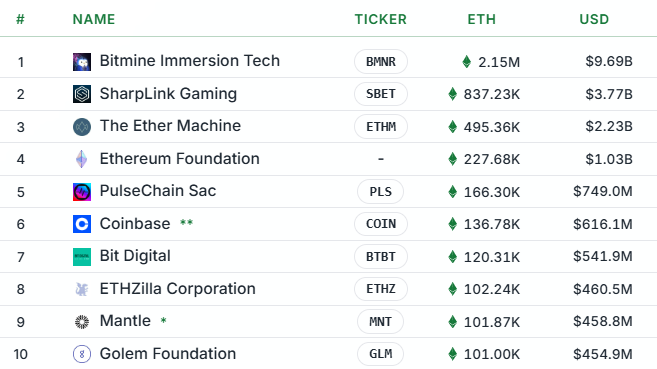
Top ten ETH treasury firms (Source: StrategicETHReserve)
Meanwhile, SharpLink Gaming comes in second with around 837.23K, valued at approximately $3.77 billion, on its balance sheet.
Related Articles:
About Author

About Author