


Stablecoin Issuers Must Offer Yields To Compete, Ex-Standard Chartered Exec Says
Stablecoins must offer yields if they are to remain competitive, said Will Beeson, the former head of tokenized asset infrastructure at Standard Chartered.
“In a competitive market with others issuing their own stablecoins, you end up in a situation where you’re looking for ways to incentivize users to use your stablecoin,” Beeson told Decrypt. “The ability to pay yield would be an important way to do that.”
Stablecoins Are Not Allowed To Offer Yields Directly To Holders, But There Are Workarounds
Beeson’s comments come after US President Donald Trump signed the GENIUS Act into law in July.
It offers the first comprehensive regulatory framework for payment stablecoins, and requires issuers to maintain a 1:1 backing with low-risk liquid assets, such as US Treasury bills.
The act also establishes licensing and regulatory requirements for both domestic and offshore stablecoin issuers.
Following the Act’s signing, the stablecoin market has grown steadily. Data from DeFiLlama shows the market’s capitalization has climbed from $260.715 billion on July 18, when the GENIUS Act was signed by Trump, to over $286.222 billion today. This is after a more than $1.638 billion increase in the last week.
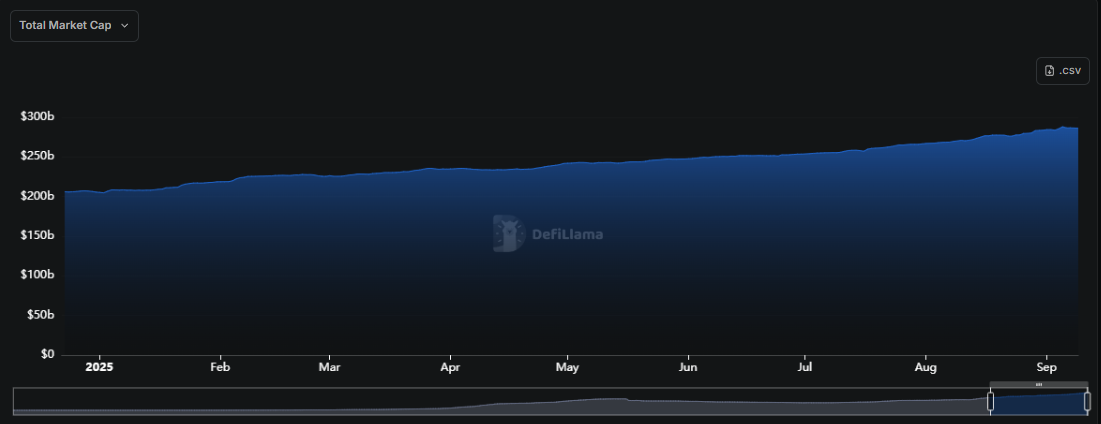
Stablecoin market cap (Source: DefiLlama)
One restriction with the GENIUS Act, however, is that issuers are prohibited from offering their token holders yields directly.
But the bill does not prevent intermediaries or third parties from paying incentives, presenting stablecoin issuers with a potential workaround, according to Beeson.
Coinbase has already taken advantage of that loophole, and currently pays interest on USD Coin (USDC) balances on its platform in Circle’s stablecoin.
Banks Press Congress To Completely Restrict Yields
The current regulatory gap with regards to yields being offered to stablecoin holders via third parties is being contested by the banking industry.
In an Aug. 12 letter to Congress, the Bank Policy Institute and four other major trade groups cited a report from the US Treasury Department that said yield-bearing stablecoins could drain as much as $6.6 trillion from the US deposit system.
“With affiliates of stablecoin issuers or exchanges still being able to pay interest on stablecoins, the risk of significant deposit flight is even greater,” they wrote in the letter.
According to Beeson, the calls from the banking sector to completely close the door on stablecoin yields is not solely due to potential systemic risks, but has more to do with fears that yield-bearing stablecoins might be seen as a more attractive savings tool than low-yield bank deposits.
Crypto groups, including the Blockchain Association and the Crypto Council for Innovation, responded with a letter of their own on Aug. 20.
The groups wrote that the banking sector’s claims that yield-bearing stablecoins could drain as much as $6.6 trillion from the banking sector “does not hold up to scrutiny.”
“Allowing responsible, robustly regulated platforms to share benefits with customers is not a loophole – it is a feature that promotes financial inclusion, fosters innovation, and ensures American leadership in the next generation of payments,” they wrote.
Related Articles:
About Author

About Author