


Strategy Won’t Issue Preferred Equity In Japan In Next 12 Months, Giving Metaplanet A Head Start

Bitcoin maxi Michael Saylor says that his firm Strategy will not launch a preferred equity offering in Japan in the next 12 months, giving fellow corporate BTC buyer Metaplanet a head start.
Both Strategy and Metaplanet are among the top five biggest corporate BTC investors. Strategy leads the market overall, while Metaplanet is ranked at number 4 globally and number 1 in Asia, data from Bitcoin Treasuries shows.
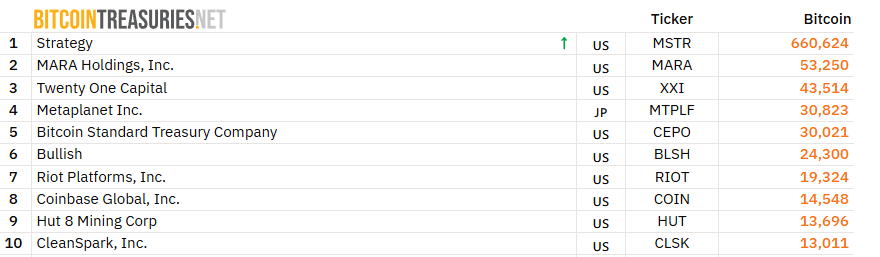
Top 10 largest corporate BTC holders (Source: Bitcoin Treasuries)
Metaplanet Moving To Introduce Its Own Digital Credit Instruments In Japan
Saylor was asked the question by Metaplanet CEO Simon Gerovich during the Bitcoin MENA conference.
Saylor’s answer was, “not in the next twelve months, I will give you a twelve month head start.”
Gerovich had asked the question as Metaplanet moves to introduce its own digital credit instruments into Japan’s perpetual preferred market.
Currently, Japan only has five listed perpetual preferred equities, according to Gerovich. Metaplanet now aims to offer the sixth and seventh with its new “Mercury” and “Mars” instruments.
Gerovich described Metaplanet’s Mercury offering as his firm’s equivalent to Strategy’s STRK. The offering pays investors 4.9% in yen and also comes with convertibility.
Gerovich compared that yield to the close-to-zero or roughly 50bps yields offered by Japanese bank deposits and money market funds, noting that Metaplanet’s offering pays out ten times more.
The second instrument, Mars, is designed to mirror Strategy’s STRC, which is a short duration high yield credit product, Gerovich said.
The exchange at the Bitcoin MENA conference follows Strategy’s move to expand its own preferred program. The company now has 4 perpetual preferred stock offerings in the US. It also recently launched its first offering outside of the US, Stream (STRM), which is a euro-denominated offering.
Saylor And Gerovich Divided Over How Many Companies Should Issue Digital Credit
During the discussion, Saylor and Gerovich shared opposing views on how many Bitcoin treasury companies should issue digital credit.
On one hand, Saylor encouraged broad participation and says he expects a dozen issuers.
Meanwhile, Gerovich argued that the focus should not be on how many companies can issue digital credit, but rather on balance sheet strength.
Saylor Pitches Overcollateralized Bitcoin-Backed Digital Banking Products
Saylor has publicly championed for companies to create their own Bitcoin treasury. Speaking at the same conference, the Strategy Executive Chairman also proposed the creation of BTC-backed digital banking products that offer investors much higher yields than traditional bank deposits.
Saylor said that countries could use overcollateralized Bitcoin reserves and tokenized credit instruments to create regulated accounts.
He went on to outline a structure in which digital credit instruments make up roughly 80% of a fund, combined with 20% in fiat currency and a 10% reserve buffer to help reduce volatility.
Saylor said that if such a product were offered through a regulated entity, depositors may end up sending billions of dollars to institutions to get access to the higher yields on offer.
Meanwhile, he believes that such products could attract between “$20 trillion or $50 trillion” in capital flows if a country adopts the model. If this happens, he says it could result in the country becoming the “digital banking capital of the world.”
Related Articles:
About Author

About Author