


Tezos Price Slips 3% Despite Successful Tallinn Protocol Upgrade

The Tezos price has dropped 3% in the last 24 hours despite the network successfully implementing its latest protocol upgrade,
Tallinn, which reduces block times to 6 seconds and improves storage efficiency. The upgrade, the 20th for the layer-1 proof-of-stake blockchain, also lowers latency, speeds up transaction finality, and allows all validators, or “bakers,” to attest to every block using BLS cryptographic signatures, lightning node workloads, and paving the way for faster block processing.
Tallinn further introduces an address indexing mechanism that removes redundant data, improving storage efficiency for applications on Tezos by a factor of 100. These improvements are aimed at increasing transaction throughput and reducing settlement times, positioning Tezos to better handle growing use cases across decentralized finance, NFTs, and other blockchain applications.
Tezos Focuses on Scalability Despite Market Pullback
Despite these technical upgrades, Tezos joins broader market weakness affecting crypto prices, which have seen a general pullback in recent sessions. The decline highlights the ongoing sensitivity of crypto assets to market sentiment, even as networks improve their core performance.
First-generation blockchains like Bitcoin and Ethereum remain slower, relying heavily on layer-2 solutions such as the Lightning Network or modular scaling approaches to improve throughput. In contrast, monolithic networks like Solana and upgraded protocols like Tezos aim to enhance performance directly on the base layer.
The Tallinn upgrade underscores Tezos’ commitment to high-speed, efficient blockchain operations, signaling a focus on long-term scalability and network usability, even if market prices fluctuate in the short term.
Tezos Price Nears Key $0.60 Breakout
Tezos (XTZ) signals of a trend reversal after forming a rounded bottom pattern on the daily chart against Tether (USDT). The pattern, often associated with a shift from bearish to bullish momentum, has sparked cautious optimism among traders despite XTZ still trading below key resistance levels.
XTZ/USDT is trading around $0.56 after posting a daily decline of nearly 4%. While the short-term move remains under pressure, the broader structure suggests selling momentum may be weakening following a prolonged downtrend that dominated most of 2025.
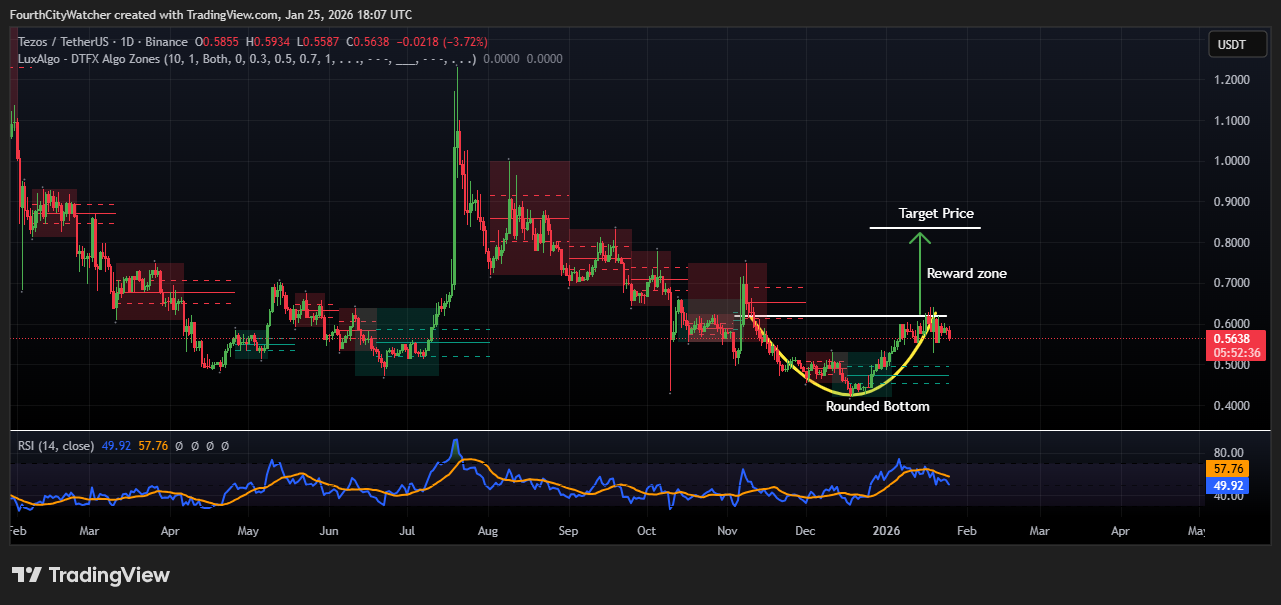
The rounded bottom formation developed between November and early January, signaling gradual accumulation after months of lower lows. Price action has since pushed toward the $0.60 zone, which now acts as an important resistance area. This level aligns with a previous supply zone highlighted on the chart, where sellers have historically stepped in.
RSI Signals Room for Upside
A confirmed daily close above $0.60 could open the door for further upside, with the chart marking a potential reward zone stretching toward the $0.75–$0.80 range. This target area coincides with prior consolidation levels and could attract momentum traders if volume increases.
On the downside, failure to hold above the $0.55 region may expose XTZ to renewed selling pressure, with support seen near the $0.50 psychological level. The risk-reward structure shown on the chart suggests bulls are attempting to flip former resistance into support, a key requirement for trend continuation.
Meanwhile, the Relative Strength Index (RSI) on the daily timeframe is hovering near neutral levels, around 50–58. This indicates neither overbought nor oversold conditions, leaving room for a stronger directional move. A sustained RSI push above 60 would further support the bullish case.
About Author

About Author