


What is the Next Crypto to Hit $1 in 2026?
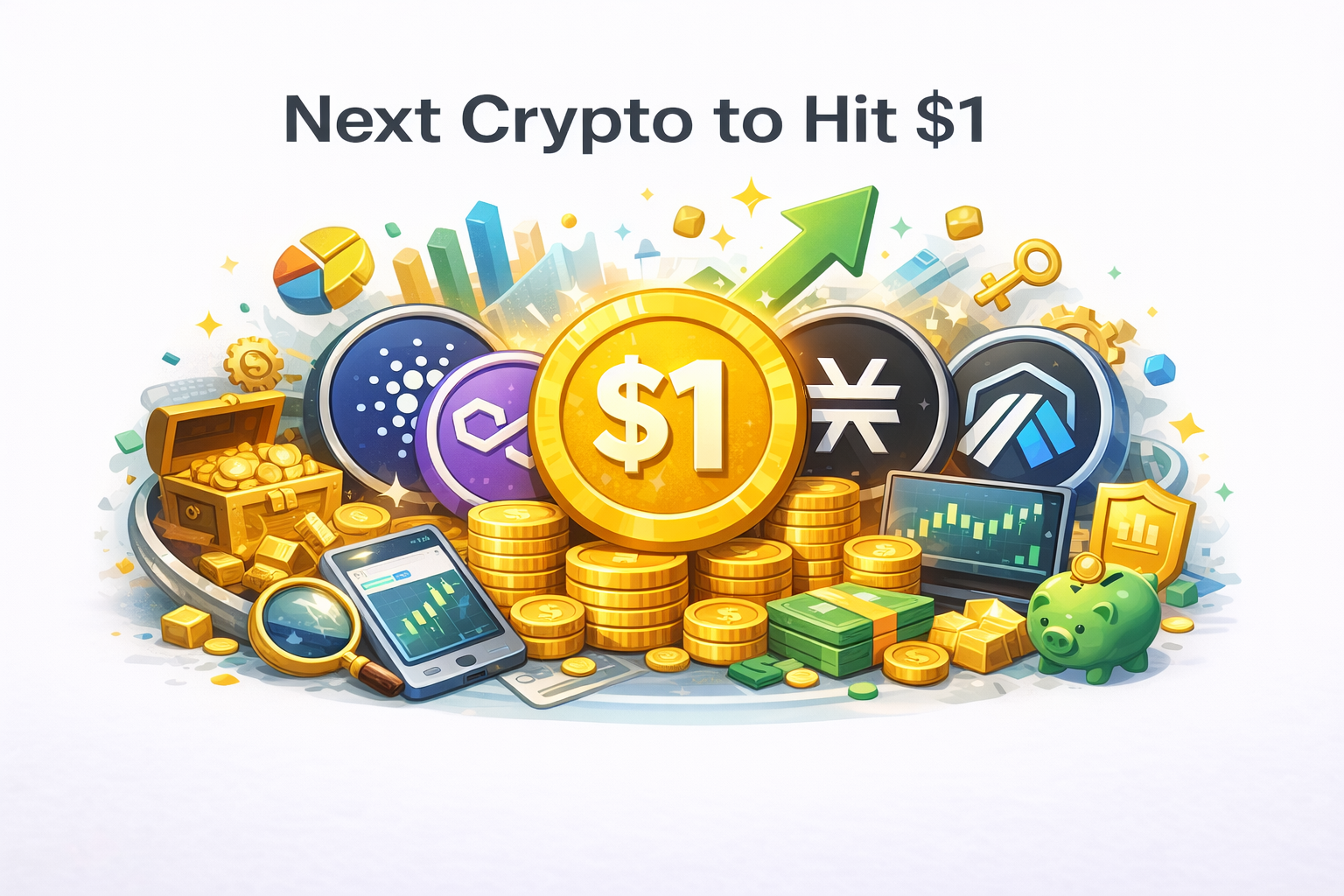
The $1 price mark creates a clear divide between tokens investors take seriously and those they dismiss as penny coins. This separation makes it a critical psychological threshold in crypto markets. When people search for the next crypto to hit $1, they want projects with controlled supply, real demand, and market caps that make the target actually possible.
Consider a token priced at $0.36 with a $15 billion market cap versus one at $0.000008 with $5 billion. The first coin sits far closer to $1 because the supply structure determines feasibility. In contrast, the second token would need impossible capital inflows to reach the same level. This milestone shows price normalization based on project value instead of speculation alone.
Most investors miss one key point about the next crypto to hit $1. Specifically, projects with trillions of tokens need market caps larger than the global economy. Therefore, this guide covers tokens where the math works and skips the ones that never will.
Main Highlights About Next Crypto to Hit $1
▪️ The path to $1 depends on supply dynamics, not current price. A token with a 1 billion circulating supply needs only a $1 billion market cap, while a token with a 589 trillion supply would need $589 trillion.
▪️ Presale projects like Bitcoin Hyper, MaxiDoge, and LiquidChain offer early entry before exchange listings but carry higher execution risk.
▪️ Established tokens like Cardano, Polygon, and Stacks previously traded above $1 and maintain the core foundation to return there.
▪️ Market cap requirements show what’s actually feasible. ADA needs roughly $36 billion to hit $1, while SHIB would require over $589 trillion.
▪️ Burn mechanisms speed up progress toward $1 for tokens that actively reduce circulating supply over time.
▪️ Layer-2 networks like Arbitrum and Stacks benefit from Ethereum and Bitcoin growth and create secondary demand for their native tokens.
Crypto Projects With Momentum That Could Reach $1
Several crypto presales show the tokenomics and utility structures that could support a $1 price target. These projects remain in development phases and aim for future exchange exposure through community traction and technical milestones they deliver over time.

- Introducing the first Bitcoin L2 solution
- Allows users to trade BTC almost instantaneously
- Enhanced transaction security with ZK-proofs
 USDC
USDC ETH
ETH USDT
USDT

- High Staking Incentives / Yield Mechanism
- Strong Presale Momentum & Early Demand
- Meme Branding + Aspirational / Niche Positioning
 BNB
BNB Credit Card
- ETH
- +1 more

- Raising consciousness around the world
- Live social media app ready to scale to help communities
- Payments, NFTs and community membership
- USDC

- Layer-3 blockchain connecting Bitcoin, Ethereum and Solana
- Unified liquidity pools and a high-performance VM
- Lucrative staking rewards
- ETH
- Credit Card
- USDT
- +2 more

- Real Utility in the Creator Economy
- AI-Powered Tools and Automation
- Staking Incentives & Token Holder Benefits
- ETH
- Credit Card
- BNB
All Crypto Candidates That Could Hit $1 to Watch in 2026
The following table covers both presale opportunities and established tokens with realistic paths to $1. Each project met our evaluation criteria for supply structure, market cap requirements, and fundamental demand drivers.
| 🪙 Token | 🚀 Stage | 📐 Supply Structure | 💵 Market Cap Required at $1 | 📸 Feasibility Snapshot |
|---|---|---|---|---|
| Bitcoin Hyper (HYPER) | Presale | Fixed, capped | ~$21B | Achievable if execution and listings align |
| MaxiDoge (MAXI) | Presale | Very large supply | ~$150.24B | Structurally difficult due to extreme scale |
| BMIC (BMIC) | Presale | Moderate, capped | ~$1.5B | Realistic with enterprise adoption |
| LiquidChain (LIQUID) | Presale | Large but finite | ~$11.8B | Possible, but requires broad multi-chain usage |
| SUBBD (SUBBD) | Presale | Clean 1B cap | ~$1.0B | Relatively close compared to most presales |
| Little Pepe (LILPEPE) | Presale | Fixed, low current valuation | ~$1.0B | Supply math works; demand remains the key variable |
| Cardano (ADA) | Live | Large but capped | $36B | High; already proven above $1 historically |
| Polygon (POL) | Live | Fixed, deflationary | $10.56B | High; prior $1+ history supports feasibility |
| Stacks (STX) | Live | Near-max supply | $1.81B | High; modest growth needed |
| Arbitrum (ARB) | Live | Inflation via unlocks | $5.82B | Medium–High; feasible but unlocks add pressure |
1. Can Bitcoin Hyper (HYPER) Reach $1?
Bitcoin Hyper operates as a Layer-2 solution that combines Bitcoin’s security with the speed of Solana’s Virtual Machine. The system uses a canonical bridge to move BTC onto the Layer-2, where it can power DeFi protocols, payment systems, and decentralized applications without the slow confirmation times that limit Bitcoin’s base chain.
As a result, transaction speeds shift from minutes to seconds while costs remain minimal. This addresses two critical barriers that have kept developers away from Bitcoin for years. In turn, the platform gives projects access to Bitcoin’s trillion-dollar liquidity and established network while they operate in an environment fast enough for real-world applications.
The token supply caps at 21 billion, which means the $1 target requires a $21 billion fully diluted valuation. Layer-2 infrastructure tokens have hit comparable valuations when they prove technical capability and attract genuine user activity. Therefore, feasibility depends entirely on whether the team delivers a product that people actually use.
| 💸 Current Price | $0.013675 |
| 📊 Funds Raised | $32.01M |
| 🗓️ Launch Timeline | Q1 2026 |
| 💰 Market Cap at $1 | 21B |
| ✅ Pros | • Taps into trillion-dollar BTC ecosystem without base layer constraints • Significant early funding demonstrates genuine market interest • Attracts developers familiar with high-speed execution environments |
| ❌ Cons | • The canonical bridge represents a single point of failure for asset security • Faces Layer-2 rivals like Lightning Network with years of battle-testing |
What Could Drive HYPER to $1
Bitcoin holders who want to earn yield on their BTC without a bridge to other chains create natural demand for Layer-2 solutions that keep them in the Bitcoin ecosystem. Major exchange listings after the presale period would bring significant liquidity and expose the token to retail investors who currently lack access.
The Solana Virtual Machine integration appeals to developers already familiar with Solana’s tools, which could pull projects and users from that ecosystem into Bitcoin’s network. Each of these factors expands the potential user base and drives organic demand for the token past initial speculation.
Resources
Website | Whitepaper | Coinsult audit | Official X / Telegram
2. Can MaxiDoge (MAXI) Reach $1?
MaxiDoge functions as a competitive platform where leverage traders face off in weekly tournaments hosted on partner futures exchanges. Traders compete based on their leverage multiples and profit results, and the system ranks participants to determine prize distribution from a dedicated reward pool.
With a fixed cap of 150.24 billion units and zero inflation, the tokenomics ensure total supply stays constant. Burn protocols actively remove tokens when competition milestones are hit, and this mechanism creates deflationary pressure that works in favor of price appreciation. Over time, increased competition activity accelerates the burn rate.
Venture capital firms got excluded from allocation entirely, which ensures control remains with the community. At $1, MAXI would need a $150 billion fully diluted market cap. As a result, the project would require substantial market share in the leverage trading market to justify this valuation.
| 💸 Current Price | $0.0002802 |
| 📊 Funds Raised | $4.96M |
| 🗓️ Launch Timeline | Q1 2026 |
| 💰 Market Cap at $1 | ~$150.24B |
| ✅ Pros | • Community-owned structure eliminates scheduled unlock dumps • Targets existing high-volume user base familiar with risk mechanics • Recurring competitions drive consistent platform engagement |
| ❌ Cons | • Value relies on sustained trader participation in tournaments • $150B target exceeds most established DeFi protocols • Tournament model must prove it keeps users engaged long-term |
What Could Drive MAXI to $1
Weekly tournaments create a constant platform activity as traders return to compete for prize pools, which builds a participatory user base instead of passive holders. Token burns tied directly to competition volume mean increased platform usage automatically reduces supply, so adoption and scarcity connect directly through the burn mechanism.
Major exchange access would expose MAXI to retail traders who already engage with leverage products and understand the competitive mechanics. Success depends on whether the tournament model proves sticky enough to retain active participants.
Resources
Website | Whitepaper | Solidproof audit | Official X / Telegram
3. Can BMIC (BMIC) Reach $1?

BMIC addresses a future security crisis as quantum computers gain the ability to break current blockchain encryption standards. This token powers a quantum-resistant infrastructure network where users burn BMIC to generate compute credits for security services. The burn-to-utility model generates direct utility demand tied to actual usage.
Quantum computing advances pose real threats to blockchain security within the next few years, and major institutions need solutions now to protect wallets, enterprise APIs, and systems that stake assets before vulnerabilities emerge. BMIC positions itself as the infrastructure layer that secures these systems ahead of the threat.
| 💸 Current Price | $0.049474 |
| 📊 Stage | $698.13K |
| 🗓️ Launch Timeline | TBA |
| 💰 Market Cap at $1 | ~$1.5B |
| ✅ Pros | • Positions as an early solution before quantum threats materialize • Users burn tokens for compute credits, creating direct demand • Financial institutions need quantum-proof infrastructure now • Solves regulatory requirements before mandates take effect |
| ❌ Cons | • Quantum computers may take longer to break encryption than expected • Technology requires education for non-technical investors |
What Could Drive BMIC to $1
Financial institutions and crypto exchanges face mounting pressure to implement quantum-proof security before regulatory bodies mandate it. BMIC offers infrastructure that solves compliance requirements ahead of enforcement deadlines. Every compute credit purchase requires users to burn tokens permanently, so network adoption directly shrinks supply in proportion to usage levels.
Governments and industry groups already discuss quantum security standards for blockchain systems, and early movers that establish technical credibility could become default providers when regulators formalize requirements. The timeline for quantum threats determines urgency, and institutions prefer proactive security over reactive patches.
Resources
Website | Whitepaper | Security audit | Official X / Telegram
4. Can LiquidChain (LIQUID) Reach $1?
LiquidChain tackles DeFi’s liquidity fragmentation problem with a protocol that connects Bitcoin, Ethereum, and Solana into one unified execution layer. Traders today lose billions annually because they split capital across separate chains, manage different gas tokens for each network, and expose their funds to bridge vulnerabilities with every cross-chain move. As a consequence, identical assets trade at wildly different prices simply because liquidity stays trapped in isolated pools.
Atomic settlements verify positions across all three chains through cryptographic proofs, and a single LIQUID token covers transaction fees regardless of which chain hosts the asset beneath. In practice, users eliminate the requirement to hold BTC, ETH, and SOL just for gas payments. Furthermore, the protocol provides direct access to combined liquidity depth and could remove most of the slippage and price inefficiency that traders currently treat as fixed costs.
| 💸 Current Price | $0.0135 |
| 📊 Funds Raised | $670.08K |
| 🗓️ Launch Timeline | TBA |
| 💰 Market Cap at $1 | ~$11.8B |
| ✅ Pros | • Removes the exploit vector that has drained $2.5B+ from DeFi users • Trustless execution across chains without third-party custody • BTC, ETH, and SOL integration captures the majority of crypto liquidity |
| ❌ Cons | • Multi-chain atomic swaps introduce additional points of failure • Faces protocols like Thorchain and Chainflip with years of operation • Needs liquidity to attract users, needs users to build liquidity |
What Could Drive LIQUID to $1
Bridge exploits have drained over $2.5 billion from DeFi users in recent years, which creates demand for infrastructure that removes bridge risk entirely. The unified gas model appeals directly to users tired of constant token swaps and wallet management across ecosystems, as it converts friction into simplicity.
Institutional traders need verifiable cross-chain execution they can trust with large positions, and current bridge solutions fail their security standards. If LiquidChain proves its atomic settlement model works reliably at scale, it could capture significant volume from traders who currently avoid cross-chain opportunities because the infrastructure remains too risky.
Resources
Website | Whitepaper | CertiK audit | Official X / Telegram
5. Can SUBBD Token (SUBBD) Reach $1?

SUBBD gives content creators an alternative to platforms that extract 30-50% of their revenue while they control audience access and payment terms. The platform combines direct crypto payments with AI production tools that generate images, automate live streams, and create content without expensive software subscriptions.
Creators who hold tokens have access to these AI features at reduced rates. The model generates consistent demand from users who need the tools daily, instead of occasional speculators.
The project recruited 2,000 creator ambassadors who control 250 million followers before launch. These influencers bring immediate audience scale that most platforms take years to achieve. With this network in place, SUBBD can capture real revenue from day one, and sustainable revenue drives token value more reliably than hype cycles alone.
| 💸 Current Price | $0.0574875 |
| 📊 Funds Raised | $1.61M |
| 🗓️ Launch Timeline | TBA |
| 💰 Market Cap at $1 | ~$1B |
| ✅ Pros | • Solves real pain points like image generation and stream automation • Fixed staking APY incentivizes token holders to lock supply • Creates organic buy pressure from audiences who want exclusive access |
| ❌ Cons | • The platform hasn’t launched to demonstrate actual tool quality • Ambassadors don’t guarantee mainstream creator adoption |
What Could Drive SUBBD to $1
Creators lose half their income to platform fees on traditional sites. That’s why even a 10% fee reduction makes migration financially compelling for anyone with a serious audience size. The AI tools cut production costs that currently force creators to choose between quality and profitability. This expands the pool of people who can sustain full-time content careers.
Token holders unlock exclusive content tiers that non-holders cannot access. The result is buy pressure from actual community members who want the content instead of traders who chase quick flips. The model succeeds if creators stay and audiences pay, not if speculation drives short-term price spikes that vanish when attention moves to newer projects.
Resources
Website | Whitepaper | Coinsult / Solidproof audit | Official X / Telegram
6. Can Little Pepe (LILPEPE) Reach $1?
Little Pepe solves the technical problems that destroy value in meme coin trades through a dedicated Ethereum Layer-2 network. Meme traders currently lose money to high gas fees, buy/sell taxes that drain every transaction, and bot attacks that frontrun legitimate orders. This network strips out these friction points completely and includes mandatory anti-bot protection that levels the field for retail participants.
EVM compatibility allows projects to deploy without code rewrites, and the native launchpad forces liquidity locks as a non-negotiable requirement. These features tackle the rug pull epidemic that has cost meme coin investors billions and destroyed trust across the category.
Meme coins drove billions in volume throughout 2024 and 2025, even with broken infrastructure. A project purpose-built for meme traders could capture major market share if it actually fixes these core problems.
| 💸 Current Price | $0.0022 |
| 📊 Funds Raised | $28.78M |
| 🗓️ Launch Timeline | Q1-Q2 2026 |
| 💰 Market Cap at $1 | ~$1B |
| ✅ Pros | • Targets billions in annual meme coin trading volume • Eliminates bot attacks, buy/sell taxes, and rug pull vulnerabilities • Layer-2 cuts Ethereum gas costs that eat into meme trader profits |
| ❌ Cons | • Success requires meme projects to leave the Ethereum mainnet • Competes with Base, Arbitrum, and other established networks • Platform reputation depends on security measures that must never fail |
What Could Drive LILPEPE to $1
Meme traders pay some of the highest fees in crypto because they trade frequently on the Ethereum mainnet, where gas costs spike during volatile periods. A Layer-2 that cuts these costs by 90%+ keeps more profit in trader pockets, which makes migration rational purely on economics.
Projects that launch on Little Pepe avoid the reputation damage from rug pulls since the platform enforces locked liquidity by default, not as an optional feature that teams can skip. The anti-rug infrastructure could become the standard expectation for new meme launches. First-mover networks that establish this standard tend to retain dominance even as competitors show up later.
Resources
Website | Whitepaper | CertiK audit | Official X / Telegram
7. Can Cardano (ADA) Reach $1?
Cardano operates as one of the oldest active Layer-1 blockchains with a development philosophy rooted in academic research and peer review before deployment. The network runs on Proof-of-Stake consensus through its Ouroboros protocol and caps total supply at 45 billion ADA, with roughly 36 billion tokens now in circulation.
ADA traded above $3 in 2021 when its market cap exceeded $90 billion, which proves the market has already paid far higher valuations under favorable conditions. The project maintains consistent technical progress through upgrades like Hydra for scaling, and Ouroboros Leios for throughput improvements, and it holds one of crypto’s largest active communities.
| 💸 Current Price | $0.3641 |
| 📊 Market Cap | $13.09B |
| 🔝 All-time High | $3.10 (September 2021) |
| 💰 Market Cap at $1 | 35.96B |
| ✅ Pros | • Peer-reviewed upgrades like Hydra and Ouroboros Leios add credibility • One of crypto’s biggest user bases provides long-term support • The market already valued ADA at $90B+ market cap in 2021 |
| ❌ Cons | • Smart contract ecosystem lags behind Solana and Ethereum competitors • Needs favorable altcoin conditions to return to $1+ • On-chain decision-making can slow protocol upgrades and adaptability |
What Could Drive ADA to $1
Cardano holds a well-established position among institutional investors who view it as one of the more credible blockchain projects. This reputation becomes valuable when traditional finance allocates capital to crypto during bull markets. The DeFi ecosystem on Cardano has grown steadily with decentralized exchanges, stablecoins, and protocols that now lock hundreds of millions in value.
Regulated access through platforms like DZ Bank under MiCAR compliance removes friction for European institutions that want exposure but need regulatory clarity first. These factors position ADA to benefit more from institutional inflows compared to newer projects without comparable regulatory progress or academic credibility.
Resources
Website | Whitepaper | Contract adress | Official X / Telegram
8. Can Polygon (POL) Reach $1?

Polygon processes more Ethereum transactions than any other Layer-2 network and has evolved from a simple sidechain into a full zero-knowledge rollup infrastructure provider. The token transitioned from MATIC to POL in 2025 through a 1:1 swap as part of the Polygon 2.0 upgrade. This kept the total supply constant while it expanded technical capabilities.
Market history shows POL traded near $3 during its MATIC phase, so buyers already valued this infrastructure at higher levels when conditions aligned. Polygon now handles over 1.4 billion transactions annually and secured partnerships with household names like Starbucks, Nike, and Meta. These partnerships bring real-world usage beyond crypto-native applications.
Network economics work in favor of token appreciation through a burn mechanism that removes approximately 1 million POL tokens daily via transaction fees. Higher activity accelerates deflation directly. This creates a feedback loop where increased adoption tightens scarcity over time.
| 💸 Current Price | $0.1344 |
| 📊 Market Cap | $1.41B |
| 🔝 All-time High | $1.29 (March 2024) |
| 💰 Market Cap at $1 | 10.56B |
| ✅ Pros | • Starbucks, Nike, and Meta integrations bring real-world transaction volume • 1M+ POL burned daily creates 3.5% annual deflationary pressure • 99% conversion eliminates old token overhang and confusion • Processes more L2 transactions than any competing network |
| ❌ Cons | • Faces market leader with higher TVL and institutional adoption |
What Could Drive POL to $1
AggLayer v0.3 connects multiple blockchains into a unified liquidity layer where users execute cross-chain transactions without bridges or wrapped tokens. This solves the fragmentation that splits capital across incompatible networks. Each transaction burns tokens automatically, and the burn rate accelerates as network usage grows. The result is scarcity that compounds over time.
Enterprise payment integrations with companies like Starbucks convert millions of daily consumer transactions into blockchain activity. Mainstream adoption at this scale transforms Polygon from a crypto-only network into infrastructure that processes mainstream commerce. Real-world payment volume at scale could exceed speculative trading and establish sustainable demand from sources outside traditional crypto markets.
Resources
Website | Whitepaper | Contract adress | Official X / Telegram
9. Can Stacks (STX) Reach $1?
Stacks brings programmable smart contracts to Bitcoin without any modifications to Bitcoin’s base protocol. The network uses a Proof of Transfer consensus mechanism that settles transactions on Bitcoin’s blockchain for security, while it executes complex logic that the base layer cannot handle. As a result, developers can build DeFi applications and decentralized platforms that inherit Bitcoin’s security guarantees directly.
Market history supports a $1 target since STX has already traded at $3, which required a far larger market cap than a dollar price would demand. In addition, recent technical improvements deliver practical benefits that address previous limitations and strengthen the investment case.
Most notably, the Nakamoto upgrade cut transaction finality to under 10 seconds, while sBTC creates a bridge-free way for Bitcoin holders to access DeFi applications with their actual BTC instead of synthetic versions that introduce counterparty risk. Together, these upgrades position Stacks to capture value from Bitcoin’s trillion-dollar ecosystem.
| 💸 Current Price | $0.3308 |
| 📊 Market Cap | $600M |
| 🔝 All-time High | $3.84 (April 2024) |
| 💰 Market Cap at $1 | 1.81B |
| ✅ Pros | • First-mover advantage as the primary smart contract layer for Bitcoin • Enables BTC holders to access DeFi without custodial risk • Token inflation is minimal as circulation approaches 1.81B cap |
| ❌ Cons | • An alternative Bitcoin L2 with similar smart contract capabilities exists • Growth requires BTC holders to want DeFi exposure |
What Could Drive STX to $1
Bitcoin holders control over a trillion dollars in value, but historically lack access to yield opportunities unless they rely on third-party custodians or use bridges to other chains. sBTC solves this problem because it lets BTC move into DeFi protocols while it remains verifiable on Bitcoin’s blockchain, and the mechanism unlocks massive capital that currently sits idle.
The Layer-2 narrative around Bitcoin intensifies as institutions search for ways to make their BTC productive, and Stacks offers the most mature infrastructure for this use case. Protocol revenue from transaction fees and smart contract activity flows to the network as usage scales. Profits like this build fundamental value past token speculation alone.
Resources
Website | Whitepaper | Contract adress | Official X / Telegram
10. Can Arbitrum (ARB) Reach $1?

Arbitrum holds the top position among Ethereum Layer-2 networks, measured by total value locked and processes over 3.4 million transactions daily. The network captured over 65% of the Layer-2 stablecoin market with $8.6 billion in circulation, which demonstrates real capital allocation from users and protocols that chose Arbitrum over competitive solutions.
ARB launched at $8.67 before it declined significantly, and this drop shows both the initial market enthusiasm and the correction that followed token unlock events. Sequencer fees generate actual revenue as they process transactions. Thanks to this, there is a foundation for potential value distribution mechanisms that could direct returns to token holders in the future.
Enterprise adoption signals mainstream validation as platforms like Robinhood and Franklin Templeton selected Arbitrum to power their blockchain operations. Institutional selection of this type typically comes before broader market recognition and sustained network growth.
| 💸 Current Price | $0.1936 |
| 📊 Market Cap | $1.12B |
| 🔝 All-time High | $2.40 (January 2024) |
| 💰 Market Cap at $1 | 5.82B |
| ✅ Pros | • Sequencer fees generate actual income that could flow to holders • Controls the majority of Ethereum L2 capital with $3.4M+ daily transactions • Rust/C++ support expands developer pool beyond Solidity coders |
| ❌ Cons | • Scheduled releases through 2026 create consistent selling pressure • OP Stack networks capture market share with lower fees Protocol earnings don’t distribute to token holders yet |
What Could Drive ARB to $1
Arbitrum already controls the majority of Layer-2 capital, and network effects tend to compound this advantage as developers and users concentrate where liquidity already exists. Fee revenue sharing through governance could transform ARB from a governance token into one that distributes actual protocol earnings to holders.
The Stylus upgrade allows developers to write smart contracts in Rust, C++, and other languages outside Solidity, which expands the developer pool dramatically and could pull talent from non-blockchain sectors. Each of these catalysts operates independently, so Arbitrum doesn’t need all three to succeed simultaneously for price appreciation to occur.
Resources
Website | Whitepaper | Contract adress | Official X / Discord
Why These Coins Might NOT Hit $1
Some popular low-priced tokens attract investor attention based on price alone. Investors often ignore the supply mathematics that make $1 impossible to achieve. The tokens below face structural barriers that will never allow them to reach that milestone.
⛔️ Shiba Inu (SHIB): SHIB holds approximately 589 trillion tokens in circulation. This means the token would need a market cap that exceeds $589 trillion to reach $1. The entire global economy produces roughly $100 trillion in GDP annually. Current burn rates would take over 40,000 years to reduce supply to feasible levels.
⛔️ Pepe (PEPE): PEPE would require a market cap roughly 4 times larger than all stocks on the NYSE combined to reach $1 with its 420.69 trillion token supply. Even $0.01 would demand a $4.2 trillion valuation, which exceeds Bitcoin and Ethereum combined.
⛔️ Terra Classic (LUNC): The May 2022 collapse caused Luna’s supply to hyperinflate from 350 million to nearly 6.5 trillion tokens. Community burn efforts remove a few billion tokens monthly, but this pace would take hundreds of years to make $1 mathematically possible.
⛔️ BitTorrent (BTT): A 2022 redenomination increased supply by 1,000x and created 990 trillion total tokens. This corporate decision permanently locked the token into micro-pricing, and the project lacks any credible plan to reduce circulation or increase scarcity.
⛔️ Amp (AMP): The SEC labeled AMP a security in 2022, which triggered major exchange delistings. This regulatory classification blocks retail access and prevents institutional investment. Also, it caps price appreciation regardless of the collateral protocol’s actual utility.
Why $1 Is a Major Milestone in Crypto: Concept and Examples
The human brain processes whole numbers more easily than fractions of a cent. That explains why $1+ tokens appear more “established” to new investors regardless of fundamentals. As a result, media coverage reinforces this bias. Headlines about “ADA breaks $1” generate more engagement than stories about SHIB moving from $0.000008 to $0.00001, even when percentage gains match.
Market cap calculations at $1 reveal the true feasibility of price targets. A token priced at $0.50 with 2 billion tokens needs only a $2 billion market cap to hit $1. In contrast, a token at $0.0001 with 10 trillion tokens needs a $10 trillion market cap for the same milestone. This metric allows investors to assess whether a $1 target requires a $5 billion valuation (achievable) or a $500 billion valuation (requires Bitcoin-level adoption).
‼️Price alone tells investors nothing about actual value, and market cap comparisons expose this reality quickly. Token A at $0.01 with a 100 billion supply and Token B at $50 with a 20 million supply both carry a $1 billion market cap. The lower price simply creates an illusion of affordability that misleads inexperienced investors into poor allocation decisions.
What are the Top Cryptos That Already Hit $1? Examples
Several major cryptocurrencies have broken through the $1 barrier, which demonstrates that the milestone remains achievable for projects with appropriate supply structures and genuine demand.
| 🪙 Token | 🔝 All-Time High | 💸 Current Price | 📅 Year First Hit $1 |
|---|---|---|---|
| Bitcoin (BTC) | $126,198 | $93,117 | 2011 |
| Ethereum (ETH) | $4,953 | $3,210 | 2017 |
| XRP (XRP) | $3.65 | $1.98 | 2017 |
| BNB (BNB) | $1,369 | $924 | 2018 |
| Solana (SOL) | $293 | $133 | 2021 |
These examples show that tokens with reasonable supply structures can achieve and maintain $1+ valuations when market conditions favor growth. Cardano and Polygon both previously traded well above $1 and possess the fundamental foundation to return there.
Market Cap Comparison Table: What It Takes to Reach $1
The market cap requirements for each token separate realistic $1 paths from mathematical impossibilities:
| 🪙 Coin | 💸 Current Price | 🔄 Circulating Supply | 📈 Current Market Cap | 📅 Increase Needed |
|---|---|---|---|---|
| Bitcoin Hyper (HYPER) | $0.013675 | $21B | ~$285.7M | ~73.5× |
| MaxiDoge (MAXI) | $0.0002802 | 150.24B | ~$117.6M | ~3,584× |
| BMIC (BMIC) | $0.049474 | 1.5B | ~$73.9M | ~20.3× |
| LiquidChain (LIQUID) | $0.0135 | 11.8B | ~$156.35M | ~75.5× |
| SUBBD (SUBBD) | $0.0574875 | 1B | ~$57.5M | ~17.4× |
| Little Pepe (LILPEPE) | $0.0022 | 1B | ~$2.2M | ~455× |
| Cardano (ADA) | $0.3641 | 36B | $13.09B | 2.75× |
| Polygon (POL) | $0.1344 | 10.56B | $1.41B | 7.44× |
| Stacks (STX) | $0.3308 | 1.81B | $600M | 3.02× |
| Arbitrum (ARB) | $0.1936 | 5.82B | $1.12B | 5.17× |
The table shows a clear divide between achievable targets and impossible dreams. Tokens like ADA, POL, and STX need market cap increases between 2× and 7.5× to reach $1, well within what we’ve seen during past bull market rallies. SHIB and PEPE would need increases that exceed 100,000×, a target that simply cannot happen under any realistic scenario.
‼️For presale projects, the valuations reflect total supply multiplied by current price (fully diluted valuation or FDV), not actual market cap at launch. Unlock schedules, vesting terms, liquidity levels, and buyer demand will determine the real market cap once these tokens go live.
Crypto Market Trends in 2026 That Could Push Coins Toward $1
Several macro factors could accelerate token appreciation for projects that stand to benefit from broader industry trends.
📌 Increased Retail Participation
Spot Bitcoin ETF approvals brought new capital into the crypto ecosystem, and as retail investors grow comfortable with regulated Bitcoin products, many now seek exposure to higher-growth altcoins. Tokens with compelling narratives and reasonable supply structures often benefit from this capital rotation.
📌 Layer-2 Adoption
Ethereum gas fees during periods of high activity drive users toward Layer-2 solutions, and networks like Polygon and Arbitrum capture this demand to create organic utility for their native tokens. As dApp migration to L2s accelerates, token demand follows naturally.
📌 AI and Blockchain Integration
Projects that combine artificial intelligence with blockchain infrastructure attract both tech-focused investors and speculative capital, but sustainability depends on genuine utility. AI narrative tokens often see amplified gains during periods of AI industry excitement.
📌 Token Burn Adoption
More projects now implement deflationary mechanisms that reduce circulating supply over time, which creates a sharp contrast to inflationary models that dilute holder value. Burn mechanics create scarcity that supports price appreciation when demand remains constant.
📌 Improved Tokenomics Across Newer Projects
Recent presales often feature fixed supplies, locked team allocations, and clear utility mechanisms that reflect lessons from earlier token design mistakes. Projects with transparent, investor-friendly tokenomics tend to attract longer-term capital.
📌 Market Recovery Cycles
The crypto market operates in cycles where bear markets compress valuations across all categories while bull markets lift quality projects significantly. Tokens that maintain development and community engagement during downturns often become the next cryptocurrencies to explode during recoveries.
How to Spot the Next Cryptocurrencies That Could Hit $1 – Early Signals
The identification of cryptos with potential before they reach the $1 milestone requires attention to quantitative metrics, as well as qualitative factors.
🔍 Supply Mathematics: Calculate the market cap required for $1 before you analyze any other factor, as tokens with 100 trillion+ supply cannot reach $1 under any realistic scenario, regardless of other strengths.

🔍 Burn Mechanisms: Projects that actively reduce circulation accelerate their path to $1 through automated burns tied to transactions, manual burns from treasury, or deflationary tokenomics built into protocol design.

🔍 Developer Activity: GitHub commits, protocol updates, and roadmap execution demonstrate team commitment and show that projects with frequent, meaningful development activity tend to attract long-term holders who provide price support.

🔍 Exchange Accessibility: Tokens available on major exchanges like Coinbase, Binance, and Kraken reach larger investor pools, and upcoming listings often trigger liquidity events that push prices higher.

🔍 Real Usage: Transaction volume, active addresses, and total value locked indicate genuine demand and show that tokens with these metrics possess organic demand drivers independent of speculative interest.

🔍 Institutional Signals: Partnerships with established companies, regulatory approvals, and institutional investment indicate mainstream validation, and these signals often precede significant price appreciation.
Advantages and Risks of Investing in Cryptos Under 1 Dollar
The decision to invest in coins under $1 requires a clear assessment of both potential rewards and inherent risks.
Pros
-
Lower entry points allow larger position sizes
-
Greater percentage gain potential
-
Access to ground-floor opportunities
-
Exposure to innovative technology
Cons
-
Many low-priced tokens carry fatal supply flaws
-
Liquidity constraints limit exit options
-
Project failure rates exceed traditional assets
-
Regulatory uncertainty affects the entire sector
Advantages of Low-Priced Crypto
The following section provides a clearer explanation of the points mentioned earlier:
🟢 Larger Position Sizes: Investors can accumulate meaningful token quantities at under $1 prices and store them in the best wallets for crypto. This creates a stronger psychological attachment to positions and reduces the temptation to sell during minor volatility.
🟢 Percentage Gain Potential: A token that moves from $0.10 to $1 delivers a 10x return, while established coins at $50,000+ prices require massive capital inflows to achieve similar percentage gains.
🟢 Ground-Floor Access: Presale participation and early exchange listings allow investors to acquire tokens before broader market awareness develops, and this timing advantage compounds when projects achieve mainstream recognition.
🟢 Technology Exposure: Many tokens under $1 represent innovative solutions to genuine problems, which means early investment provides exposure to potentially transformative technology at favorable valuations.
Risks of Low-Priced Crypto
Here are the most common risks explained:
🔴 Supply Structure Flaws: Most sub-$1 tokens carry unfavorable supply dynamics, and trillion-token supplies make meaningful appreciation mathematically impossible regardless of demand levels.
🔴 Liquidity Constraints: Lower market cap tokens often suffer from thin order books, which means large positions can move prices significantly during entry or exit and create slippage costs that erode returns.
🔴 Project Failure Rates: The majority of crypto projects fail to achieve their stated goals, and presales carry particular risk because teams may abandon development after they raise funds.
🔴 Regulatory Uncertainty: Governments worldwide continue to develop crypto regulations, and adverse rulings can immediately impact token accessibility and value, particularly for smaller projects without legal resources.
Market Forces That Could Push Cryptocurrencies Under $1 Toward the $1 Mark in 2026
Several macroeconomic and industry-specific factors could create favorable conditions for tokens priced below $1 to appreciate significantly.
Altcoin Rotation During Bull Markets
Bull market cycles tend to follow a predictable pattern where Bitcoin leads initial price appreciation, then traders shift their focus to alternative cryptocurrencies. This capital migration accelerates once Bitcoin’s momentum slows and investors search for assets with higher return potential.
Tokens priced below $1 with reasonable market caps frequently deliver outsized gains during these phases because they require less total capital to move significantly. The rise of regulated crypto investment products may intensify this trend and channel more institutional money toward quality lower-cap projects.
Larger Presales and Increased VC Liquidity
Funding rounds have grown substantially in recent years, and many of the best crypto presales to buy now raise tens of millions before they list on exchanges. Teams that secure this level of capital can speed up development, bring in experienced developers, and build the partnerships that create real token utility. Strong presale numbers also signal market confidence and attract more investors once tokens go public.
However, well-funded projects still face challenges that can slow progress, and large raises don’t guarantee teams will deliver on their plans. Investors should check team track records, review development progress, and see how clearly projects manage their presale funds before they invest.
Meme Coin Revivals and Narrative Cycles
Meme coins and narrative-driven tokens continue to pull in substantial short-term capital when market sentiment turns positive. Tokens that catch viral momentum, launch with a limited initial supply, and tap into current cultural trends can race toward $1 much faster than projects focused purely on utility.
This speed comes with significant tradeoffs, as meme-driven coins typically crash hard once the initial excitement wears off, and new narratives take over. The sustainability question remains central, since few meme tokens hold their value past a single rally cycle.
Expanding U.S. Exchange Appetite and ETF Tailwinds
The approval of spot Bitcoin ETFs and similar Ethereum products has brought serious new money into crypto markets and helped make digital assets more acceptable to mainstream investors. These regulated products let institutional and retail investors get into the space through familiar channels.
ETFs themselves don’t hold smaller tokens directly, but the wave of new money lifts the broader market. Investors who start with regulated Bitcoin or Ethereum products often explore alternative tokens once they feel more comfortable, which creates extra demand for quality projects priced below $1.
Growing Institutional and Banking Access to Crypto
Traditional financial institutions have started to relax their rules on digital assets, and this development lets wealth managers add crypto-related products to client portfolios in certain markets. The shift opens up capital sources that were completely closed off to crypto just a few years ago.
Clearer regulations now allow banks to help with crypto transactions, so regular investors can get involved without technical headaches. These changes create new paths for institutional money that didn’t exist before. This fresh capital helps the entire market, including tokens priced below $1.
How Long Can It Take for Cryptocurrencies Under $1 to Reach the $1 Level?
Timeline expectations vary widely based on where a token starts, current market conditions, and how well the project delivers.
1️⃣ Fast Path (Months): New cryptos to invest in, tokens with small supply, strong demand, and good timing can hit $1 within months of launch. SUBBD at $0.057 would need around 17x growth, which can happen when presale excitement carries over to exchange listings.
2️⃣ Medium Path (1-2 Years): Established tokens like Cardano ($0.36) and Stacks ($0.33) need 2-3x growth to reach $1. When market conditions turn positive, these moves can play out within 12-24 months based on past cycles.
3️⃣ Extended Path (3+ Years): Tokens like Arbitrum ($0.19) need roughly 5x growth to cross the dollar mark. These longer timelines usually require bull markets that stick around and real expansion across their networks.
| ⚡ Factors That Speed Progress | 📉 Factors That Delay Progress |
|---|---|
| Token burns reduce the circulating supply | Token unlocks add selling pressure |
| Major exchange listings expand investor access | Competition from similar projects diverts attention |
| Partnership announcements generate demand | General market downturns suppress prices |
| Protocol upgrades improve utility | Team execution failures stall development |
| Favorable regulatory developments boost confidence | Negative regulatory actions limit access |
CoinNews Methodology for Selecting Top Cryptos Under $1
We apply a point-based evaluation framework to identify which tokens have a credible shot at the $1 mark. Also, we weigh different criteria according to how much they impact price potential.
➡️ 1. Supply Mathematics (25%): We calculate the numbers on what market cap each token needs to hit $1 and filter out anything that demands over $100 billion in valuation unless extraordinary circumstances apply.
➡️ 2. Past Price Records (15%): Tokens that previously crossed the $1 threshold score higher because buyers have already shown they’ll pay those prices under the right conditions.
➡️ 3. Technical Progress (20%): We check GitHub activity, protocol improvements, and whether teams actually deliver on their plans to separate active projects from ones teams have left behind.
➡️ 4. Token Economics (20%): We favor capped supplies, reduction mechanisms, and transparent distribution models, while we score down projects with constant dilution or allocations that favor insiders too heavily.
➡️ 5. Trading Access (10%): Availability on recognized exchanges with decent volume and narrow bid-ask spreads matters because investors need practical ways to buy and sell without high costs.
➡️ 6. Code Review Status (5%): Third-party audits from firms like Coinsult, CertiK, and Solidproof carry weight as evidence of security work, while unverified smart contracts raise concerns.
➡️ 7. User Base Activity (5%): Consistent participation across social platforms like X, Telegram, and Discord signals genuine support that survives market downturns and periods of low speculation.
Final Thoughts: Is $1 a Realistic Target?
Whether a token can hit $1 depends entirely on supply math, not hope or hype. Cardano, Polygon, and Stacks have already proven they can trade above $1, and they only need market caps in the tens of billions to get back there. Projects like SUBBD, BMIC, and MaxiDoge start with controlled supplies that make the math work, though they carry the typical risks of any newer launch.
The tokens that can’t reach $1 are easy to spot because the numbers don’t lie. SHIB would need a $589 trillion market cap, and PEPE isn’t far behind at $420 trillion. No narrative or community enthusiasm changes those facts.
Do the market cap calculation first, check if the team delivers on promises, then decide if current conditions support growth. The path to $1 exists for some tokens but remains a fantasy for others based purely on economics.
FAQs About The Next Crypto to Hit $1
What does it really mean when a coin hits $1?
When a coin reaches $1, its total market value equals the number of tokens in circulation. This threshold tends to validate a project in investors’ eyes and often pulls in new buyers who see dollar-priced tokens as more credible than fractional alternatives.
What is the next crypto that can hit $1?
The tokens with the clearest mathematical path include Cardano (ADA), Polygon (POL), Stacks (STX), and Arbitrum (ARB) based on their supply levels and past price performance. Early-stage options like SUBBD and Bitcoin Hyper work with controlled supplies that make the target realistic.
Which meme coin could reach $1?
The popular meme tokens face impossible supply barriers. Shiba Inu alone would need a $589 trillion valuation. Meme tokens with supplies below 10 billion have the math on their side, but whether actual demand materializes remains the bigger question.
What are the cryptocurrencies under $1 with high potential?
Cardano ($0.36), Polygon ($0.13), Stacks ($0.33), and Arbitrum ($0.19) pair current prices with solid development teams and real-world use. Each token has traded well above $1 before, which proves the market will pay those levels under favorable conditions.
What are the best cryptos to buy under $1?
Your answer depends on how much risk you’ll accept. Established names like ADA and POL carry less risk but offer moderate gains. Newer launches like Bitcoin Hyper and SUBBD present bigger upside with higher execution uncertainty. Always research thoroughly before you commit funds.
How long does it take for a crypto to hit $1?
The timeline shifts based on where a token starts and what the broader market does. Tokens that need 2-3x growth (like ADA or STX) might hit $1 within 12-24 months when conditions align. Projects that need 10x or more typically require complete bull cycles that span 2-4 years.
Can I earn money with low-cost cryptos?
You can, but results vary widely. Tokens with sensible supplies and actual utility can produce strong returns when markets cooperate. Tokens with trillion-level counts rarely move much, no matter how aggressive the promotion gets. Focus on supply economics rather than sticker price when you evaluate opportunities.
References
Grayscale 2026 Digital Asset Outlook: Institutional and Regulatory Trend Insights
ArXiv: Cryptocurrency Market Capitalization Dynamics
MDPI: Cryptocurrency Price Prediction – Survey of Methods
Chainalysis Adoption Index: Real Data on User Adoption, Geography, and Growth