


Australia’s Financial Regulator Introduces Licensing Exemptions For Stablecoin Distributors

The Australian Securities and Investments Commission (ASIC) has introduced licensing exemptions for intermediaries that distribute stablecoins issued by licensed entities.
Intermediaries that are involved in the distribution of stablecoins issued by licensed entities are no longer required to hold their own AFS, market or clearing and settlement facility licenses under the new ASIC Corporations (Stablecoin Distribution Exemption) Instrument 2025/631.
New Stablecoin Exemptions Apply To Other Stablecoin-Related Services
The regulator said that the exemption will only apply to stablecoins that are classified as financial products under the current Corporations Act and that are issued by AFS-licensed entities.
The exemption also covers a range of financial services that are related to the secondary distribution of stablecoins. This includes providing general advice, market making, dealing in a stablecoin, and custodial services.
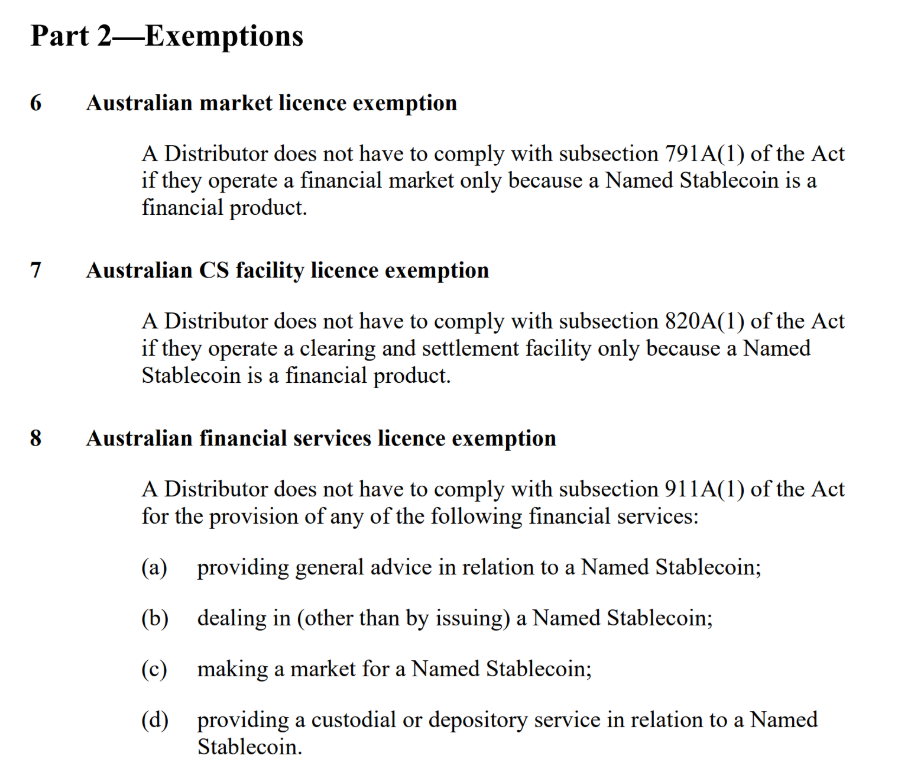
ASIC stablecoin exemptions (Source: ASIC)
ASIC said in a statement that the exemptions are part of the regulator’s efforts to support “responsible innovation in the rapidly evolving digital assets space, while ensuring important consumer protections are in place.”
At the moment, the exemption currently only applies to a single issuer called Catena Digital Pty, which issues the AUDM stablecoin. The exemption’s scope, however, is set to change as more stablecoin issuers obtain AFS licenses, the regulator said.
The exemptions also follow feedback ASIC received on a recent consultation paper that explored possible updates to the regulator’s digital asset guidance. One of the main pain points that were flagged by industry executives was the burdensome compliance costs for stablecoin intermediaries under the current licensing rules.
ASIC said that the exemptions will expire on June 1, 2028, unless it is repealed earlier.
Banks Still A Hurdle For Crypto Adoption
While the exemptions apply to stablecoin intermediaries, citizens in Australia continue to face restrictions imposed by banks on crypto transactions, especially when it comes to depositing funds on exchange platforms.
According to a survey by leading crypto exchange Binance, 58% of 1,900 respondents called for easier and unlimited deposits. Meanwhile, 22% of the respondents said they switched banks to gain better access to crypto.
Australia is not alone in that regard, with banks in the UK also hindering adoption for their citizens. Another recent survey found that 40% of 2,000 respondents said that their banks had either delayed or outright blocked payment to a crypto provider.
The Bank of England also recently proposed issuing restrictions on stablecoin ownership for citizens to between 10,000 and 20,000 British pounds. It also wanted to impose restrictions on corporate stablecoin ownership.
However, the industry was quick to push back on this proposal and criticize the central bank for the idea.
Following that, a report from the Financial TImes said that the UK is set to expand cooperation with the US on digital assets and explore an approach to boost innovation.
According to that report, the initiative aims to do more to harmonize regulatory frameworks, particularly for stablecoins. This is after the US, under the Donald Trump Administration, has chosen to embrace digital assets over the past few months.
Related Articles:
About Author

About Author