


Best Crypto Presales: LIQUID Builds as Nasdaq Makes Digital Liquidity a Priority

Nasdaq is putting digital liquidity closer to the center of its market-infrastructure strategy. On August 11, the exchange group announced a new Digital Liquidity Networks unit, bringing together its work in digital assets, tokenization, and modern market infrastructure. Nasdaq said the division is intended to help reduce friction, expand access, and support markets operating beyond traditional exchanges.
That choice of language is revealing – tokenizing an asset is only part of the job. Markets also need enough buyers, sellers, and connected capital for those assets to trade efficiently.
Crypto has spent years discovering the same thing from the opposite direction: Bitcoin, Ethereum, and Solana each contain substantial liquidity pools, but those pools remain separated by distinct networks and technical standards.
LiquidChain (LIQUID) is built around that fragmentation problem, as a Layer 3 protocol designed to connect liquidity across Bitcoin, Ethereum, and Solana through a shared execution layer. LIQUID costs $0.0148, has raised $937,000 in presale, and currently pays 1,206% APY.
Nasdaq is pursuing institutional market infrastructure, and LiquidChain is tackling a separate crypto-native market. The common problem is making liquidity easier to reach.
How LiquidChain Connects Markets Across Three Chains
Layer 1 blockchains provide the foundation. Layer 2 networks generally help an individual ecosystem process more activity at a greater speed or lower cost. LiquidChain starts at a higher level, asking what happens when several successful blockchain economies need to work together.
Its protocol is designed to verify activity across Bitcoin, Ethereum, and Solana and make assets from those networks available through unified liquidity pools. LiquidChain‘s whitepaper explains how Bitcoin transactions, Ethereum states, and Solana accounts can be checked through a trust-minimized proof-and-messaging system, while its high-performance virtual machine handles execution.
The practical goal is deeper shared markets – a decentralized exchange built on LiquidChain can reach connected liquidity from multiple ecosystems rather than maintaining separate pools for each chain. A lending protocol can also find the same market depth. LiquidChain is the protocol underneath them, coordinating liquidity and execution across the connected networks.
The project also says assets can be verifiably represented on the Layer 3 without using conventional wrapped versions every time capital crosses an ecosystem. Transactions involving several chains are designed to settle atomically, meaning every required step completes or the entire operation fails.
Developers get another advantage: LiquidChain is designed around deploying through one shared environment and reaching users across Bitcoin, Ethereum, and Solana – all at once – rather than maintaining substantially the same application on three separate chains. It can take a lot of the development costs out of the process for a new crypto innovation.
Is LIQUID the Best Crypto Presale?
Nasdaq’s new unit helps illustrate why liquidity is becoming an infrastructure question in its own right. The company says Digital Liquidity Networks will combine liquidity platforms, tokenization capabilities, and technology serving digital-asset markets. Nasdaq is also acquiring LeveL Markets, an off-exchange U.S. equity venue reaching more than 2,500 institutional clients, which will sit inside the new unit.
None of this is connected to LiquidChain, but it is a useful parallel of a growing problem in crypto. One chain is not going to win – Bitcoin is unlikely to become Ethereum, and Ethereum has little reason to become Solana. Each has accumulated its own users, assets, and advantages.
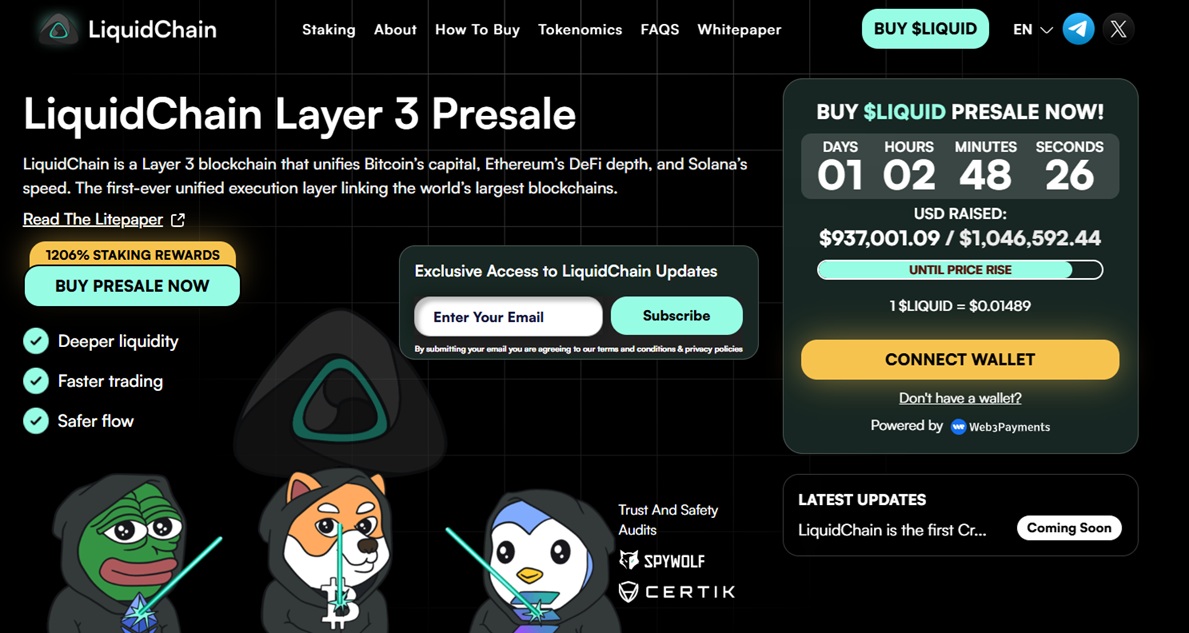
LiquidChain is betting that multichain is permanent and that, if several chains remain successful, liquidity will remain distributed among them. So a protocol that makes those pools available through a shared layer becomes more useful as the underlying ecosystems grow.
This gives LIQUID an unusual growth case for 2026 and 2027, with the goal of coordinating capital that already exists elsewhere.
The $937,000 presale remains early, leaving substantial work ahead, and the 1,206% staking APY rewards early participation, but it is not the long-term argument. If LiquidChain succeeds, demand will come from actual network activity and from builders choosing the protocol because connected liquidity improves what their applications can offer.
LIQUID, as the token used across the protocol, addresses an infrastructure question that increasingly extends beyond crypto itself: once financial markets become digital, how do you prevent their liquidity from becoming trapped in separate places?
If LiquidChain’s solution is correct, it will soon earn its place among the big players in crypto.
Markets Get Better When Capital Can Meet
The first generation of blockchain competition was obsessed with building the best individual network – faster blocks, lower fees, and more applications were treated as ways to pull users toward one ecosystem.
That competition produced several winners rather than one, which is why LiquidChain is needed. Bitcoin, Ethereum, and Solana can remain separate chains – the ambition is to make their liquidity feel considerably less separate.
About Author

About Author




