


Best Crypto Presales? LIQUID Says Tokenization Will Need More Than Blockchains

Tokenization is moving from experiment to market infrastructure, with companies like the Depository Trust & Clearing Corporation preparing to launch tokenization services in October, focusing on interoperability, liquidity mobility, and connecting traditional assets with blockchain-based markets. Nasdaq has meanwhile created a new Digital Liquidity Networks unit as part of its own push toward tokenized and always-on markets.
The harder problem comes after an asset is put on-chain – a tokenized stock or Treasury can technically trade digitally, but that does not guarantee deep liquidity, easy settlement across networks, or access to capital sitting somewhere else. Recent research into tokenized real-world assets has found that secondary-market liquidity remains a bottleneck for many assets.
Hence, the need for projects like LiquidChain (LIQUID), which is carving out the Layer 3 market space and connecting liquidity and execution across Bitcoin, Ethereum, and Solana.
LIQUID has raised $940,000 in its presale so far, at a current price of $0.0148, and offers staking at 1,202% APY. After launch, it aims to consolidate the three major chains into a single liquidity pool.
How LiquidChain Makes Tokenization More Useful
If Layer 1 blockchains provide the base infrastructure, and Layer 2s generally make an individual ecosystem faster or cheaper, Layer 3s take a different role: aggregating activity across several networks.
LiquidChain is designed around that idea – its architecture verifies activity across Bitcoin, Ethereum, and Solana while using a shared execution environment for transactions involving their assets.
What this means is that cross-chain operations settle atomically – the required steps either complete together or fail together rather than leaving part of a transaction stranded. LiquidChain describes its broader aim as combining Bitcoin’s capital, Ethereum’s DeFi depth, and Solana’s speed into one place.
The more interesting consequence is that tokenized finance becomes less dependent on where an asset happens to live – a financial system containing tokenized equities, Treasury products, stablecoins, and crypto-native assets may eventually span many networks. That creates more choice, but it also creates more fragmentation.
LiquidChain says that the infrastructure layer can absorb most of that noise: the value proposition is not simply moving a token from A to B, but making capital available across several blockchain economies.
That is close to the problem institutional providers are now confronting from the TradFi side – tokenization will require infrastructure capable of moving assets across platforms, networks, and asset forms – without messing around with bridging or wrapped assets.
LiquidChain can remove the problems: users can use assets regardless of where they are, and developers and platforms using LiquidChain don’t need to keep re-engineering their tools and front-ends for different chains.
Could LIQUID Become One of the Best Crypto Presales?
Tokenized markets are moving beyond small crypto experiments and closer to mainstream financial plumbing – yet the industry still has to solve interoperability.
The Financial Times has previously highlighted fragmented liquidity and poor interoperability between financial systems as persistent obstacles, even as Wall Street increases its blockchain investment.
So LiquidChain’s timing is interesting: the project understands that the future is multichain, but assets shouldn’t get trapped along the way.
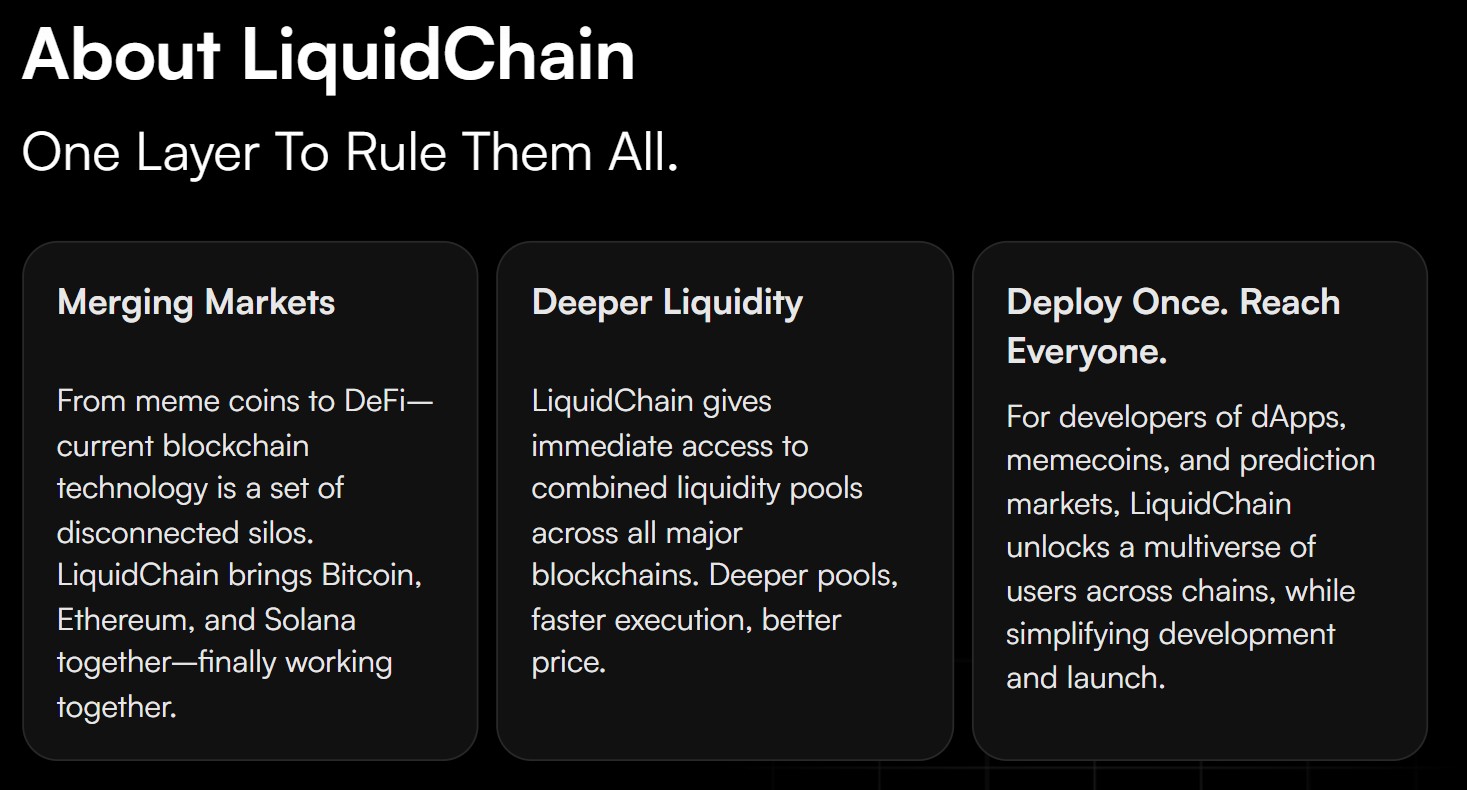
If Bitcoin retains its enormous capital base, Ethereum remains central to decentralized finance, and Solana continues expanding payments and tokenized assets, applications increasingly have reasons to reach more than one ecosystem. LIQUID builds the infrastructure required to make that less cumbersome.
The $940,000 presale remains relatively early, which leaves considerable execution ahead – LiquidChain has to demonstrate that developers prefer its shared Layer 3 model and that connected liquidity translates into deeper, more useful markets.
The real value proposition is usage: more transactions, more connected capital, and applications that work better because liquidity is no longer confined. In that world, LIQUID is the gas token that powers it all.
Putting Assets On-Chain Is Only the Beginning
Blockchain can make ownership programmable, make settlement faster, and allow markets to remain open for longer.
But as systems grow, disconnected pools of liquidity will become an ever-growing pain point unless the infrastructure unites chains.
That’s exactly LiquidChain’s proposition, and why it may be the best crypto presale to follow in the years ahead.
About Author

About Author