


Best Crypto Presales: LIQUID Targets the Liquidity Problem Behind Tokenized Gold

London’s gold market is preparing for a blockchain upgrade, with regulators developing a framework for tokenized gold, and the Financial Conduct Authority discussing how digital claims on physical bullion could eventually be used as collateral in wholesale markets.
The attraction is easy to understand – a token can make an old asset easier to divide, transfer, and move into digital markets. What it does not automatically solve is what happens when those markets live on different networks: Tokenization can create new pools of capital while remaining fragmented.
Crypto already knows that problem well – Bitcoin, Ethereum, and Solana have all built substantial networks, yet liquidity remains fundamentally divided between their respective systems.
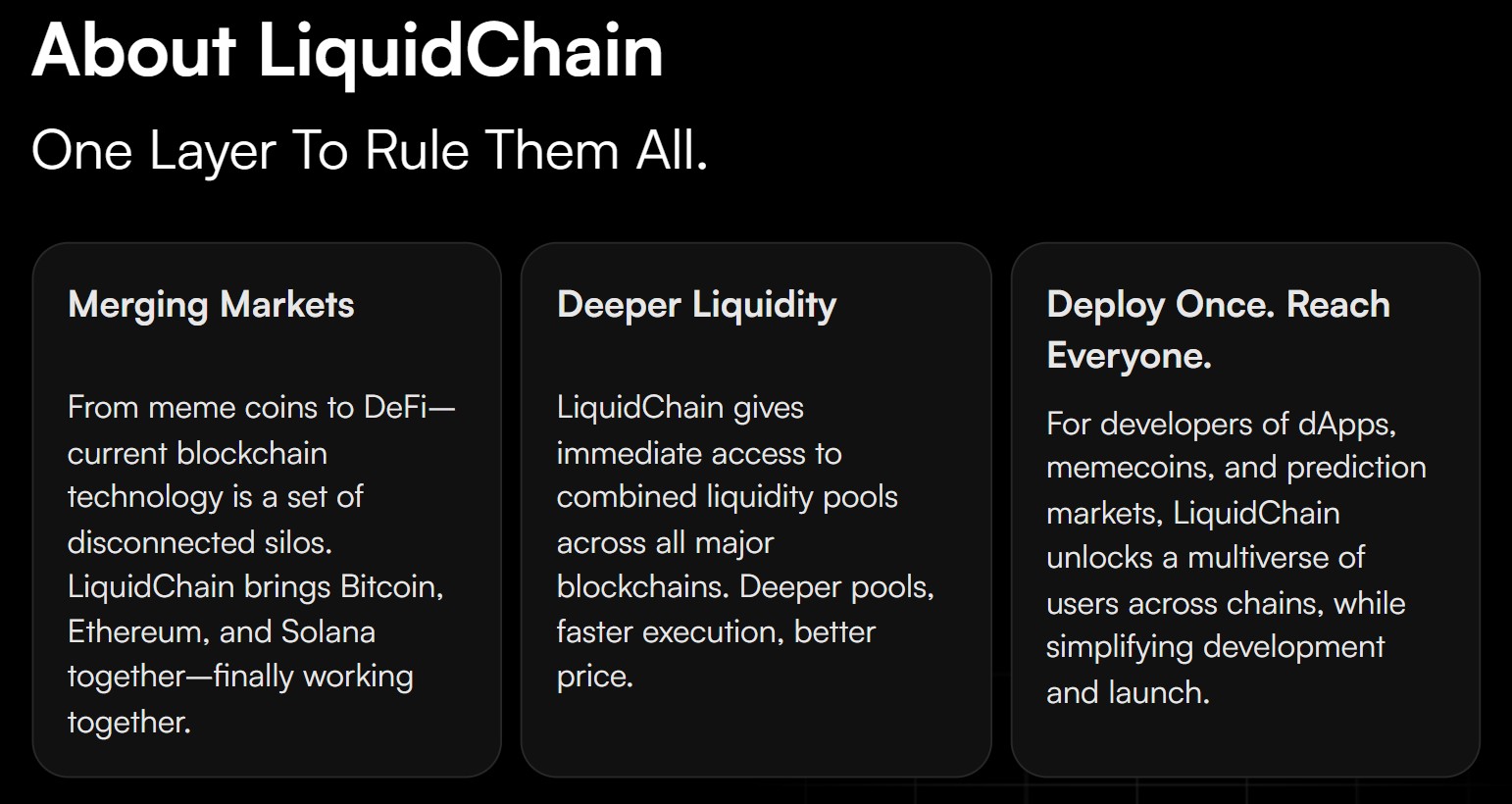
That is the problem that LiquidChain (LIQUID) is tackling, as a Layer 3 protocol designed to connect liquidity across all the major chains, creating a shared execution environment for BTC, ETH, and SOL.
LIQUID’s early presale has raised $930,000 so far, with staking offering early holders 1,206% APY.
With Bitcoin at $65,204.87, up 4.65% over seven days, and Ethereum at $1,926.82 after a 5.35% weekly gain, the question is less about whether capital will come on-chain and more about whether separate pools of it can be united.
How LiquidChain Connects Liquidity Instead of Building Another Silo
Layer 1 networks provide the base infrastructure, and Layer 2s generally make an individual ecosystem faster or cheaper. LiquidChain’s Layer 3 approach starts from a different problem: several successful networks already exist, and their liquidity does not combine.
LiquidChain is designed to sit atop Bitcoin, Ethereum, and Solana, verifying activity across all three in real time. Bitcoin transactions, Ethereum states, and Solana accounts can all be checked by the shared layer.
Assets from those networks can then be verifiably represented inside LiquidChain’s unified liquidity pools, creating fungible cross-chain markets without relying on the conventional process of wrapping assets.
That means a decentralized exchange using LiquidChain can work with liquidity connected across BTC, ETH, and SOL rather than maintaining isolated markets for each network. A lending protocol can also tap the same underlying infrastructure. LiquidChain is the protocol coordinating those pools.
For developers, the idea is similarly practical: LiquidChain says builders can deploy once and reach liquidity and users across multiple networks, rather than rebuilding the same application in each ecosystem.
Could Tokenization Make LIQUID One of the Best Crypto Presales?
Tokenized gold makes the fragmentation problem easier to see because the underlying asset predates crypto by thousands of years.
The FCA discussions reportedly include using tokenized bullion as wholesale collateral: HSBC’s tokenized gold product in Hong Kong has already processed more than $2.2 billion through over 276,000 transactions, according to figures reported by the Financial Times.
As more conventional assets become digital, the industry will likely end up recreating the same boundaries it was supposed to remove. A tokenized asset available on one ledger is not automatically liquid on another – different settlement environments, applications and pools can still divide buyers from sellers.
LiquidChain is not directly connected to the FCA’s gold initiative, nor is it currently designed specifically for London bullion markets. But it comes along at a time when the financial system is increasingly concerned with how digital assets move and interact once they exist on-chain.
That makes 2026 and 2027 potentially important for protocols focused on interoperability rather than more isolated networks. LiquidChain benefits if Bitcoin, Ethereum, and Solana all remain relevant – every successful ecosystem adding more capital can eventually be coordinated through its shared layer.
The $930,000 presale remains early relative to larger infrastructure raises and there is plenty left to prove: the protocol needs working applications, liquidity, and reliable cross-chain execution after launch.
But with the 1,000%+ staking APY and early audits from CertiK and SpyWolf, LIQUID looks to be building its idea of the future well.
Tokenizing Assets Is Only Half the Job
Turning gold into a token sounds futuristic, but in one sense, it is the easy part. The harder problem is making digital assets useful once they are spread across different networks, markets and applications.
LiquidChain is suggesting that the next stage belongs to protocols that connect those pools rather than forcing everyone onto the same blockchain.
If tokenization keeps pushing traditional assets on-chain through 2026 and 2027, liquidity will matter as much as issuance – and LIQUID is being built for that second problem.
About Author

About Author