


Best Crypto Presales: LIQUID Wants to Turn Separate Chains Into One Market

Crypto solved one difficult problem and created another – Bitcoin, Ethereum and Solana are all massive chains, but capital sitting on one network does cannot access the market on another. The industry has become larger without becoming unified.
Layer 2s helped with a different bottleneck, by giving individual blockchain ecosystems more room to process transactions cheaply and quickly. LiquidChain is making the case for Layer 3s: infrastructure designed to connect liquidity across chains.
LiquidChain (LIQUID) is an exciting new presale connecting Bitcoin, Ethereum, and Solana together into a shared liquidity pool. LIQUID is priced at $0.0148, its presale has raised $930,000 so far, and staking currently pays 1,214% APY. Buyers are backing the simple idea that the next useful piece of crypto infrastructure is the one that makes successful networks less separate.
How LiquidChain Turns Several Liquidity Pools Into a Shared Market
LiquidChain does not work like an exchange that happens to support several chains; instead, it provides the protocol underneath applications, allowing them to work with liquidity across different networks through one shared execution layer.
Its architecture starts by creating verifiable representations of assets from Bitcoin, Ethereum and Solana on the Layer 3. LiquidChain describes these as unified liquidity pools, designed to produce fungible cross-chain markets without wrapping assets simply because they originated elsewhere.
That difference becomes clearer from the perspective of a developer, where a decentralized exchange built through LiquidChain can reach capital across the three connected ecosystems rather than launching separate pools and fragmenting traders between them.
LIQUID combines a high-performance virtual machine with state verification across the underlying networks – Bitcoin tranactions, Ethereum states and Solana accounts can all be checked by the Layer 3, allowing activity to cross those boundaries. LiquidChain says linked transactions settle atomically, which removes one of the uglier features of cross-chain crypto: a transaction succeeding in one place and breaking somewhere further along the route.
There is also an efficiency argument for builders – LiquidChain is designed around deploying once and reaching users across several ecosystems, rather than developers needing to maintain the same application separately for Bitcoin, Ethereum, and Solana. The protocol’s own materials make developer reach and combined liquidity central to its design.
Why Connected Liquidity Could Give LIQUID a Big 2026 and 2027
LiquidChain becomes more interesting if crypto never settles on one dominant chain. Bitcoin has its monetary weight, Ethereum has deep DeFi infrastructure, and Solana wins for high-speed trading. None has an obvious reason to disappear simply because another network becomes successful.
But the consequence is fragmentation – deep pools on separate networks do not automatically behave like one deeper market. Users still encounter bridges, separate applications and different liquidity as they cross from one ecosystem to another.
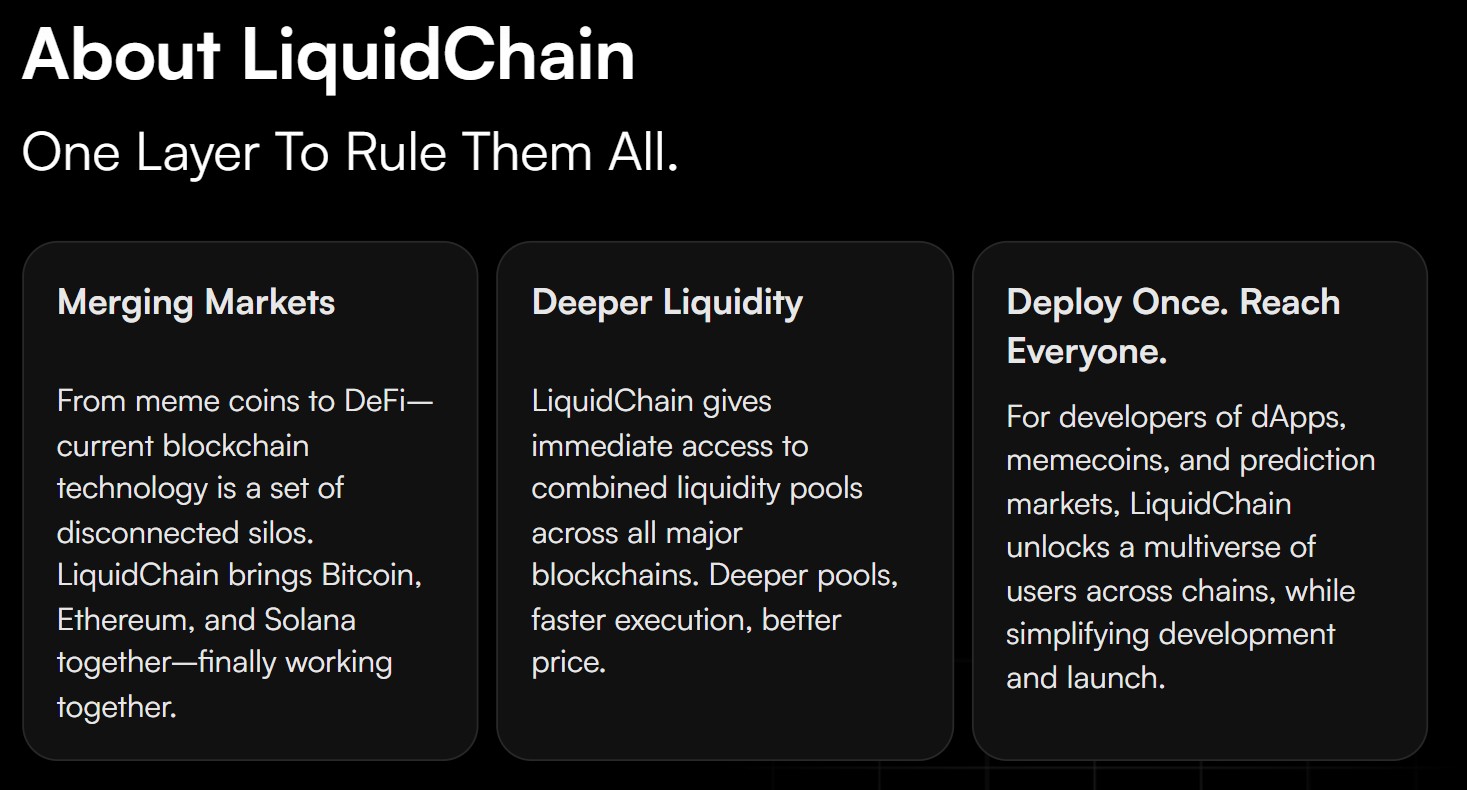
LiquidChain is saying that this problem becomes more valuable to solve as the chains themselves become more successful, giving LIQUID a different sort of opportunity from a new Layer 1 competing for users.
The protocol does not necessarily need to lure capital away from Bitcoin, Ethereum, or Solana – growth on those networks can expand the pools it ultimately hopes to connect.
The 1,214% staking return is an early presale incentive, rather than the reason the protocol should endure. Long-term demand has to come from builders choosing LiquidChain and applications finding genuinely better markets through connected liquidity.
For investors comparing the best crypto presales, that is the larger case for LIQUID. It is not trying to predict whether Bitcoin, Ethereum or Solana wins, but instead considers the possibility that all three keep winning in different ways.
Bigger Networks Need Better Connections
Blockchain history has often been told as a competition: Bitcoin against Ethereum, Ethereum against Solana, one generation replacing another.
The market has been messier – new networks arrived and old ones remained valuable. Capital accumulated in several places at once.
LiquidChain’s ambition is not to make three chains technically identical, but to make the liquidity spread across them behave more like part of the same market.
If crypto enters 2027 with even more assets, applications and capital divided between successful networks, connection may become as important as another increase in raw speed. LIQUID is an early wager on exactly that.
About Author

About Author




