


Best Crypto Presales: Why Crypto Investors See a Big Future for LiquidChain

Crypto has spent years building faster chains, cheaper execution layers, and more elaborate applications. But what it has not built nearly as well is a way for its largest ecosystems to work together. Bitcoin, Ethereum and Solana each hold massive pools of capital, but moving assets and activity between them still involves bridges, wrapped tokens, and fragmented liquidity. It’s a fragmented mess that needs solving.
That is the opportunity behind LiquidChain (LIQUID), a Layer 3 project designed to bring Bitcoin, Ethereum and Solana into a shared execution and liquidity environment. Its presale has now raised $913,000, with LIQUID priced at $0.0148 and staking available at an APY of 1,232%.
LiquidChain is not just another layer promising faster transactions, but building to make three of crypto’s most important economies useful together.
How LiquidChain Turns Separate Networks Into One Market
Layer 1 blockchains establish the rules: Bitcoin provides an exceptionally secure monetary network, Ethereum grew a deep ecosystem of smart contracts, and Solana is built for high speed. And then Layer 2 networks improved individual chains by processing transactions faster or more cheaply.
LiquidChain proposes a Layer 3 above them, with an architecture that creates a shared execution environment where applications can interact with capital originating across Bitcoin, Ethereum, and Solana. Rather than asking developers to choose one ecosystem and accept the limitations of that decision, LiquidChain wants them to deploy once and reach users and liquidity across all three.
The system is built around unified liquidity pools, a high-performance virtual machine, and cross-chain proofs and messaging. Assets from the connected networks are available on LiquidChain, enabling them to participate in major markets without relying on the conventional token-wrapping process. The project’s virtual machine is designed for real-time DeFi operations, while its verification layer checks Bitcoin transactions, Ethereum account states, and Solana accounts, allowing users to dip into each as needed.
The ambition is not simply to make bridging slightly less awkward, but to make the borders between blockchains vanish – and LIQUID could determine whether cross-chain finance remains a specialist activity or becomes ordinary infrastructure.
Think of it in terms of how we use the web: Most people using the internet do not think about the route a packet of data takes. LIQUID says that crypto will mature when users no longer need to study bridge mechanics, destination chains, and incompatible wallets before moving their own money.
The token itself, LIQUID, is designed to support network participation, governance, and staking, with a total supply of 11.8 billion tokens, with allocations reserved for development, rewards, growth, and exchange listings. Its Ethereum smart contract has also undergone reviews from CertiK and SpyWolf.
Why LiquidChain Could Be One of the Best Crypto Presales for 2026
LiquidChain’s opportunity rests on a change in how investors think about blockchain competition. The first era of crypto rewarded networks that could prove they worked, and the next era rewarded networks that could execute transactions faster and at lower cost.
The coming contest may be less about building another chain and more about deciding which infrastructure can connect the chains that everyone uses.
It’s a large prize: Bitcoin possesses crypto’s deepest pool of monetary capital, but its base layer was not designed for DeFi. Ethereum has become the industry’s largest programmable economy, but liquidity is divided across its mainnet and numerous scaling networks. Solana offers speed and an active trading culture, but remains its own environment.
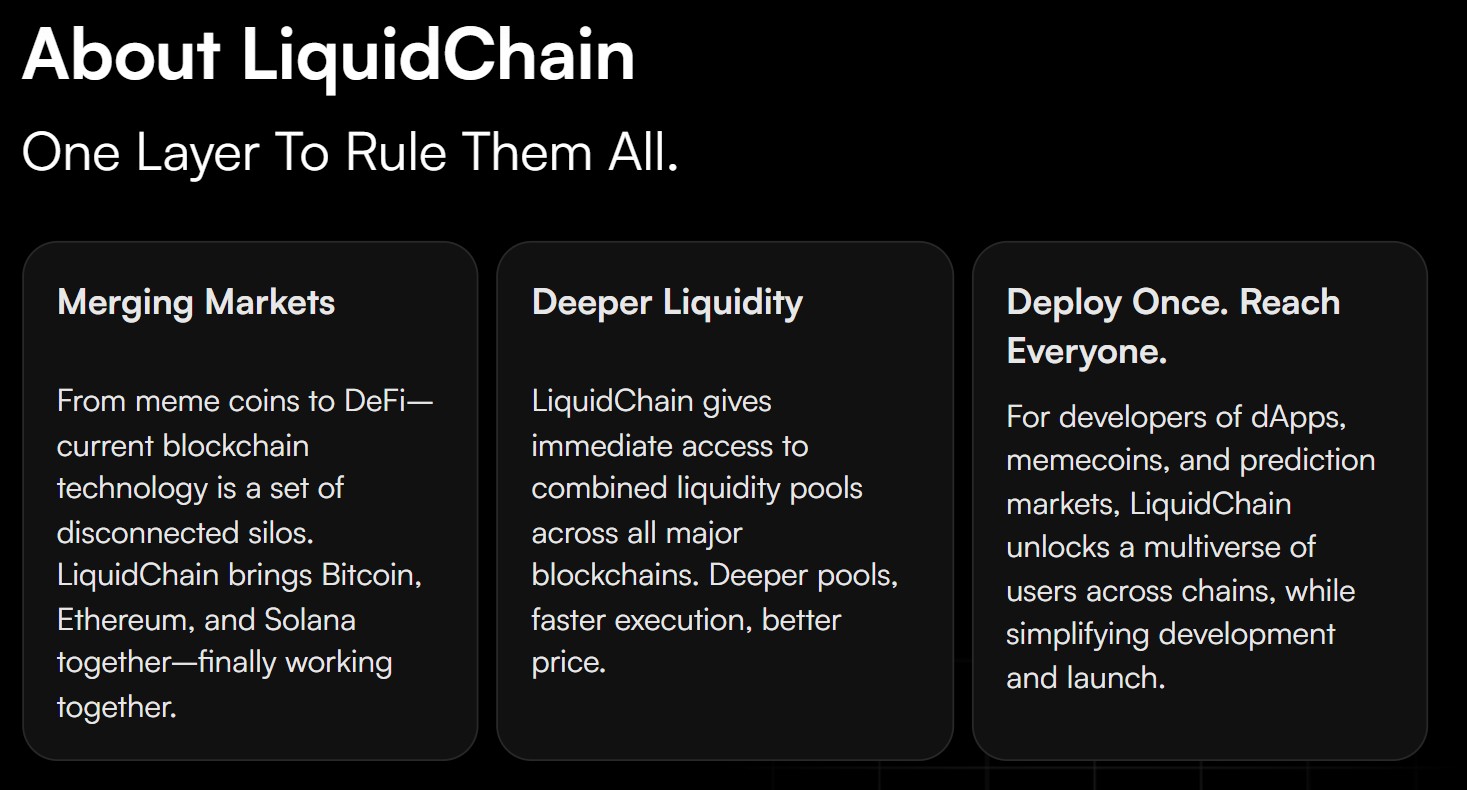
LiquidChain does not need any of those networks to lose – but just let users move around all three without the cost, friction, and security risks that come from bridging and wrapping.
This gives LIQUID a different source of upside from a token attached to a single application. Demand can come from users paying network fees, developers deploying cross-chain applications, participants staking tokens, and governance activity as the ecosystem expands. Success is not guaranteed – building secure, atomic interactions across fundamentally different chains is difficult – but the problem is real, visible, and becoming more expensive as crypto’s separate economies grow.
Raising more than $900,000 before an exchange listing indicates that investors have noticed the scale of that opportunity. The 1232% staking APY also gives presale participants a way to increase their token holdings while waiting for the network’s broader rollout.
Crypto’s Future May Be Built Between the Chains
Blockchains were created to remove barriers, yet ironically, the industry has spent much of its history constructing new ones between competing networks.
LiquidChain says that the next important piece of infrastructure will not be another destination – it will be the road between them. It is a layer capable of carrying capital, applications, and users across crypto without forcing them to care where one network ends and another begins.
Layer 3 – with LIQUID leading the charge – can mark the moment crypto stops behaving like a collection of disconnected experiments and begins operating as one market.
About Author

About Author