


Best Crypto to Buy: Can LIQUID Solve the Problem of Multi-Chain?

Crypto has spent years celebrating the rise of multiple successful blockchains – the awkward part is that users increasingly have to live with all of them.
Bitcoin is trading at $68,471.98 after gaining 5.72% over the past day, while Ethereum has jumped 8.65% to $2,082.44. Both are also firmly higher over seven days. Solana, meanwhile, is up 8.45%. As ever majors pump along with Bitcoin, but in terms of day-to-day use, we live in a multi-chain world where no blockchain is obviously waiting to replace the others.
That creates a different problem – capital can be plentiful across crypto, yet inconveniently divided among networks that operate under different rules.
LiquidChain (LIQUID) is building specifically around that fragmentation: it is a Layer 3 protocol designed to bring liquidity and activity from Bitcoin, Ethereum, and Solana into one shared environment.
LIQUID currently costs $0.0148, the early presale has raised $940,000, and staking offers 1,202% APY. Solving a novel problem, it is one for the watchlist.
Multi-Chain Crypto Solved One Problem and Created Another
There was a time when blockchain competition looked much simpler: Bitcoin had established digital scarcity while Ethereum introduced a programmable environment for decentralized applications.
Newer chains then competed on throughput, fees, and user experience, and none managed to render the others irrelevant.
That has left crypto with several substantial economies operating alongside one another – each with substantial liquidity.
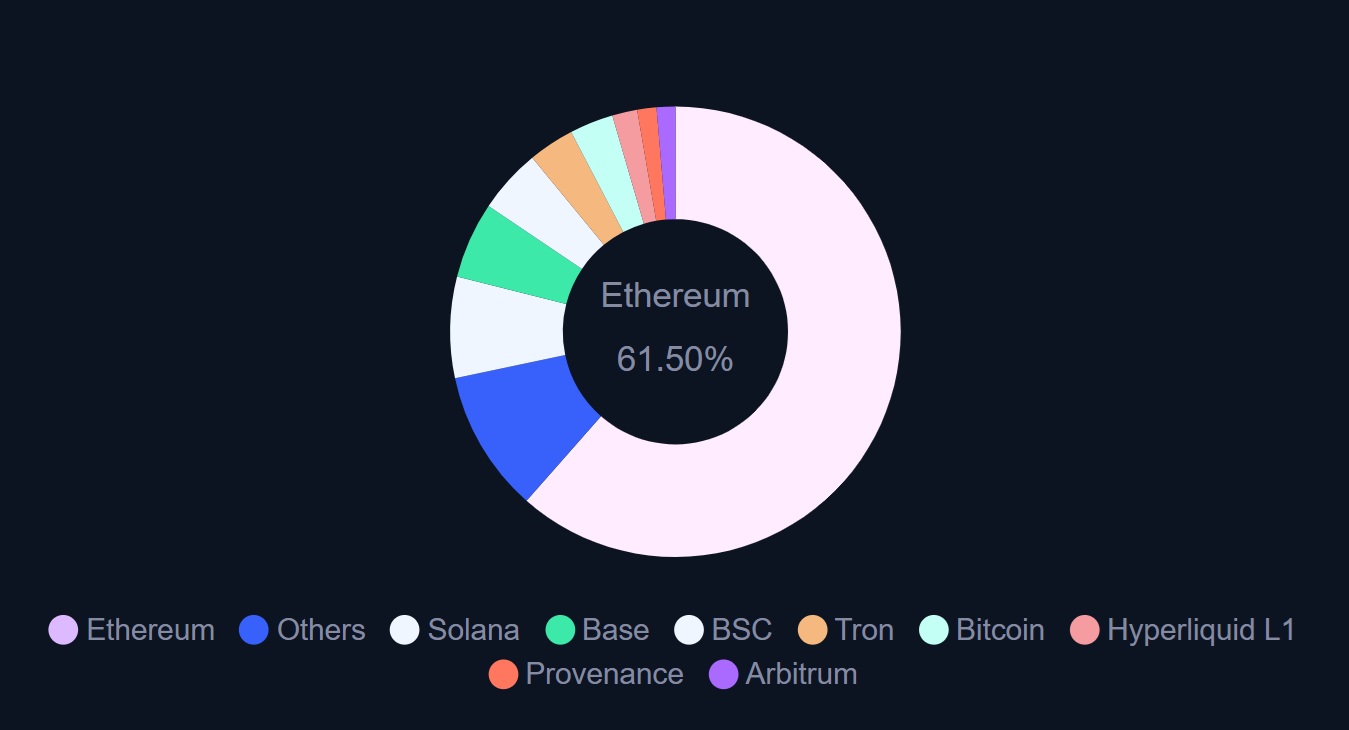
For users, however, owning assets across several successful networks can mean maintaining multiple wallets, moving funds between ecosystems, and dealing with different liquidity pools depending on where a transaction happens.
Developers inherit the same problem from the other side: Building a product for one network provides access to that ecosystem, but reaching users and capital elsewhere may require additional deployments and infrastructure.
The multichain future is here – just not especially unified.
So LiquidChain approaches that problem by treating the major chains as sources of capital rather than isolated destinations.
Its Layer 3 is designed to verify activity originating from different blockchain architectures, including Bitcoin transactions, Ethereum states, and Solana accounts. That information can then feed into a common environment where applications can interact with liquidity originating across the supported networks.
Unified liquidity pools sit at the center of the idea – instead of an application depending entirely on whatever capital happens to exist on the chain where it was deployed, LiquidChain will make liquidity across Bitcoin, Ethereum, and Solana accessible through shared infrastructure.
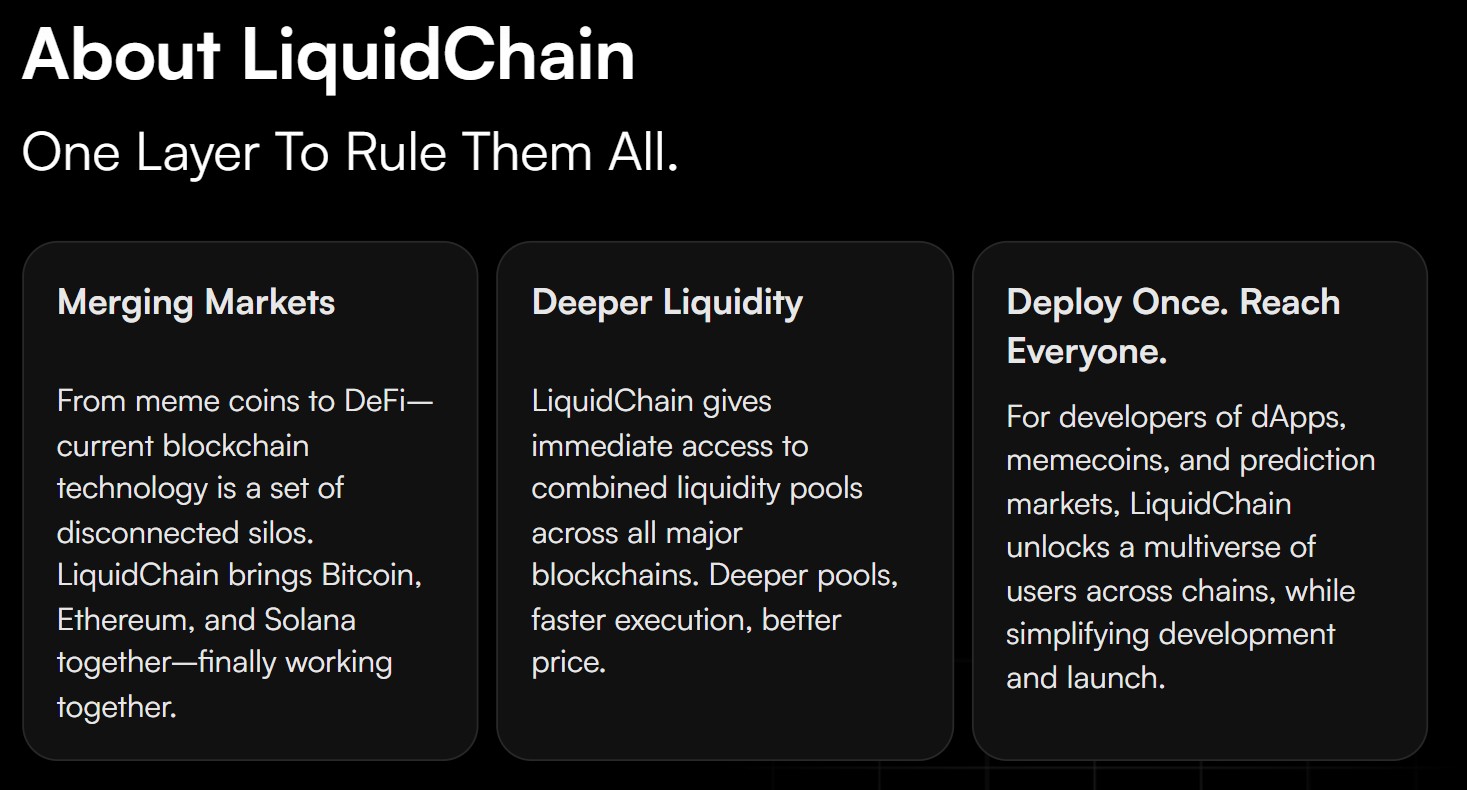
In short, users could access liquidity across BTC, ETH, and SOL without having to think as much about where their money sits, while developers could build products that reach capital across those ecosystems without maintaining separate versions of the same market.
For somebody trying to make a trade, the useful question is not necessarily whether their capital began – it is whether enough liquidity exists to execute what they want at a sensible price.
Atomic Execution Could Make Cross-Chain Activity Less Fragile
Shared liquidity is only useful if transactions involving several networks can be completed reliably. LiquidChain, therefore, also incorporates atomic multichain execution – if an operation requires several connected steps, the design calls for those steps to complete together or fail together.
That is important because cross-chain activity can otherwise leave users exposed to partial execution, in which one transaction succeeds while another leg fails, resulting in an outcome they never intended.
The practical benefit could be particularly useful for applications that need to coordinate liquidity rather than simply transfer a token between blockchains. Trading, lending, and other financial products become considerably easier to use if the infrastructure handles the network boundaries rather than asking the user to manage every step.
Best Crypto to Buy? LIQUID Bets There Will Be Several Winners
The investment case for LIQUID depends heavily on one assumption: crypto remains multichain. So far, that looks entirely plausible.
That is the opportunity LiquidChain is targeting. The presale has raised $940,000 so far, with LIQUID priced at $0.0148. Staking offers 1,202% APY during the current stage, with the rate expected to decline as more holders participate. SpyWolf and CertiK have reviewed the project contracts.
The much bigger test will arrive when its infrastructure is live and can prove a benefit to developers and users.
If that works, LiquidChain does not need to predict which blockchain ultimately wins – its opportunity comes from the probability that several of them already have.
About Author

About Author