

Cardano Blockchain Split in Two Due To Developer’s Careless Experiment, Hoskinson Involves FBI
The Cardano blockchain experienced a brief split after a pseudonymous X developer known as Homer J crafted a delegation transaction that exploited a software vulnerability. The network split caused some top cryptocurrency exchanges to suspend ADA operations, while co-founder Charles Hoskinson has involved federal law enforcement agencies.
The Effect of the Split on the Cardano Network
The Cardano blockchain started around 08:00 UTC when an invalid delegation transaction was received. The transaction passed validation on newer versions of Nodes but was rejected on older versions, resulting in two ledger states that were incompatible.
The bug was similar to one observed on the Cardano testnet a day earlier, and indicates that the exploit was tested before being deployed to mainnet, as reported by an incident report of the Cardano ecosystem organization Intersect.
Both chains kept on producing blocks during the incident, and some of the same transactions were presented on at least two chains. Although the network was functioning in principle, large exchanges such as Coinbase, Kraken, and Upbit, among others, reacted by halting the operations of ADA as they awaited which chain to gain consensus dominance.
Block explorers either froze or displayed contradictory information at the time of partition. There was an unequal state in the split between DeFi protocols, with smart contract interactions potentially running on either chain and smart contract transactions carried out on both chains.
Cardano’s Quick Action To Get the Blockchain Back on Track
The typical transaction confirmation time of several seconds (on Cardano) had increased to minutes. In some cases, transactions were not processed at all, as the network dealt with the partition. Because of this, the Cardano team began working immediately to fix the partition.
The division lasted a few hours as the Cardano Foundation, Intersect, and EMURGO began negotiating an emergency response together with Input Output Global (IOG).
The Cardano development team had released emergency patches to fix the issue within three hours of its discovery. By November 22, the Cardano network had converged, with the blockchain returning to its normal consensus and operation.
Hoskinson Involves Enforcement Agencies
Within hours of the incident, X user Homer J, a pseudonymous developer, came out and publicly declared that he was the cause of the chain split. Homer defined his actions as an accident involving careless testing and apologized to the Cardano community.
He explained that it began as a personal test of whether he could replicate the bad transaction. Homer said he found himself stupidly depending on AI instructions on how to block all traffic in/out of his Linux server without first properly testing it on testnet.
In an X post, Cardano founder and IOG co-founder Charles Hoskinson called the actions of Homer J a premeditated attack even after he had apologized. It was entirely personal and now he is attempting to make it back because he realizes the FBI is already in the picture, Hoskinson wrote.
ADA Recovers Above $0.40 After 20% Plunge
As a result of the network split, the native token of Cardano, ADA, suffered a huge price dip. The price of ADA dropped from $0.45 on November 21 to trade as low as $0.39.
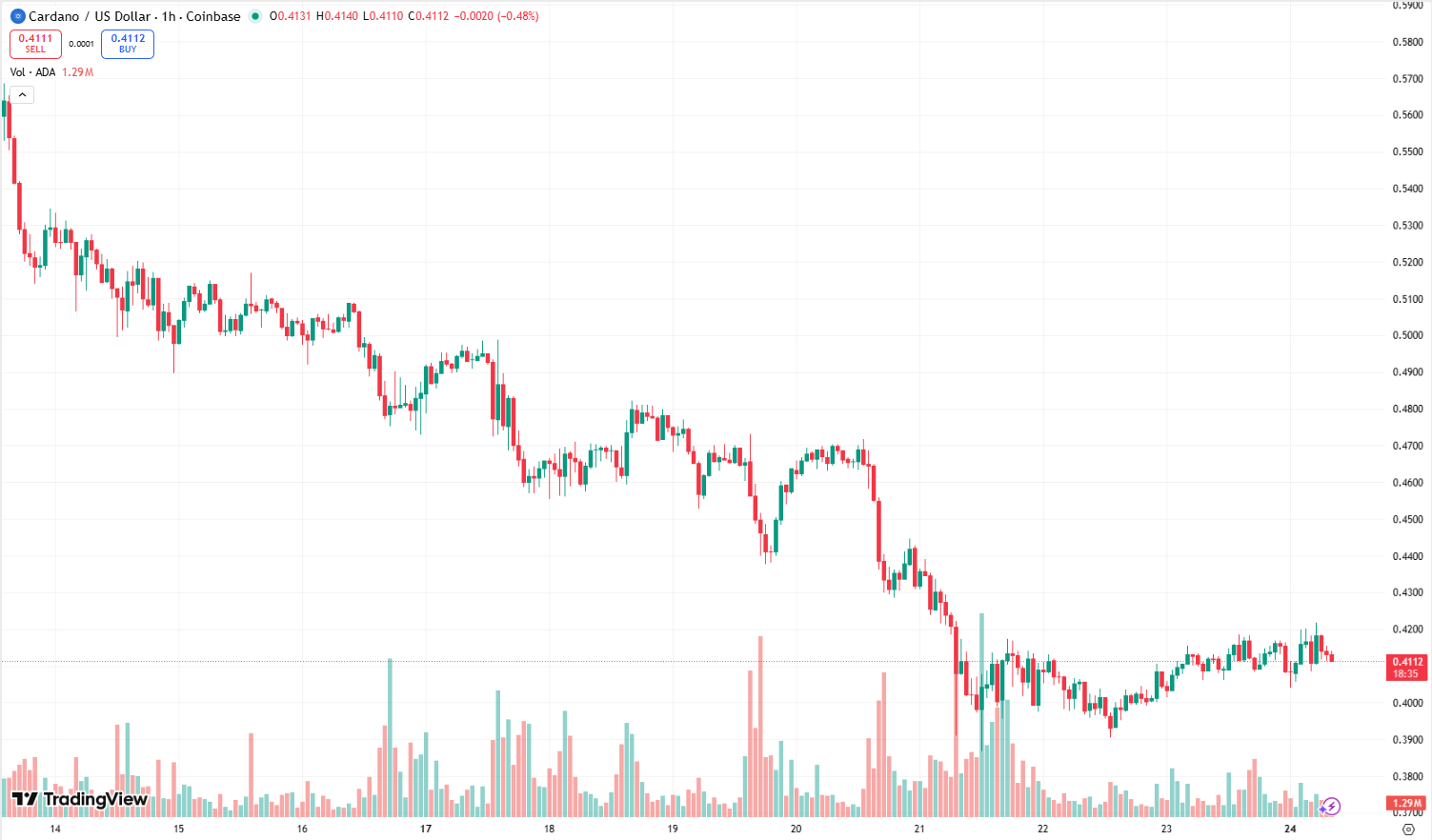
However, with the network split fixed and the broader crypto market recovering, the price of ADA has recovered and now trades around the $0.41 level.
About Author

About Author