


Circle Investigates Reversible USDC Transactions To Prevent Fraud, Crypto Community Responds

Circle, the stablecoin giant and the issuer of USDC, is looking at the prospect of introducing reversible transactions as a way of recovering funds in case of fraud or disputes. While the move will bring blockchain payments in line with traditional finance standards, the crypto community has reacted to the plans, calling it a clash with the crypto ethos.
Circle is Exploring a Reversible USDC Transaction Option
In an interview with FT, Circle’s president, Heath Tarbert, revealed that the stablecoin issuer is examining reversible transactions to help recover funds from fraud and hacks. According to Tarbert, if the mechanism is added, USDC transactions can be reversed if it is linked to fraud or hacks, while still maintaining settlement finality.
Tarbert adds that while the possibility of reversibility of transactions is being considered, the company also wants to retain settlement finality. He also adds that there is an inherent tension there between being able to transfer something immediately, but having it be irrevocable.
Circle’s proposal to make USDC transactions could make crypto operate similarly to traditional finance models. With this, more financial institutions could be encouraged to participate in crypto and DeFi. The main problem is that if DeFi protocols and decentralized exchanges adopt similar policies, they will become more centralized.
A Step Away From Traditional Crypto Ethos
While Circle’s plan could attract financial institutions and push stablecoins towards mainstream adoption, its considerations would stray from one of the basic concepts of crypto: immutability.
Blockchains are built such that finalized transactions cannot be modified. DustyBC Crypto, a top crypto figure, writes that the move will increase security and trust in stablecoins.

While supporters of reversibility argue that Circle’s move, if implemented, could increase the mainstream trust of stablecoins, many experts have called it a step away from the decentralized ethos of cryptocurrencies.
If one entity has the power to reverse the funds involved in a transaction, then cryptocurrencies will become just as centralized as traditional finance. Crypto enthusiasts worry that a system like this could lead to surveillance and oversight over transactions, which they view as contradictory to the original goals of Web3.
Is Circle Pushing for More Centralized Control Over Crypto?
Currently, in cases of fraud and hacks, Circle, like other stablecoin issuers, can freeze the assets or blacklist addresses to stop them from engaging with their fiat-backed stablecoins. However, no stablecoin issuer has the power to reverse transactions.
While the case can be argued for building more trust in cryptocurrencies, crypto enthusiasts have argued that Circle just wants more control over stablecoins.
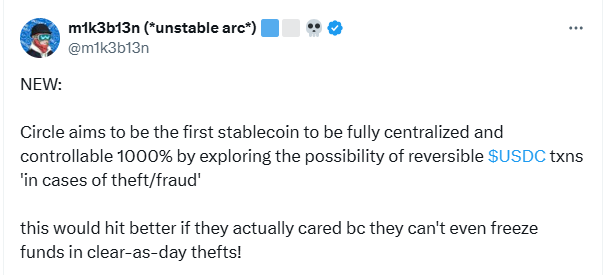
A crypto enthusiast, m1k3b13n, writes that Circle only wants centralized control, as they don’t even proactively freeze funds in accounts. A sentiment that ZachXBT, one of the leading crypto figures, shares.
It’s important to note that Circle has not yet implemented reversible transactions; the USDC issuer is only exploring possible solutions. However, it has created a divide in the crypto community, with some mulling on its potential impact (push for mainstream adoption) and others debating its implications for the crypto ethos and DeFi ecosystem.
About Author

About Author