


Crypto Market Roars to Life, but Multichain Liquidity Remains Broken: Is LIQUID the Best Crypto Presale?

Crypto has suddenly found its appetite again, with Bitcoin recording its strongest weeks in years, while Ethereum has also jumped sharply as capital returns across the market.
The move has been helped by a weaker dollar, regulatory optimism in Washington, and changing expectations around U.S. bond markets. Even with stocks under pressure, Bitcoin has continued climbing, showing just how quickly demand for digital assets has returned.
But a bigger crypto market does not necessarily create a better-connected one – Bitcoin, Ethereum, and Solana each attract billions of dollars, but their liquidity remains separated by different networks.
It’s a growing issue, but one that LiquidChain (LIQUID) is solving with a Layer 3 built around one of the most novel ideas of the year: shared liquidity across all three.
The early presale has already raised $944,000, with LIQUID priced at $0.0149, and audits already completed.
Crypto Has Plenty of Liquidity – Just Not in One Place
The latest rally makes crypto’s fragmentation easier to see. Ethereum’s weekly gain approaching 30% is particularly impressive. Those gains create larger pools of capital inside their respective ecosystems.
The problem starts when somebody wants to use capital somewhere else – moving between blockchains involves bridges, swaps, separate liquidity pools, and a tax in terms of time and gas.
Pricing can also differ depending on where an asset trades, and developers targeting multiple ecosystems need additional infrastructure simply to reach users and capital elsewhere.
It’s a mess, especially as institutional capital moves in. More successful chains create more fragmentation, not less. LiquidChain says that this will become increasingly difficult to tolerate as crypto matures.
LiquidChain Wants Three Markets to Behave More Like One
LiquidChain is developing a shared Layer 3 environment spanning Bitcoin, Ethereum, and Solana, and rather than asking users to treat each blockchain as a separate destination, its architecture is designed to make liquidity across the three ecosystems accessible through one infrastructure.
Under the hood, LiquidChain verifies what is happening on Bitcoin, Ethereum, and Solana in real time, then lets those assets and transactions interact within a single shared execution layer. Instead of wrapping an asset, bridging it elsewhere, and hoping every step completes, the network coordinates the entire transaction and settles all required parts together (or not at all).
For users, it means all of the major chains are accessible without repeatedly moving money between separate ecosystems. For developers, it means building products that can reach capital across all three rather than maintaining isolated markets for each network – if they plug into LIQUID, they can support the three major chains automatically.
End result? All the complications of a multichain market are increasingly disappearing, and crypto can be treated as one market.
Why Fragmentation Could Become a Bigger Problem
There is an easy assumption that better bridges eventually solve the multichain problem – but connectivity and liquidity are not quite the same thing.
Two networks can communicate while still maintaining different markets, different pools of capital, and different prices – moving an asset does not automatically make all the liquidity surrounding that asset available everywhere else. Asymmetric information can cause one person to win and another to lose, rather than treating them fairly.
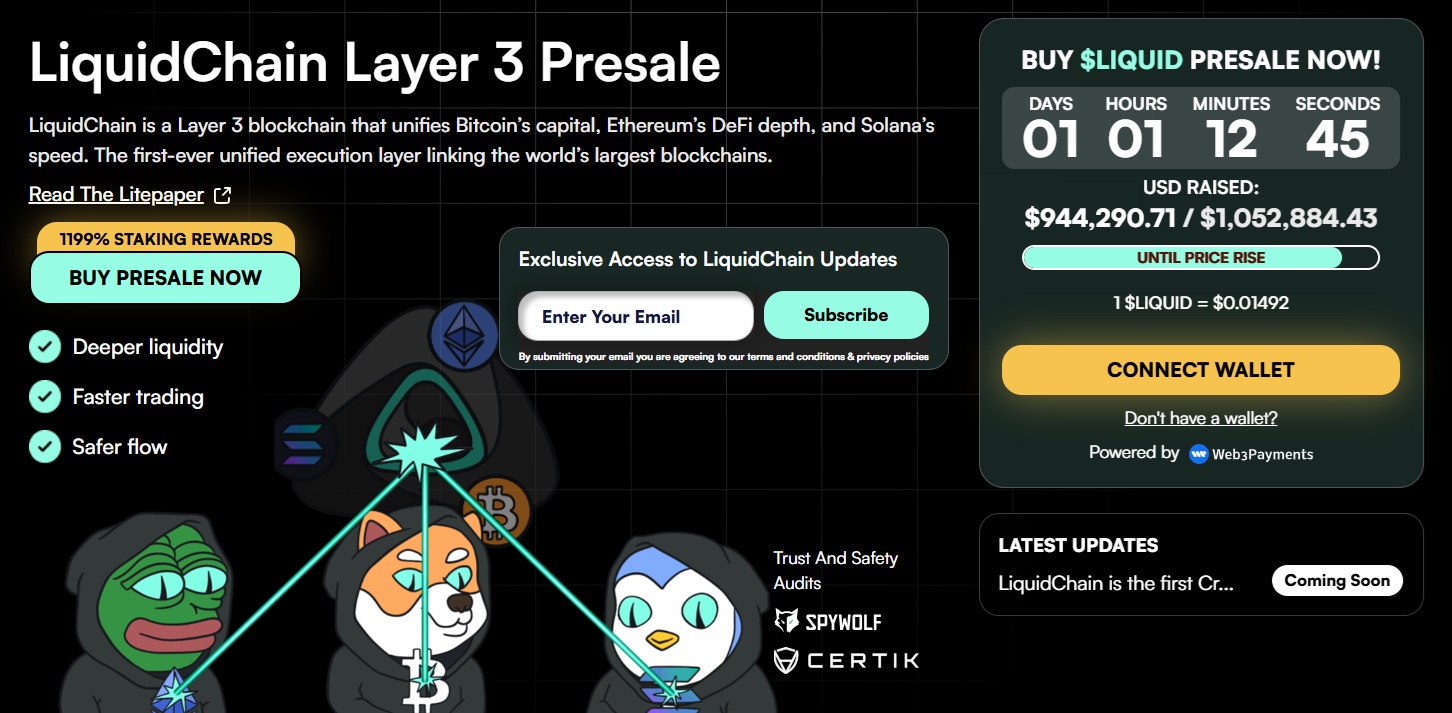
Whereas a single protocol that unites these silos into a single pool unlocks assets and information for everyone.
So LiquidChain’s major opportunity comes from several large blockchain economies continuing to grow – and being the infrastructure people use to access that liquidity.
Is LIQUID the Best Crypto Presale?
LiquidChain remains an early-stage proposition, and LIQUID costs $0.0149, raising $944,000 so far. Staking offers 1,200% APY at the current stage, with the yield expected to decline as more holders join.
The relatively small raise is interesting compared to the scale of the problem LiquidChain wants to address: Bitcoin, Ethereum, and Solana already represent enormous pools of capital – LIQUID does not need to create those markets from scratch.
The important test post-launch will be showing that users and developers want shared access to them, but the underlying direction is becoming harder to dismiss. Crypto is growing into a collection of major ecosystems rather than consolidating neatly into a single chain.
SpyWolf and CertiK have reviewed the project contracts, and it appears the project plans to launch on mainnet within the next six months.
Until then, LiquidChain does not need another blockchain to win – the opportunity comes from several of them continuing to win at the same time.
About Author

About Author