


Ethereum Price Drops -3.5% as Vitalik Buterin Speaks on its Role in AI-Driven Future
Vitalik Buterin Details Ethereum’s AI Integration Roadmap

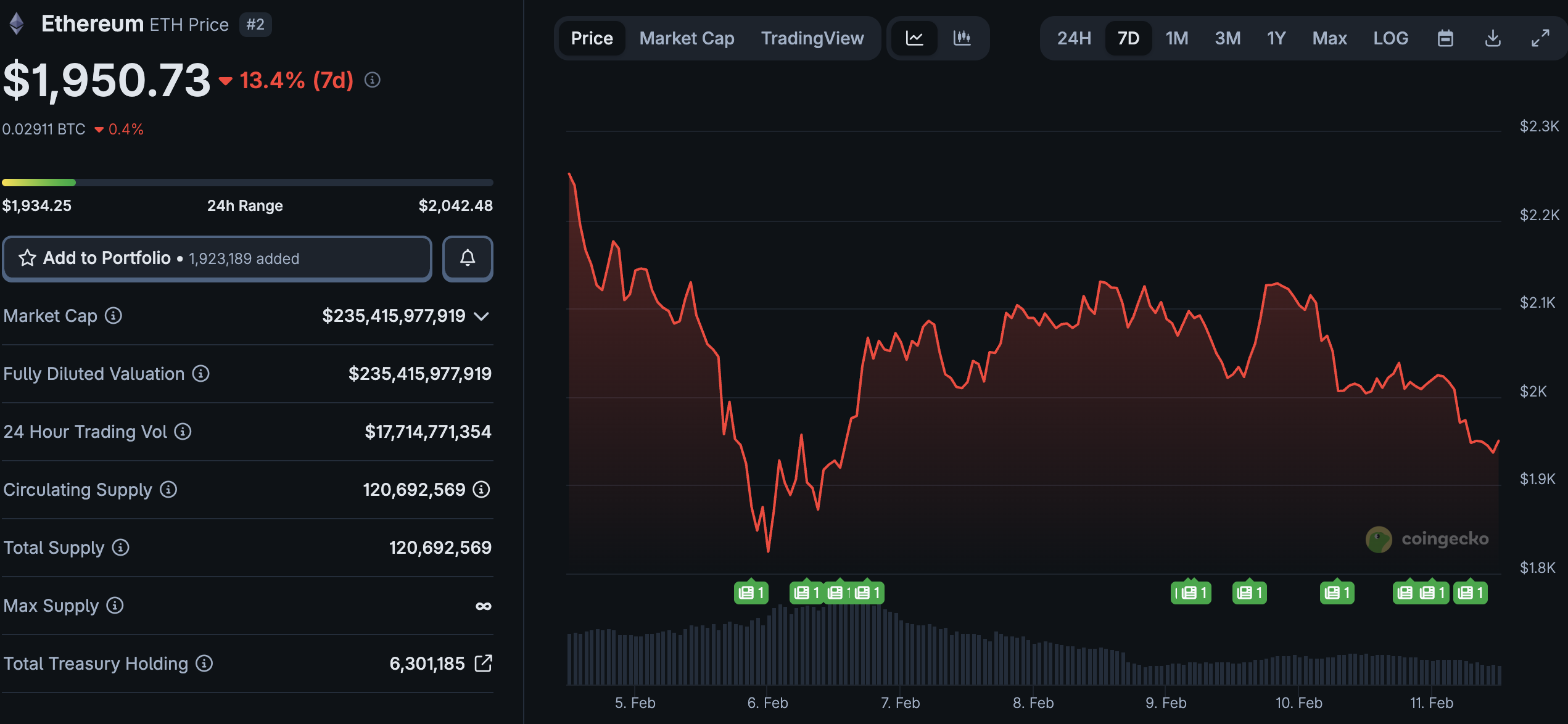
Ethereum co-founder Vitalik Buterin has unveiled a strategic framework positioning the blockchain as a critical governance and verification layer for the burgeoning AI crypto sector. Responding to accelerating industry demands for autonomous infrastructure, Buterin’s roadmap highlights a shift toward “defensive acceleration” to ensure decentralized oversight of AI agents. The announcement comes as the Ethereum price dropped -3.5% overnight, losing the key $2,000 support level for the second time since the monumental crypto crash on February 5.
The new vision serves as a direct counterpoint to Solana co-founder Anatoly Yakovenko’s recent advocacy for unrestricted AI development. Buterin argues for a more structured approach, prioritizing safety, privacy, and decentralization over raw computational speed.
This philosophical pivot aligns with the Ethereum Foundation’s ongoing security initiatives, which have increasingly focused on future-proofing the network against emerging technological threats such as quantum computing.
What Does Vitalik Buterin’s Decentralized AI Crypto Framework for Ethereum Look Like?
Vitalik Buterin’s technical blueprint rests on four pillars to support autonomous agent economies: trustless privacy via zero-knowledge proofs (ZK proofs), blockchain-based verification, AI-assisted governance, and robust reputation systems.
A central component of this architecture is the integration of new standards like ERC-8004. As ERC-8004 goes live, enabling AI-to-AI interactions, the network can now support sophisticated reputation stamping for autonomous agents without relying on centralized gatekeepers.
Optimizing throughput remains a prerequisite for utilizing Ethereum as a “verification layer” for high-frequency AI activity. Recent network upgrades have proven effective in this regard, with ETH transaction fees hitting multi-year lows just as the demand for computational data availability rises.
Vitalik emphasized the urgency of this pivot in his roadmap, stating, “2026 is the year we take back lost ground in computing self-sovereignty.” This marks a definitive move away from convenience-first trade-offs toward user-controlled infrastructure capable of rivaling centralized giants like Google and OpenAI.
DISCOVER: Top Crypto Presale to buy in February
What Does This Mean for the Ethereum Price in the Long Run?
Positioning Ethereum as the bedrock for the AI crypto economy could significantly alter its valuation models, shifting investor focus from simple transaction volume to high-value settlement and data verification.
This ecosystem’s maturation continues to attract institutional confidence; for instance, Fidelity recently launched a dollar-backed stablecoin on Ethereum, underscoring the traditional finance sector’s belief in the network’s durability.
According to CoinGlass data, spot Ethereum ETFs have also enjoyed two consecutive green days, with positive flows totaling over $70M between February 9 and 10.
However, after losing $2,000 again overnight as the Ethereum price dropped -3.5%, the short-term goal for investors is to regain that key level. Flipping $2,100 would bring ETH USD back above a long-standing support zone and be key to any hopes of a sustained move to the upside.
Crypto Twitter analyst @TedPillows has highlighted a similar setup, emphasizing the importance of regaining $2,000. He points out that a failure to do so could see ETH USD drop to its next support zone between $1,800 and $1,850.
Put simply, the Ethereum price is currently stuck in a tight range between $1,800 and $2,000, and until either direction is breached, expect volatility. Keeping an eye on ETF flows and on-chain trading volume will be key indicators when attempting to figure out ETH’s next move.
EXPLORE: Best Crypto Meme Coins to buy in 2026
Drop CoinNews a Follow on X and Telegram for all of the Latest Crypto Market Updates and Professional Market Analysis.
About Author

About Author




