


Next 50X Crypto? Why LIQUID Is One of the Best Altcoins Right Now

Crypto’s largest networks have spent years becoming faster, richer and more specialized – but they are still rubbish at communicating with one another. Bitcoin holds the industry’s deepest pool of capital, Ethereum supports DeFi, and Solana offers the speed needed for applications that cannot wait several minutes for settlement. But each advantage remains largely confined to its own ecosystem.
That division is becoming harder to ignore in a hesitant market. Bitcoin trades at $64,134.49 after falling 1.19% over 24 hours, although it remains 1.58% higher across seven days. Ethereum has dropped 1.42% to $1,864.68, leaving its weekly gain at 2.35%. The total cryptocurrency market is valued at approximately $2.19 trillion, while Bitcoin controls 58.7% of it.
The next phase of crypto may well belong to infrastructure that connects existing networks rather than attempting to replace them. That is the idea behind LiquidChain (LIQUID), a project priced at $0.0148 in presale after raising more than $917,000. Its current staking pool offer s1,228% APY.
How LiquidChain Turns Separate Networks Into One Market
Crypto does not lack liquidity – it lacks liquidity in the right place at the right moment.
A trader may hold Bitcoin but need access to an Ethereum lending market, or a developer may build on Solana for its speed but still want Ethereum users and Bitcoin capital. At present, crossing those boundaries involves bridges, wrapped assets, separate wallets, and repeated transactions. Each additional step introduces friction and another place where execution can fail.
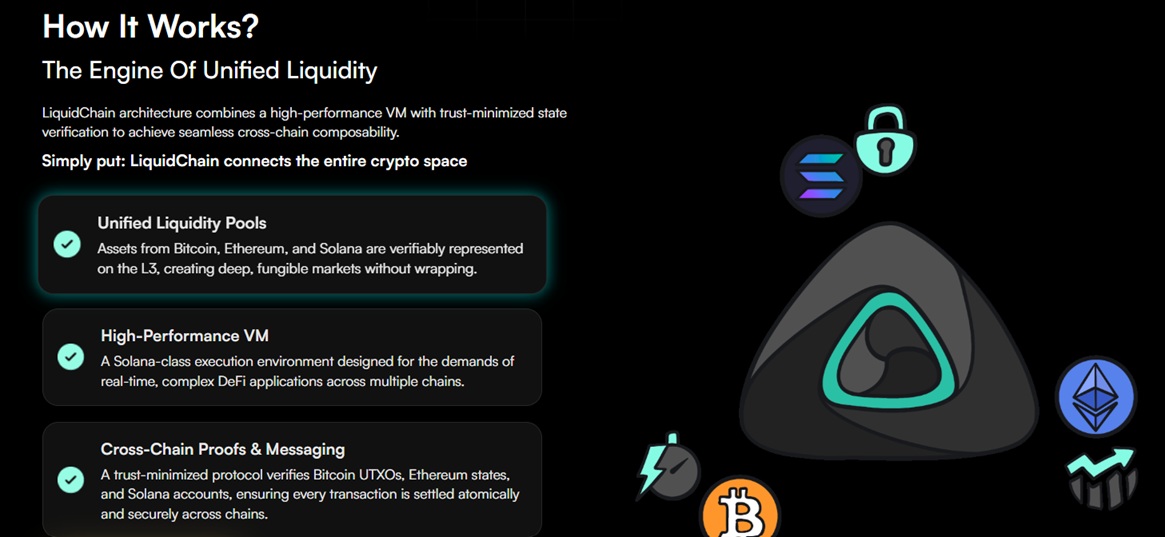
LiquidChain is designed as a shared settlement and execution layer across Bitcoin, Ethereum, and Solana, offering unified liquidity pools in which assets from the three networks are verifiably represented on the Layer 3. The intention is to create deeper cross-chain markets without depending on conventional wrapped versions of those assets.
The system combines pools from all three chains in Liquid’s Virtual Machine, a high-performance execution environment designed for real-time DeFi operations. Trust-minimized proofs and messaging are intended to verify the states of Bitcoin, Ethereum, and Solana – all at once. In practical terms, either the connected parts of a cross-chain transaction complete together, or none of them do.
That could also change how developers approach multi-chain products: rather than rebuilding an application for several networks and dividing its users between separate deployments, a team can deploy through LiquidChain and reach liquidity across all three. One application could theoretically serve Bitcoin holders, Ethereum’s DeFi community, and Solana’s high-frequency users.
So the ambition, in layman’s terms, is not to make the underlying blockchains irrelevant but to make their boundaries less visible.
LIQUID (the token) is intended to support network participation, governance, and staking, while liquidity providers will receive rewards proportional to their contributions to unified pools.
Could LIQUID Become the Next 50X Crypto?
No credible analysis can promise a 50x return – the better question is whether LiquidChain is addressing a market large enough to support substantial growth during 2026 and 2027.
Its opportunity is broader than the success of any single chain. Bitcoin, Ethereum, and Solana already possess users, developers, and capital. LiquidChain can make movement between them easy enough that traders and developers prefer a shared execution layer to today’s fragmented process.
That distinction gives LIQUID a plausible route to product demand: Deeper pools can reduce slippage and shared liquidity can make smaller markets more usable. Multichain deployment can lower development costs and atomic settlement removes part of the uncertainty associated with moving value between separate networks.
LiquidChain’s contracts have links to audits from SpyWolf and CertiK, and the mainnet launch (and exchange listings) are expected this year.
The early presale’s $917,000 raise shows that this argument has already found an audience. The next question rests on whether LiquidChain can turn three powerful but disconnected economies into one more useful market.
Crypto’s Next Breakthrough May Be Between the Chains
The industry has spent much of its history building faster islands – LiquidChain says that the greater prize lies in constructing the routes between them.
Should its Layer 3 operate as planned, LIQUID would sit where Bitcoin’s capital, Ethereum’s financial applications and Solana’s speed meet. At $0.0148, the token remains an early-stage bet on that future.
The technology still needs to be delivered, adopted, and used at scale. But the problem is real, and its market already exists.
About Author

About Author