Next Crypto to Explode? Bitcoin Hyper Revisits Satoshi’s Original Payments Vision

Bitcoin began with an unusually simple ambition – Satoshi Nakamoto’s 2008 white paper described a system for sending electronic cash directly from one person to another without routing the payment through a financial institution.
Nearly two decades later, Bitcoin has succeeded spectacularly as an asset, yet everyday payments have become a smaller part of its identity than scarcity, custody, and long-term holding.
CoinMarketCap says BTC accounts for around 58% of the entire crypto market, while Ethereum represents about 10.5%. Yet Ethereum and Solana built much richer environments for applications, trading, and programmable finance because their networks were designed for activity that Bitcoin’s deliberately conservative base layer handles less easily.
That leaves an enormous asset base looking for better infrastructure, a role Bitcoin Hyper (HYPER) is going hard for. The project’s incoming Bitcoin Layer 2 is intended to make BTC faster to move and usable for real-world, instant payments.
The presale has raised $33 million so far, with HYPER costing $0.01368 and staking offering 35% APY – a notable raise, showing a massive audience that understands the goal. Perhaps the route back toward electronic cash is not about changing Bitcoin itself, but about building something faster on top of it.
How Bitcoin Hyper Gives BTC a Faster Execution Layer
Bitcoin Hyper separates the asset from the workload, with BTC’s base chain, as ever, focused on security, decentralized verification, and an extremely durable transaction history. But BTC’s throughput, commonly estimated at around 7 transactions per second, becomes limiting when considering millions of people making everyday payments or constantly interacting with applications.
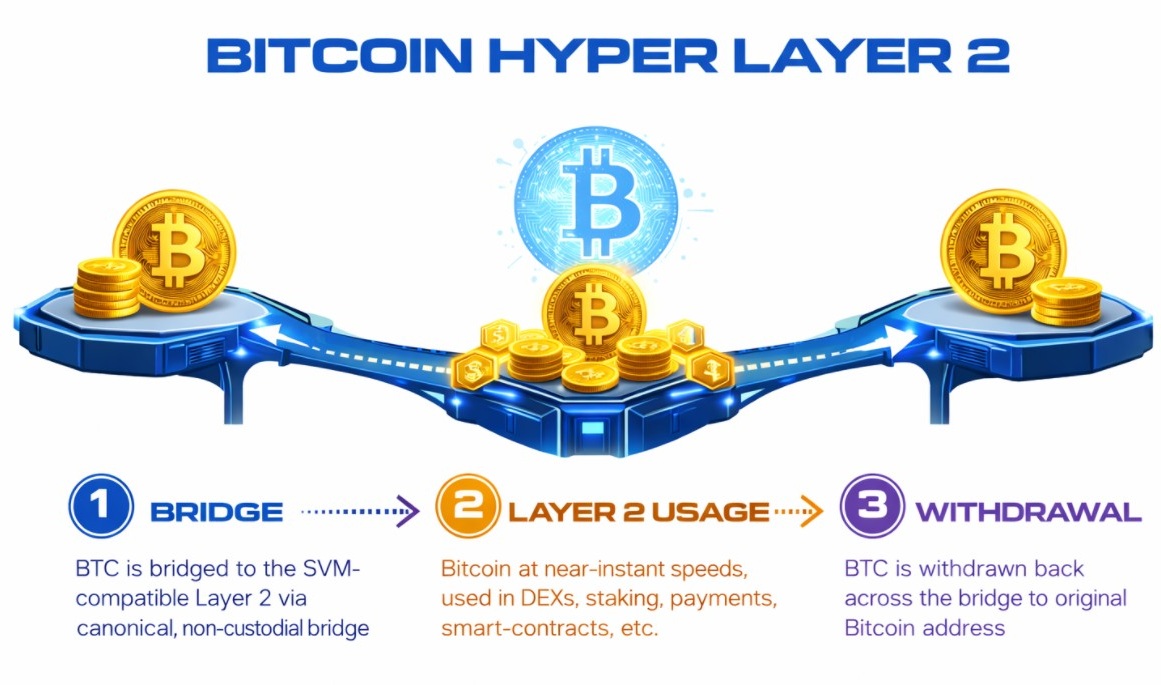
Bitcoin Hyper moves that activity onto a Layer 2 powered by the Solana Virtual Machine. The SVM is the execution environment for Solana’s high-throughput applications, and Bitcoin Hyper uses it to enable fast transfers, decentralized exchanges, staking products, and other BTC-focused services. Once live, users will be able to send and receive BTC on the Layer 2 with near-instant finality.
The important change is what it feels like to a user: Bitcoin no longer has to be an asset that is cumbersome to move whenever someone wants to use it. Payments and application activity occur in the faster environment, while Bitcoin remains beneath as the settlement foundation.
Bitcoin Hyper then batches and compresses all of the Layer 2 transactions, uses zero-knowledge proofs to demonstrate their validity, and periodically commits the resulting state to Bitcoin Layer 1.
That division lets Bitcoin continue doing what it does particularly well without forcing every coffee purchase, trade, or application interaction through the base chain.
HYPER is intended to pay for transactions on Layer 2, while holders can stake it and eventually participate in governance. Coinsult and SpyWolf are listed as auditors, and the launch is expected within 2026.
Could HYPER Be the Next Crypto to Explode?
Bitcoin commands almost three-fifths of the cryptocurrency market, but its L2 ecosystem is lacking, and decentralized finance has effectively looked elsewhere. Ethereum became home to an enormous ecosystem precisely because ETH could be put to work for exchanges, lending markets, stablecoins, and applications.)
That does not mean Bitcoin Hyper automatically inherits Bitcoin’s users or capital – but it does mean it is building beside a much larger existing asset than a new Layer 1 normally has available.
Satoshi’s original vision concerned payments, not a digital asset sitting permanently inside cold storage – the Bitcoin white paper specifically imagined direct electronic payments and even discussed how existing payment systems made small, casual transactions impractical.
While Bitcoin’s later evolution into “digital gold” has been enormously successful, it does not have to be the end of the story.
Layer 2 offers a way to revisit the older ambition without asking Bitcoin’s base chain to sacrifice the traits that made it valuable, and the $33 million already committed to HYPER shows that presale buyers see value in it.
At $0.01368, the token remains in its presale phase, while the 35% staking APY incentivizes early holders to remain involved before the network’s application economy develops.
The addressable market is difficult to ignore – Bitcoin already possesses the capital, and HYPER is trying to supply the missing places to spend, trade, and use it.
Bitcoin Does Not Have to Choose One Identity
Bitcoin becoming a store of value did not erase the first sentence of its white paper – it can remain an asset people hold for years, while Layer 2 networks experiment with what happens when owners actually want to use some of that wealth. The two ideas are not mutually exclusive.
That may ultimately be Bitcoin Hyper’s most compelling argument: it does not ask Bitcoin to become Ethereum or Solana. It simply borrows the kind of execution environment that made those networks useful, then places Bitcoin back at the center of it – and makes it spendable again.
About Author

About Author