


Next Crypto to Explode: LiquidChain Can Turn Three Blockchains Into One Market

Crypto has no shortage of capital – but getting it to work together? Much harder.
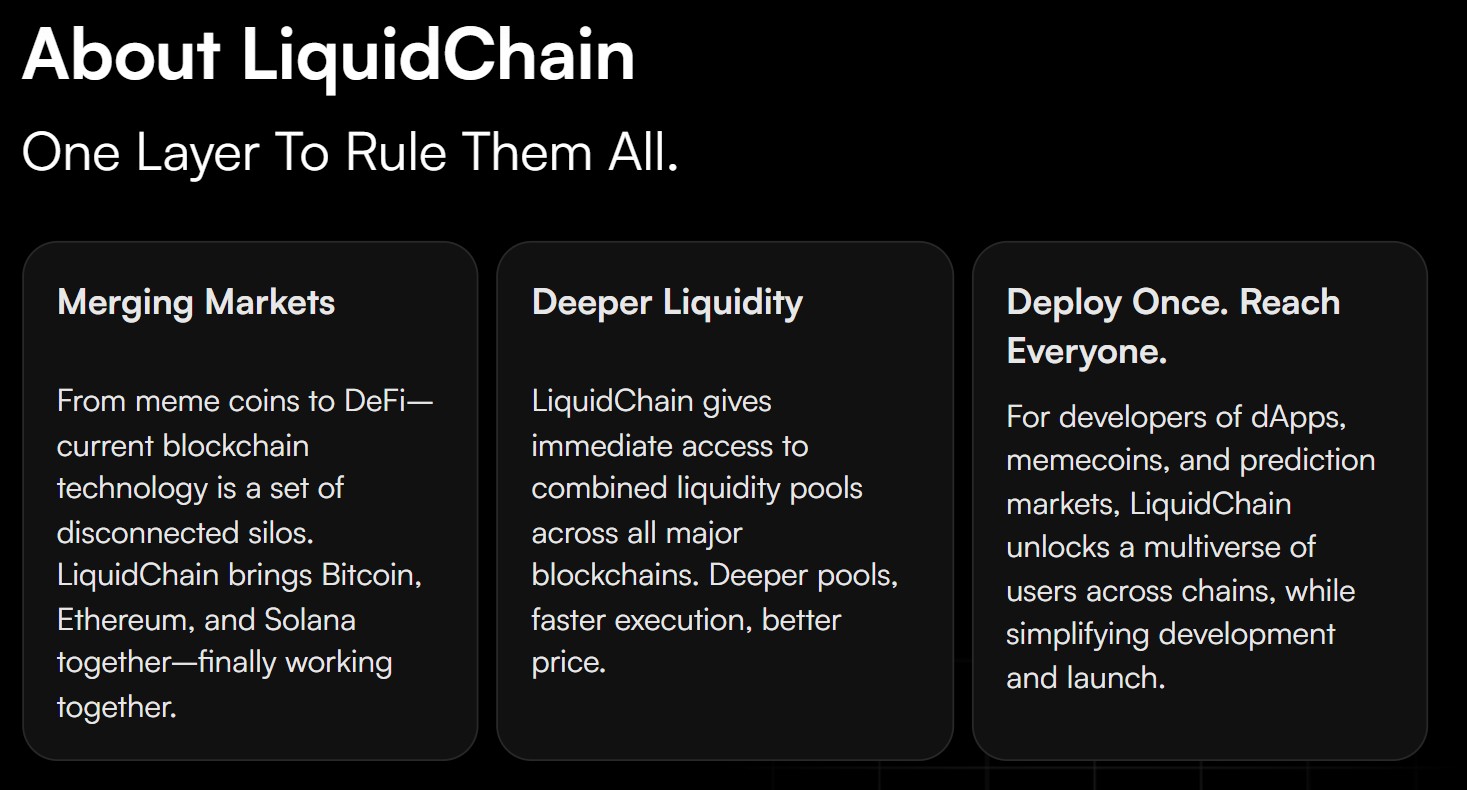
While Bitcoin, Ethereum, and Solana have each developed large market caps, their assets and applications remain divided among them. A trader on Ethereum cannot simply tap Bitcoin liquidity, while developers wanting to reach Solana users need another deployment, another set of integrations, and another pool of capital.
LiquidChain (LIQUID) takes a more ambitious approach than simply building another bridge between those markets. Its Layer 3 is designed as a shared execution and verification layer for Bitcoin, Ethereum, and Solana, allowing applications to reference activity and use liquidity across all three within the same system.
That gives LIQUID a fairly simple idea with some serious technology underneath it: three major blockchains, one market.
The presale is now closing in on its first $1 million, with $950,000 raised and LIQUID priced at $0.0149. If its multichain architecture works as intended, LiquidChain can become one of the more interesting infrastructure projects heading toward launch.
LiquidChain Is Building an Execution Layer, Not Just Another Bridge
LiquidChain works by importing verifiable information from Bitcoin, Ethereum, and Solana into a high-performance execution environment based on the Solana Virtual Machine.
Its cross-domain system can verify Bitcoin UTXOs, Ethereum account states, and Solana accounts, allowing a LiquidChain transaction to reference activity across several networks rather than treating each blockchain as a separate world.
That is where the Layer 3 designation starts to make more sense – not attempting to replace any of the three underlying networks, but coordinating information and liquidity between them.
Cross-chain messages are packaged with proofs of their source state and execution information before being verified inside LiquidChain’s execution system. Its technical lightpaper says messaging infrastructure, including LayerZero, Axelar, and Wormhole, is used to transmit those proofs between networks.
Importantly, LiquidChain describes the system as non-custodial – it does not need to accumulate everyone’s liquidity inside the L3 itself, and assets can be represented across the system without the conventional wrapped-token model.
There is another useful protection built into the design: multichain operations are intended to be atomic. Either all required actions are completed successfully, or the operation rolls back rather than leaving half of a transaction stranded on one network.
That makes LiquidChain more than a pipe for moving tokens from A to B.
What LiquidChain Can Do for Traders and Developers
The practical case starts with liquidity – imagine a decentralized exchange that can reach capital associated with Bitcoin, Ethereum, and Solana instead of depending on a comparatively shallow pool sitting on one chain.
Deeper liquidity can reduce slippage and improve pricing, particularly for larger trades – LiquidChain’s own platform describes unified liquidity pools as a route toward faster execution and better prices.
Lending applications can similarly reach assets and borrowers across several ecosystems, and prediction markets or trading apps can be built around a single execution layer without forcing users to choose a specific blockchain first.
For developers, that can remove another headache – instead of building one application for Ethereum, adapting it for Solana, and then finding another way to reach Bitcoin capital, LiquidChain’s model allows them to deploy once, and reach all three. The underlying protocol handles much of the cross-chain verification and coordination.
LiquidChain is also developing a Unified Liquidity Application as an interface for the system, with planned functions including portfolio aggregation, cross-chain asset analytics, atomic swaps, liquidity routing, and access to its Proof Registry.
A trader gains access to deeper markets, and a developer can reach a much broader audience with a single deployment. And users can interact with assets across major ecosystems without constantly thinking about wrapped tokens and separate application versions.
That is the product LiquidChain is building.
Can Exchange Listings Make LIQUID the Next Crypto to Explode?
LIQUID remains at a much earlier stage today – its presale has raised $950,000, putting the project close to its first $1 million milestone, and priced at $0.0149.
Presale staking currently offers 1,190% APY, and LiquidChain has undergone security reviews from SpyWolf and CertiK.
Exchange listings will be an important test – presale demand has brought LIQUID close to $1 million, but public markets will expose the token to a much larger pool of traders while development continues around the Layer 3 itself.
The technical ambition is substantial, but the opportunity is also easy to see.
Bitcoin, Ethereum, and Solana do not need to disappear for LiquidChain to succeed – quite the opposite: the more capital and applications each ecosystem attracts, the more valuable the infrastructure connecting them can potentially become.
If LiquidChain turns three increasingly separate blockchain economies into something closer to a single, accessible market, LIQUID has a strong case for becoming the next crypto to explode as it moves from presale to exchange trading.
About Author

About Author