


Next Crypto to Explode: LiquidChain Heats Up as Plans to Unite All the Chains Catch Hold

Crypto has spent years building islands: Bitcoin became the reserve asset, Ethereum became the financial laboratory, and Solana became the speed machine.
Layer 2s came next to make each of those worlds cheaper, faster, or more usable – the problem is that every improvement also added another border. We ended up with more chains, more bridges, more wallets, and more liquidity split across ever-shallower pools.
So while CoinMarketCap data shows the total crypto market cap at around $2.21 trillion, the industry is still waiting for infrastructure that can make the next decade less fragmented.
That is why LiquidChain (LIQUID) is building a niche – and potentially a revolution. The project is a Layer 3 network designed to unify Bitcoin, Ethereum, and Solana into a single execution layer. The early presale has now raised $858,000, with LIQUID priced at $0.0147 and staking at 1,300% APY. Those numbers explain some of the attention, but the bigger idea is simpler: crypto does not need another isolated chain as much as it needs a way for the strongest chains to behave as if they belong to the same economy.
LiquidChain is the Layer “Above Them All”
Bitcoin, Ethereum, and Solana each have their own rules, strengths, and trade-offs. Bitcoin is the deepest store of value in crypto, but it was not built for high-speed DeFi. Ethereum has the largest smart contract economy, but it still depends heavily on scaling layers. Solana offers speed and low fees but lives within its own ecosystem.
While Layer 2s reduced fees, increased throughput, or moved execution away from the main network, they also made crypto more complex. A user might hold assets on one network, trade on another, stake somewhere else, and bridge between them with a constant low-level fear that one wrong click will be expensive.
LiquidChain’s Layer 3 can sit atop this mess, making it feel like a single market. Rather than wrapping assets and moving them through conventional bridges, LiquidChain verifies Bitcoin UTXOs, Ethereum state, and Solana accounts through cross-chain proofs, then represents that liquidity on its Layer 3 – traders and dApps can then execute across chains through one SVM-style environment.
In practical terms, that means the user should not have to think so much about which chain the transaction sits on. The network handles the routing, liquidity access, and cross-chain execution in the background – no bridges, no wrapping, just LiquidChain picking from each pool as necessary.
That is important – the best infrastructure usually disappears from view (you do not think about payment rails every time you tap a card). Crypto has often forced users to understand too much about the machine, whereas LiquidChain is betting that the next step is abstraction: keep the power of multiple chains while removing the costs of moving between them.
For developers, that could also be powerful. Instead of building only for one chain’s users and liquidity, a Layer 3 model gives dApps a broader surface area – build for LiquidChain and reach Bitcoin liquidity, Ethereum assets, and Solana-style speed in one environment.
Could LIQUID Be the Next Crypto to Explode in 2026?
The case for LIQUID is that crypto’s existing structure has become awkward. The industry has scale, capital, and users, but they are scattered. A good Layer 3 turns the pile into something usable.
Bitcoin dominance remains high, which means the market is still anchored to the largest asset, yet the most active parts of crypto live elsewhere: DeFi on Ethereum and its scaling layers, and high-speed experimentation on Solana, while new consumer-facing products are being developed across smaller networks.
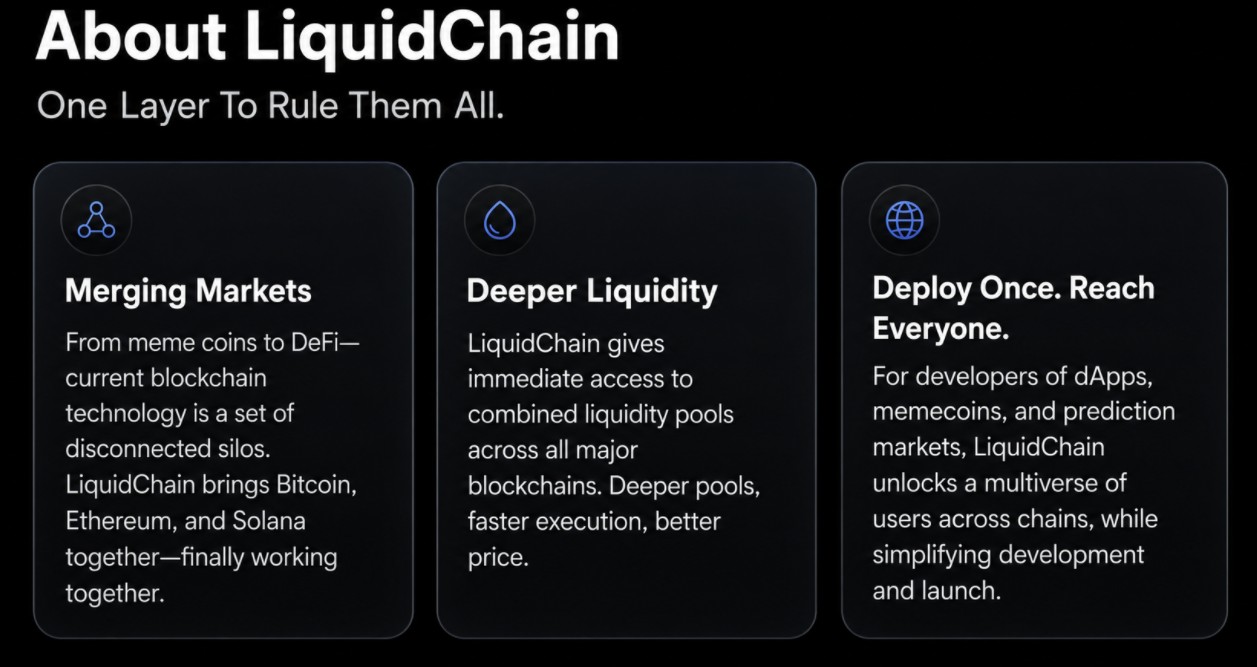
The opportunity lies in joining those pieces without making users feel as though they are crossing borders every time they act.
LiquidChain also has the advantage of a clean narrative – some projects need paragraphs of explanation before the reader knows why they exist. LIQUID’s idea is easier to grasp: unite the chains, deepen liquidity, and make crypto feel less broken.
The presale raise is still early, but $858,000 is enough to show momentum. The 1,300% staking APY will attract yield-focused buyers, though the bigger test will be whether LiquidChain can turn that early interest into network use. If it can, LIQUID stands to gain a market cap up there with the biggest of L2s, and even beyond.
If LiquidChain can reduce the borders, its value proposition becomes uniting all the chains.
The Chain That Gets Out of the Way
The strongest version of LiquidChain is not a future where users talk about Layer 3 all day, but a future where they stop caring which chain they use.
That is why LIQUID is catching attention now. The market needs infrastructure that makes crypto easier to use without shrinking it. If LiquidChain can deliver on that promise, the project could become one of the more compelling projects of 2026.
About Author

About Author