


Next Crypto to Explode: STX Jumps 120% in a Week – HYPER Next?

Stacks has become the top gainer of the latest crypto rally, with STX climbing to $0.268 after gaining more than 126% over the past week – with a 15.41% pump in the past 24 hours.
Bitcoin itself is now hovering at $80,191, up almost 25% over seven days. But STX’s considerably larger percentage move shows where some traders are looking next: projects focused on expanding what’s possible with Bitcoin.
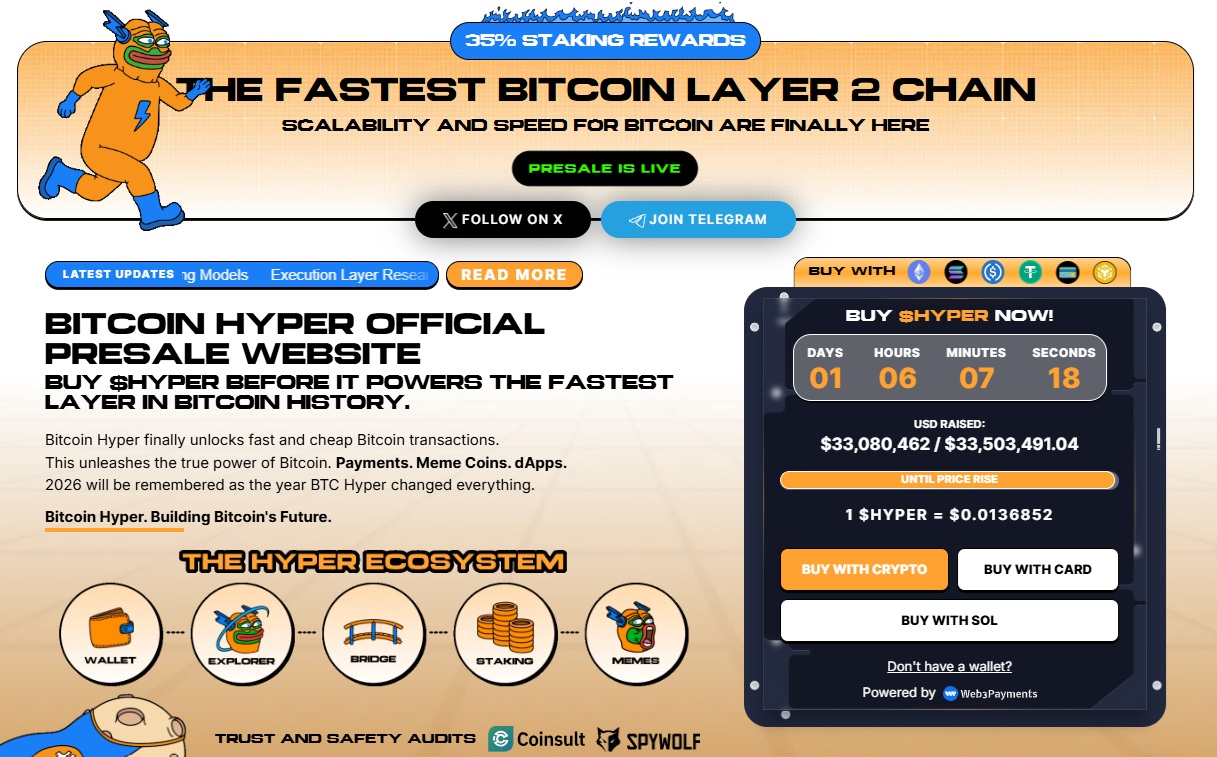
That puts Bitcoin Hyper (HYPER) in an interesting position – the presale has raised $33 million at $0.01368 for a Layer 2 that gives BTC a faster environment for payments, trading, lending, and other financial activity. Will it see similar price movements in the future?
STX Rally Puts Bitcoin Infrastructure Back in Focus
Stacks has spent years building around the idea that Bitcoin can support a much larger financial ecosystem without requiring the base chain itself to do all the work.
Its architecture allows developers to build smart contract applications connected to Bitcoin, while sBTC is designed to give users a Bitcoin-backed asset that can move into the Stacks economy.
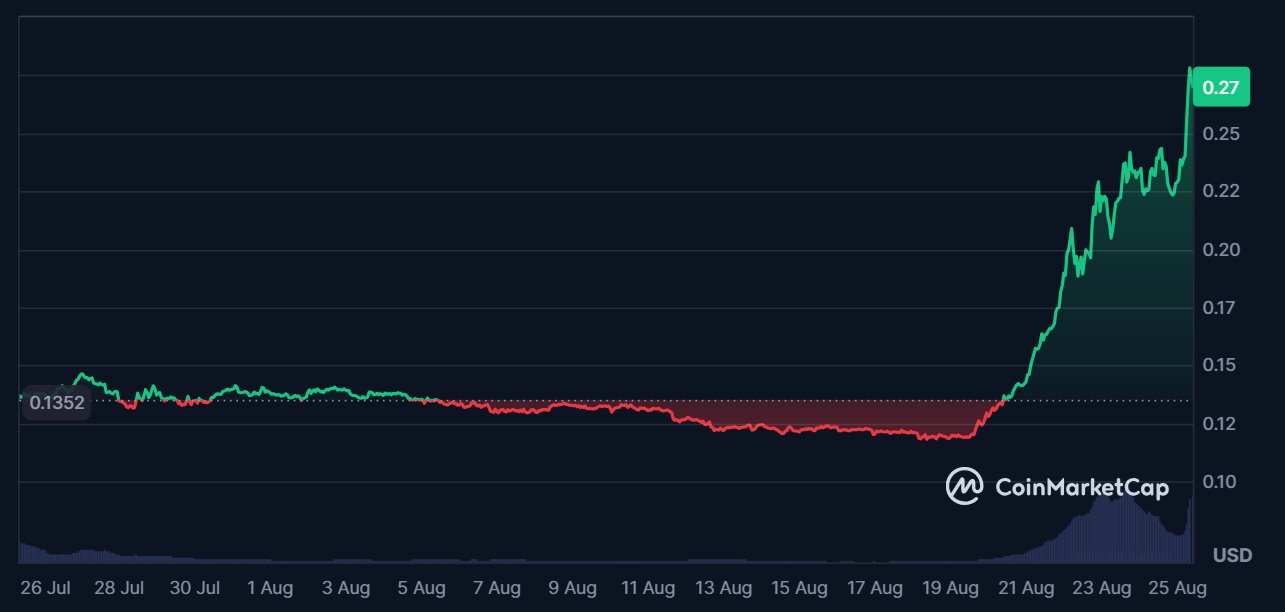
STX’s 126% weekly surge does not mean every Bitcoin-focused token is about to follow it – price moves of that size can reverse quickly, as STX has encountered many times before.
It does, however, show how aggressively capital can rotate into the Bitcoin infrastructure trade once investors become interested in seeing more utility added to BTC itself.
It’s a move that often happens when Bitcoin is heading upwards, with the long-awaited reclaim of $80,000 happening overnight.
Every rise in BTC’s value expands the pool of capital sitting inside Bitcoin, but the base network still deliberately prioritizes security and settlement over high-speed financial activity.
A more valuable Bitcoin does not suddenly become faster to trade with, easier to lend, or better suited to rapid payments – and Layer 2 projects are building that missing activity around it.
Bitcoin Hyper Takes the SVM Route
Bitcoin Hyper approaches the problem of slow, expensive BTC transfers differently from Stacks.
Its Layer 2 uses the Solana Virtual Machine, giving Bitcoin-linked capital an execution environment with a lengthy reputation (in crypto terms) for high-throughput transactions. While BTC can handle around seven transactions per second (TPS), Solana can manage thousands.
So BTC can move onto the Layer 2 and be used in an environment where interactions do not have to wait on Bitcoin Layer 1 for every step – that makes real-world payments one obvious use case, but HYPER’s ambitions extend further into trading, lending, decentralized exchanges, and other financial products.
The SVM is an important part of the L2, because speed alone only gets a network so far – developers need somewhere practical to build. By using a Solana-compatible execution environment, Bitcoin Hyper can draw on tooling and teams already familiar with those building fast crypto applications.
HYPER is then used as the network token, including paying transaction fees as users send payments instantly, at sub-cent costs.
That gives the token’s integral use in the protocol, and its longer-term prospects have a fairly clear benchmark after launch: activity.
A successful presale can create an initial holder base, but a functioning Layer 2 needs people to make payments, trade assets, use apps, and generate recurring network demand.
Bitcoin Hyper has already attracted $33 million before reaching that stage – so this is one to watch as it moves from presale to live trading
HYPER is currently priced at $0.01368, while staking offers 35% APY during the current presale stage. Coinsult and SpyWolf have audited project contracts.
Is HYPER the Next Crypto to Explode Onto the Scene?
STX’s extraordinary week provides a useful reminder of what can happen when traders suddenly focus on the infrastructure surrounding Bitcoin.
Bitcoin itself has climbed almost 25% in seven days – STX has gone considerably further, rising more than 126%.
Bitcoin Hyper still needs to turn presale demand into users, applications, and meaningful Layer 2 activity, but STX’s ~$500 million market cap may provide a good first target for HYPER.
Bitcoin has already accumulated the capital and the holders. Projects such as Stacks and Bitcoin Huper demonstrate the appetite for building infrastructure around that asset, rather than leaving every BTC sitting untouched and idle in a wallet somewhere.
Bitcoin Hyper suggests that a faster SVM-powered environment can capture another part of that opportunity.
For investors searching for the next crypto to explode, the $33 million presale shows that the idea has already found an audience.
What happens when that audience eventually meets an open market – and a working Bitcoin Layer 2 – will be the much bigger test, and perhaps a new future for Bitcoin itself.
About Author

About Author




