


BMIC (BMIC) Full Review 2026: How to Buy, Price Prediction & Launch Date
BMIC (Blockchain Micro-Ion Compute) is a decentralized security protocol building a quantum-resistant ecosystem to protect digital assets from future computing threats. Unlike standard utility tokens, BMIC functions as the economic engine for a suite of post-quantum cryptography (PQC) tools, including a secure wallet, enterprise APIs, and a decentralized compute network.
The project is currently in its presale phase, allowing early investors to acquire tokens before the platform’s public mainnet launch. The native token, $BMIC, is an ERC-20 token on the Ethereum network, designed to power the ecosystem’s “Quantum Security-as-a-Service” (QSaaS) model.
This guide explains how to buy BMIC, analyzes its quantum-security claims, and evaluates the investment risks associated with its roadmap.
How to Buy BMIC: 5 Quick Steps
To buy BMIC tokens, follow these simple steps:
- Connect and set up your Wallet: Best Wallet is a good alternative wallet for connecting to the BMIC presale widget. Other options include MetaMask, Coinbase, or Binance wallets.
- Buy ETH or USDT: You will need Ethereum (ETH) or Tether (USDT) to swap for BMIC tokens.
- Visit the official presale: Go to bmic.ai and verify the domain to avoid phishing sites.
- Connect and swap: Link your wallet and exchange your crypto for BMIC. Gas fees will apply.
- Claim after TGE: Tokens are not dropped immediately; you must claim them from the site after the Token Generation Event (Date TBA).
What Is BMIC? Token Essentials and Project Overview
BMIC is aiming to be the defensive infrastructure play for the Web3 space. As quantum computing advances, traditional encryption methods (like those protecting current Bitcoin and Ethereum wallets) face theoretical risks of being broken.
BMIC aims to solve this by building a “Quantum-Resistant Wallet” and a decentralized cloud network that utilizes post-quantum cryptography (PQC) standards approved by NIST.The token itself is used to pay for these security services, access compute power, and stake for network validation.
| Ticker | BMIC |
| Token Standard | ERC-20 (Ethereum) |
| Presale Status | Live (Ongoing) |
| Total Supply | 1,500,000,000 BMIC |
| Presale Allocation | 750,000,000 BMIC (50%) |
| Current Price | ~$0.049 (Dynamic Pricing) |
| Hard Cap | €40,000,000 |
| Audit | VCAudits (Virtual Caim) |
| Launch Date | TBA (Post-Presale) |
Core Technology & Use Case
The primary utility of BMIC is Quantum Security-as-a-Service (QSaaS). The project is developing a wallet that uses lattice-based cryptography, a method believed to be resistant to quantum computer attacks. This wallet is intended for both retail users who want to future-proof their holdings and enterprises requiring secure custody.
Beyond storage, BMIC plans to launch a Decentralized Quantum Cloud. This network will allow users to rent out idle computing power or access quantum-ready processing for complex workloads. The BMIC token serves as the currency for this marketplace: users pay in BMIC to access compute cycles or security APIs, while node operators earn BMIC for contributing resources.
BMIC Tokenomics: Are They Sound?
The tokenomics structure is heavily weighted toward the presale, which can be a double-edged sword. While it puts a majority of tokens in the hands of the community, it potentially creates a large supply of liquid tokens at launch.
| Allocation | No. of Tokens | % of Total Supply | Purpose |
| Presale | 750M | 50% | Majority public distribution. |
| Rewards & Staking | 180M | 12% | Incentives for node operators. |
| Liquidity & Exchanges | 150M | 10% | Reserved for DEX/CEX listings. |
| Private Sale | 150M | 10% | Early backer allocation. |
| Ecosystem Reserve | 135M | 9% | Future development fund. |
| Marketing | 90M | 6% | Post-launch growth campaigns. |
| Team | 45M | 3% | Notably low allocation. |
Analyst Note: The team allocation of only 3% is unusually low. While this reduces the risk of a “team dump,” it hopefully encourages long-term incentives for developers.
BMIC Roadmap & Key Development Milestones
The roadmap is divided into functional phases rather than strict calendar dates, though the team targets specific quarters for delivery.
Phase 1: Foundation (Current – Q1 2026)
- Presale launch on Ethereum
- Smart contract deployment and audit
- Development of Quantum-Resistant Wallet MVP
- Integration of NIST-approved PQC algorithms
Phase 2: Wallet Alpha (Q2 – Q3 2026)
- Release of Alpha Wallet with multi-asset storage
- Institutional pilot programs for white-label solutions
- Introduction of Staking for Security nodes
Phase 3: Beta & Governance (Q4 2026)
- Public Beta launch
- DAO governance framework activation
- Secure messaging integration
How to Buy BMIC: Follow This Step-by-Step Guide
The BMIC presale is hosted directly on the project’s website. You can buy BMIC by connecting a wallet, such as Best Wallet, and then purchasing tokens with ETH, USDT, or USDC. Follow these steps to take part safely.
Step 1: Set Up Your Wallet
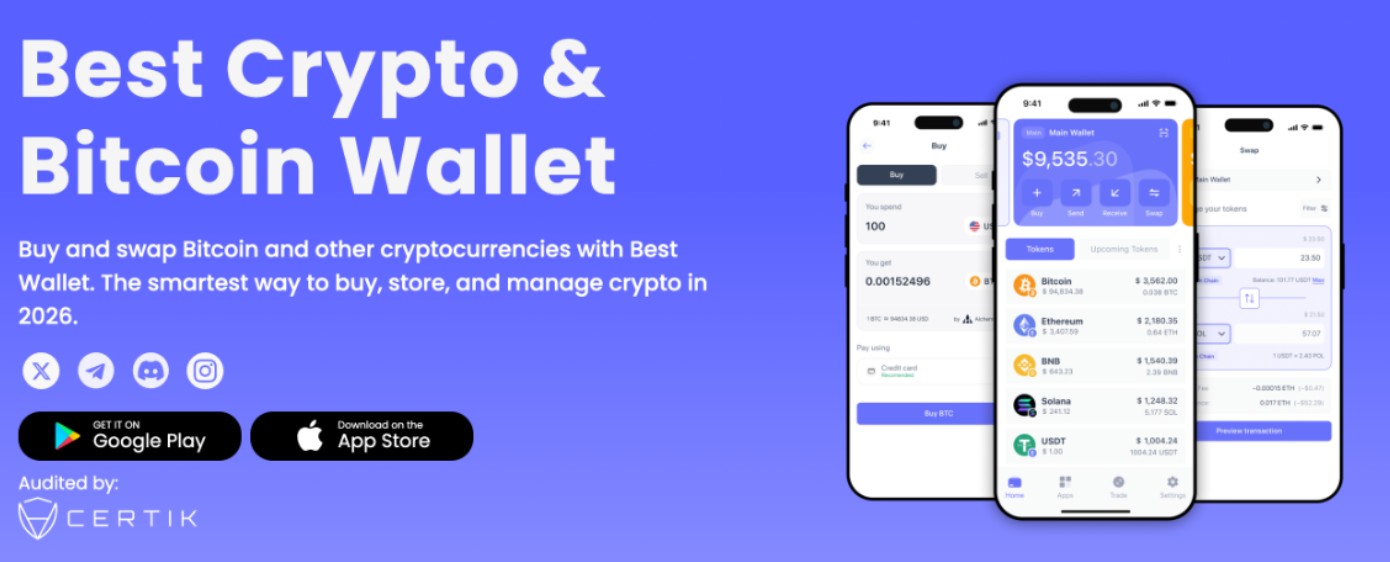
We recommend using Best Wallet for this presale. This crypto wallet features a dedicated launchpad for verified crypto presales, built-in security that alerts you to potential scams, and full compatibility with the Ethereum network. Simply download the app from the Apple Store or Google Play and back up your seed phrase securely to get started.
Step 2: Fund Your Wallet
BMIC is an ERC-20 token, so you will need Ethereum (ETH) or Tether (USDT) to make the purchase. Purchase ETH or USDT directly within Best Wallet or transfer it from an exchange like Coinbase or Binance.
- Note: Always keep at least $20 worth of ETH extra in your wallet to cover gas fees, even if you are paying with USDT.
Step 3: Connect to Official Presale
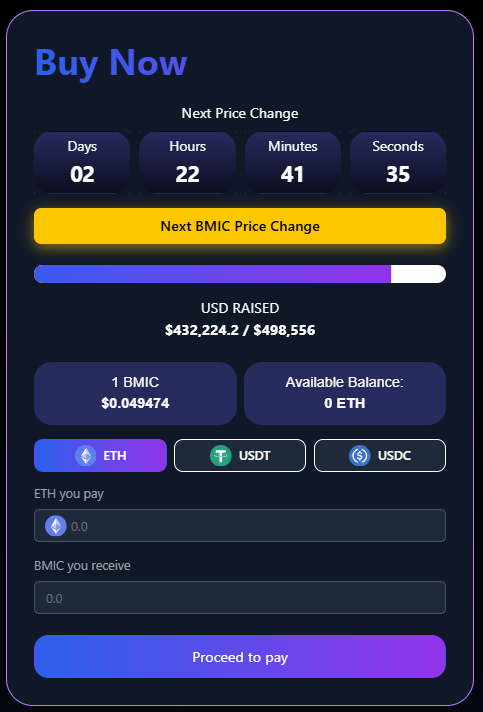
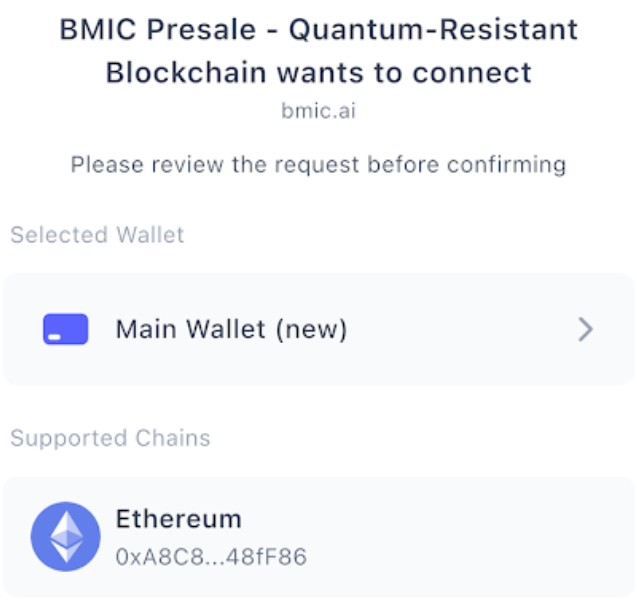
Navigate to the official site: https://bmic.ai/. Click the “Connect Wallet” button. Select “Best Wallet” (or search for your wallet or use “WalletConnect” if using a mobile app).
Approve the connection request in your wallet app.
- Security Tip: Verify the URL carefully. Scammers often buy ads for misspelled domains (e.g., bmic-token.com). Or simply follow our link.
Step 4: Swap & Confirm Transaction
Enter the amount of ETH or USDT you wish to swap. The widget will show you how many BMIC tokens you will receive. Click “Buy Now.” Your wallet will prompt you to sign the transaction. Review the gas fees and confirm.
Step 5: Verify Purchase & Track Allocation
Once the transaction is confirmed on the blockchain, return to the presale website. Your token balance should appear in the “Your Holdings” section of the widget. You will not see the tokens in your wallet app yet; this is normal for presales.
Key Considerations Before You Buy
Gas Fees: The Ethereum network can be expensive. If you are buying a small amount (e.g., $50), gas fees might eat up a significant percentage of your investment. Try to buy during off-peak hours (weekends) to save on costs.
Claiming Process: You are buying a right to claim tokens. You will need to return to the same website after the presale ends (the TGE date) to execute a “Claim” transaction, which will transfer the actual tokens to your wallet.
BMIC Is Legit, and Here Is Why
When verifying a project, we (broadly) ignore the price action and focus on the fundamentals. Our first step is to consider the actual ecosystem use case and whitepaper quality. We expect technical documentation that explains exactly how the ecosystem works. If a project relies solely on buzzwords without a clear utility, it is a red flag.
We also check for transparent roadmap timelines, ensuring the team has a realistic plan for growth and isn’t just selling a dream.
The most objective measure of safety comes from code and compliance. We specifically look for third-party audits from trusted entities, especially if the project is close to launch or live. Audited smart contracts show that the code has been stress-tested against exploits. Additionally, we check for signs of regulatory compliance, which suggests the project is building a sustainable business model capable of surviving market scrutiny, particularly as governments start to take the blockchain seriously.
Lastly, we assess the community and leadership. We look for high levels of community engagement that feel organic and educated, rather than bot-driven hype. When it comes to team transparency, we don’t necessarily require full identities, as anonymity is common in Web3. However, if the team is anonymous, they must compensate with strong code, active communication, and a great track record.
Legitimacy Checklist
- Smart Contract Audit: The BMIC smart contract has been audited by VCAudits (Virtual Caim). The report confirms the contract logic is sound and free of critical severity vulnerabilities that would allow for a rug pull.
- Clear Roadmap: The project has a detailed technical roadmap extending through 2028, focusing on specific deliverables like the NIST-approved algorithm integration rather than vague marketing buzzwords.
- Realistic Tokenomics: The 50% public sale allocation suggests the team is not hoarding supply to dump on retail investors.
Red Flags We Checked
- Anonymous Team: The team is not fully doxxed on the website. While they are referred to as the “BMIC Team” in audit documents, the lack of public LinkedIn profiles for core leadership is a risk factor common in crypto but worth noting.
- Audit Findings: The VCAudits report (available on GitHub) noted that the owner can enable/disable token claiming. This is a standard function for presale management but requires trust that the team will enable claiming at TGE.
- Bitmedia Confusion: There is often confusion between this project and the “Bitmedia.io” ad network. We found no reason to think they are the same entity.
BMIC Price Prediction 2026–2030
The following price prediction assumes the successful launch of the BMIC mainnet and the broader adoption of quantum-resistant security narratives in the crypto market.
Taking into account the BMIC roadmap, the attention we expect quantum threats to receive in the coming years, and expectations of how well BMIC may hit its goal and receive market adoption, here is how the BMIC price may play out in the future.
Our bear case assumes the project still operates but misses key launches or fails to find institutional uptake. Our bull case assumes decent product-market fit and captures a healthy segment of the quantum-resistant wallet space. Prices could go higher if BMIC becomes the ultimate solution in this area, but we prefer to tread conservatively at a time when the world is still grappling with the scope of the problem.
| Year | Bear | Average | Bull |
| 2026 | $0.06 | $0.10 | $0.18 |
| 2027 | $0.09 | $0.15 | $0.35 |
| 2028 | $0.12 | $0.22 | $0.70 |
| 2029 | $0.18 | $0.40 | $1.50 |
| 2030 | $0.25 | $0.75 | $2.50+ |
2026
Price action this year will be driven by the transition from presale to public exchange listings and by the release of the Quantum-Resistant Wallet MVP, which establishes early utility for the token. Hype is likely to be as much of a factor here than BMIC’s fundamentals.
2027
A successful rollout of the Quantum Meta-Cloud and enterprise security APIs should increase awareness and demand for BMIC, while the activation of the “Burn-to-Compute” model (scheduled either end of 2026 or early 2027) begins to exert deflationary pressure on the supply.
2028
Mainnet Launch & DAO Transition: The full launch of the BMIC Mainnet (targeted Q4 2027 – Q2 2028) and a transition to decentralized governance will solidify trust, with the bull case reflecting successful node expansion and a deeper integration into the AI compute market.
2029
If we see institutional adoption of QSaaS by 2029, and the threat of quantum computing to security becomes more tangible, we can expect widespread institutional adoption of BMIC’s Quantum Security-as-a-Service (QSaaS). BMIC has a first-mover advantage here, so our bull price considers this.
2030 and Beyond
The ultimate goal will be for BMIC to establish itself as the standard “security layer” for the post-quantum Web3 economy.
What Moves BMIC Price? Key Metrics to Monitor
- NIST Standardization: The US National Institute of Standards and Technology (NIST) is currently finalizing PQC standards. If BMIC successfully integrates the approved algorithms first, it could see a massive hype cycle.
- Exchange Listings: A Tier-1 CEX listing (Binance, Coinbase) typically provides a liquidity boost and market interest.
- Mainnet Delays: Technical delays in delivering the wallet MVP and other roadmap elements would likely cause the price to stagnate against ETH.
How We Calculate BMIC Price Predictions
Our model applies a “Utility vs. Speculation” ratio. For 2026, the price is driven 90% by speculation on the narrative. By 2028, the price model shifts to utility, requiring actual adoption of the QSaaS APIs by enterprise clients. We discount the price by 30% annually to account for the high failure rate of presale-stage startups.
BMIC Launch Date & Timeline
The project has not set a hard calendar date for the Token Generation Event (TGE), opting instead for a dynamic presale structure that ends when the hard cap is reached or the 50 phases conclude.
- Presale End Date: Dynamic (Dependent on sell-out speed).
- Token Generation Event (TGE): Expected Q2 2026.
- Claim Window: Opens immediately following TGE.
- DEX Listing: Uniswap launch expected shortly after claiming opens.
What Happens After the BMIC Presale Ends?
Once the presale concludes, the team will announce the “Claim Date.” On this day, you must connect your wallet to the website and pay a small gas fee to transfer the tokens to your wallet. Shortly after, the token will be listed on a Decentralized Exchange (DEX) like Uniswap, allowing for open market trading.
Storing Your BMIC Safely: Post-Purchase Tips
Since BMIC is an ERC-20 token, it can be stored in any Ethereum-compatible wallet once the project is live.
- Cold Storage: For investments over $1,000, we strongly recommend moving your tokens to a hardware wallet like a Ledger or Trezor after claiming. This isolates your private keys from the internet.
- Hot Wallets: For smaller amounts or active trading, Best Wallet is sufficient. Ensure you have 2FA enabled on any device where these wallets are installed.
How to Sell BMIC
You cannot sell BMIC during the presale. You must wait until the token launches on a DEX.
- Wait for Launch: Follow the official Telegram for the first listing announcement.
- Connect to DEX: Go to the exchange.
- Swap: Select BMIC in the “Sell” field and ETH or USDT in the “Buy” field.
- Approve & Trade: You will need to approve the BMIC contract for trading (a one-time gas fee) before executing the swap.
Troubleshooting Common Issues
Wallet Won’t Connect
If the “Connect Wallet” button is unresponsive, try clearing your browser cache or disabling any VPNs. Mobile users should use the built-in browser within their wallet app (e.g., the browser tab inside MetaMask) rather than Safari or Chrome.
Payment Transaction Fails
This is usually due to insufficient ETH for gas. Even if you are paying with USDT, you need ETH to pay the network fee. Ensure you have at least 0.015 ETH (~$30-40) in your wallet.
Claim Button Disabled
If you visit the site and the claim button is greyed out, the claim window has not opened yet. Check the project’s official social media channels for the exact time (UTC) of the claim launch.
Official Resources
- Website: bmic.ai
- Audit Report: VCAudits GitHub PDF
- Smart Contract: 0x48e284a9fe40ede0bd9EbD308854598A2936f70b (Do not send funds here directly)
Investment Risks & Disclaimers
Presales carry high risk. You are investing in a startup that has not yet delivered a finished product. While the quantum-security narrative is strong, there is no guarantee the team will successfully build the technology.
Regulatory Uncertainty: As a privacy-focused security tool, BMIC could face scrutiny in jurisdictions with strict financial surveillance laws.
Liquidity Risk: New tokens often experience high volatility. You may not be able to sell your tokens at the desired price if liquidity is low during the initial launch days.
Final Verdict: Should You Buy BMIC?
BMIC presents a compelling narrative by addressing the “Q-Day” threat: the day quantum computers potentially break current encryption. The project’s focus on NIST-approved algorithms and a decentralized compute network gives it a technical edge over generic meme coins. The 50% presale allocation is also a positive sign of community focus.
However, the project is still in early development. The team is not fully public, and the product is in the MVP phase. This is a classic high-risk, high-reward play.
Our Take: BMIC is suitable for investors looking to hedge against future tech risks who are comfortable with the volatility of a presale. It is not a short-term flip; its value depends on the successful delivery of the wallet and mainnet in late 2026.
FAQs About BMIC Presale
Yes, the BMIC smart contract was audited by VCAudits (Virtual Caim). The report is publicly available on GitHub.
You can purchase BMIC using Ethereum (ETH) or Tether (USDT) on the Ethereum network.
You will not receive tokens immediately. You must claim them from the official website after the presale concludes and the Token Generation Event (TGE) occurs.
The launch is expected in Q2 2026, shortly after the presale phases are complete.
The initial launch will likely be on Uniswap (DEX). The roadmap targets a “Top 10 CEX Listing” in Phase, but no specific exchange has been confirmed yet.
Staking is part of the Phase 2 roadmap. It is not currently live during the presale phase but is planned for the Alpha Wallet release.
Major catalysts include the official release of the Quantum-Resistant Wallet and announcements regarding partnerships with enterprise security firms.
The project has not explicitly stated a refund policy for missing the soft cap, but the dynamic phase structure suggests the sale will proceed with whatever funds are raised to fund initial development.
If you encounter a fake site, report it to the official team via their Telegram channel. Always verify you are on bmic.ai before connecting your wallet.