


CoinDepo vs Nexo: 2026 Comparison Guide
Crypto holders looking for new passive income sources have two main paths in 2026: specialized high-yield platforms that focus on compound interest generation, or broader wealth platforms that bundle earning with trading and other products. CoinDepo is a popular contender in the first category and offers fixed APRs that reach 22% on stablecoins such as USDT and USDC (and 18% on major cryptocurrencies including Bitcoin and Ethereum), with six compounding schedules from daily to annual. There are no platform fees on deposits or withdrawals, and users can withdraw funds at any time.
Meanwhile, Nexo has built a larger ecosystem that includes an exchange, a dual-mode card, and other crypto finance tools, although its headline yields (up to 12.5% for stablecoins and 7% for Bitcoin) come with loyalty-tier requirements and lower base rates on the same assets.
In this article, we will offer an independent perspective on CoinDepo and Nexo and compare both platforms across a wide range of criteria, so you can decide which best fits your goals in 2026.
CoinDepo vs Nexo: Comparison Overview
Over the course of our research and testing process, we found that CoinDepo generates higher yields on both stablecoins and major cryptocurrencies while maintaining a near-zero cost structure and preserving full withdrawal flexibility. Its Compound Interest Accounts pay fixed rates that climb to 18% on annual schedules for Bitcoin and Ethereum, while stablecoin APRs can rise to 22% annually.
The platform reported an average user return of 15.7% for Q2 2026, while Fireblocks’ multi-party computation custody and CoinDepo’s completed CertiK and Hacken audits give it a solid operational backbone.
Nexo supports a wider range of assets overall, has a mobile app, and offers integrated trading and spending tools – but base-tier flexible rates on Bitcoin typically sit around 5.5%, and even Nexo’s best stablecoin figures (up to 12.5%) require Platinum-tier status (which in turn requires the user to hold at least 10% of their portfolio in NEXO tokens). Therefore, CoinDepo’s significant yield gap, simpler fee model, and absence of tier conditions make it the stronger choice for earn-focused capital in our opinion.
| Feature | CoinDepo | Nexo |
| Max Stablecoin APR | Up to 22% | Up to 12.5% (tier-dependent) |
| Max BTC APR | Up to 18% | Up to 5.5–7% (tier-dependent) |
| Max Altcoin APR | Up to 18% for major alts; up to 23% for native COINDEPO token | Up to 8–16% (tier- and asset-dependent) |
| Platform Fees | 0% for deposits and withdrawals; network fees may apply to withdrawals | Network fees on select withdrawals |
| Supported Assets | Dozens of majors, stablecoins, and gold tokens | Yield products for 30+ assets; 100+ cryptocurrencies covered across the entire Nexo ecosystem |
| Mobile App | None | iOS and Android |
What Is CoinDepo?
CoinDepo is a centralized digital-asset platform that was founded in 2021 and lets users deposit Bitcoin, Ethereum, other major cryptocurrencies, stablecoins, and tokenized gold into Compound Interest Accounts. Rates run up to 18% APR for cryptocurrencies on annual schedules, while stablecoins can reach 22%. The platform also offers crypto-backed credit lines that keep the underlying deposits earning interest, so the effective cost of borrowing can turn negative when the collateral yield exceeds the loan’s interest rate.
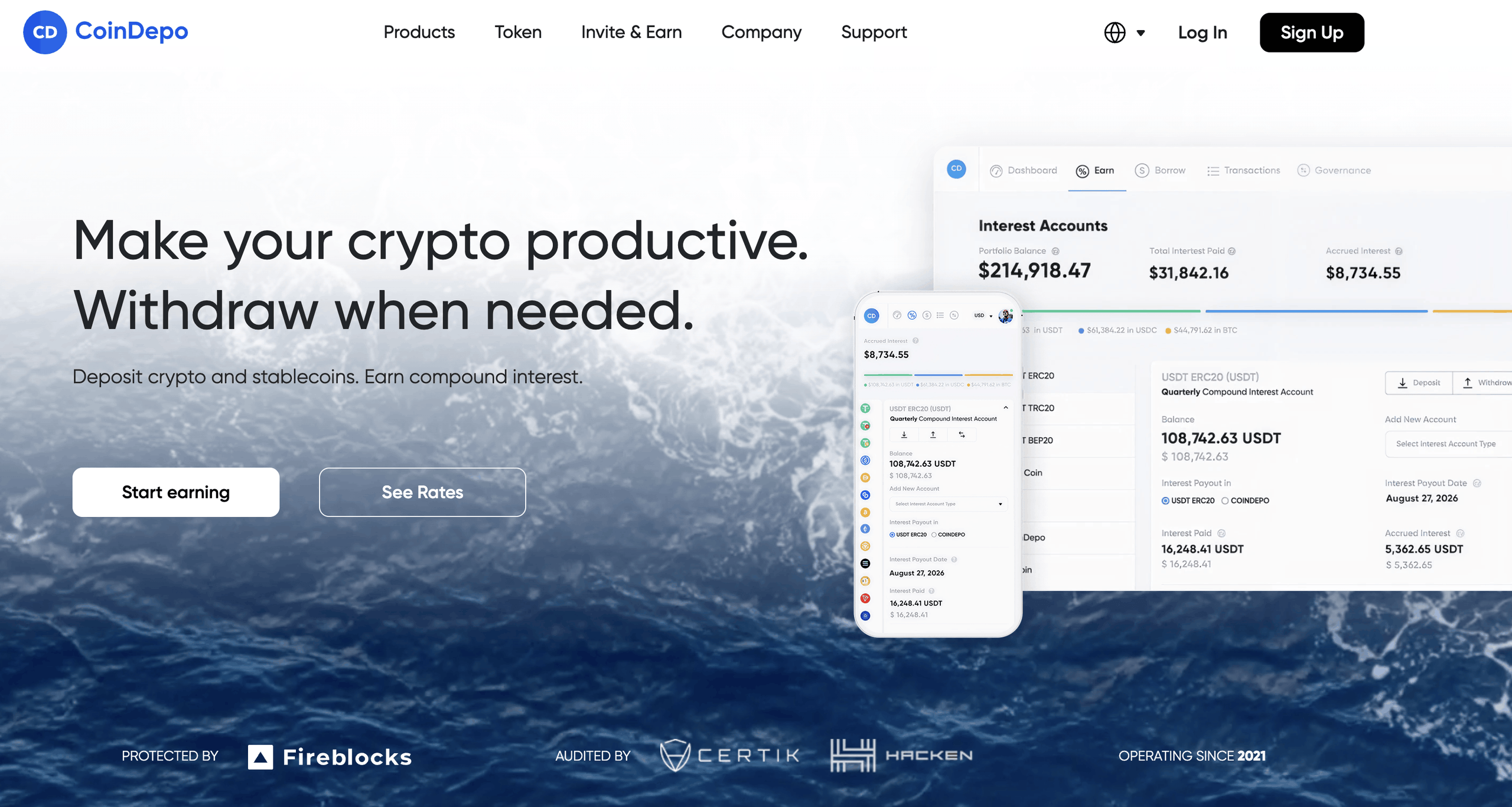
CoinDepo’s AUM (Assets Under Management) totals $243 million with over 116,000 active users at the time of writing, and the average yield paid in Q2 2026 was 15.7%. There is a minimum deposit of just $1, and users can withdraw principal and previously accrued interest at any time regardless of the account schedule they select (although interest will not be paid for incomplete periods). Holding the native COINDEPO token can boost deposit rates by up to 5% and reduce loan costs by up to 3% for holders who meet tier thresholds.
Pros and Cons of CoinDepo
Pros
- Fixed APRs up to 22% on stablecoins and 18% on cryptocurrencies without token requirements
- Zero platform fees on deposits and withdrawals
- Crypto-backed credit lines; underlying deposits continue to earn interest
- Fireblocks MPC custody plus CertiK and Hacken audits
- Flexible withdrawal access on all account types
Cons
- Smaller asset selection
- Web-first interface; no mobile app
What Is Nexo?
Nexo is a crypto wealth platform launched in 2018 that combines yield products, an integrated exchange, crypto-backed credit lines, and a dual-mode payment card. Its flexible savings products pay daily interest on more than 30 digital assets, with fixed-term options of one to twelve months offering higher rates for users who accept a lock-up.
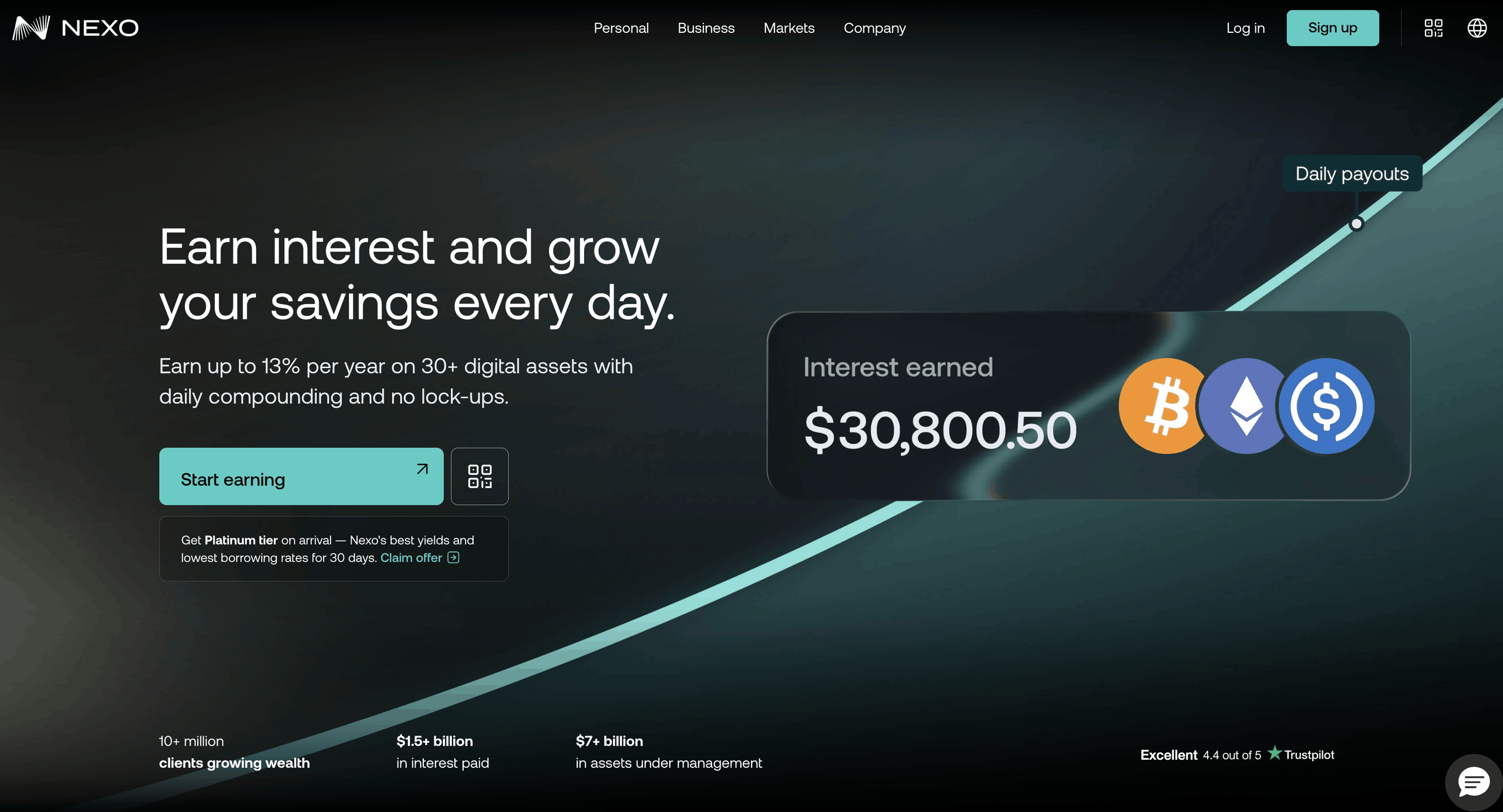
Top stablecoin yields on Nexo can reach 12.5% under specific conditions (typically fixed-term plus high loyalty tiers), while flexible Bitcoin rates are often advertised near 5.5% or below. Stablecoin rates also scale with loyalty tiers that require holding NEXO tokens equal to at least 10% of the portfolio, and a minimum portfolio balance of $5,000 is required before interest begins to accrue on many assets.
Nexo serves more than 10 million clients and has over $7 billion in AUM at the time of writing. Custody runs through partners including Fireblocks, Ledger Vault, and Bakkt in the United States, with SOC 2 Type 2 and ISO certifications in place. Nexo has operated since 2018 and has paid more than $1.5 billion in interest over that period.
Pros and Cons of Nexo
Pros
- Broad asset support exceeding 100 cryptocurrencies (yield products available on 30+)
- Mobile app for iOS and Android
- Integrated exchange, card, and credit-line tools
- Daily compounding on flexible balances
Cons
- Best rates require NEXO holdings and high tiers
- Portfolio minimums apply for interest eligibility
CoinDepo vs Nexo: Factors to Consider
Investors should weigh yields, asset coverage, costs, borrowing options, security infrastructure, regulatory standing, and day-to-day usability when choosing between CoinDepo and Nexo. We’ll dive into each point in more detail in the following sections.
Yields
CoinDepo delivers higher fixed APRs on both stablecoins and major cryptocurrencies without loyalty tiers or native-token requirements, and deposits continue earning interest even if they are used as collateral for a credit line. Stablecoin holders can earn up to 22% on annual schedules for stablecoins, while Bitcoin and Ethereum reach 18% depending on the compounding period selected.
Nexo advertises maximums near 12.5% for stablecoins, although base flexible rates on Bitcoin remain closer to 5.5% and stablecoin yields typically require Platinum-tier status plus interest paid in NEXO to approach double digits. Unlike CoinDepo, Nexo’s credit-line collateral does not continue generating yield in the same way.
CoinDepo’s average user return of 15.7% (reported for Q2 2026) exceeds what most Nexo clients receive on comparable holdings. The former’s fixed-rate structure, its lack of portfolio-balance thresholds, and the ability of credit-line collateral to continue earning yield remove important variables that can reduce potential returns on Nexo. So for depositors whose main goal is consistent income on core assets, CoinDepo comes out on top.
| Asset Class | CoinDepo (Max APR) | Nexo (Max APR) |
| Stablecoins | Up to 22% | Up to 12.5% / higher with tiers |
| BTC / ETH | Up to 18% | Up to approx. 7% |
| Altcoins | Up to 18% (depending on the asset) | Up to approx. 7–8% (13–16% for DOT) |

Range of Cryptocurrencies
CoinDepo concentrates on high-liquidity assets including Bitcoin, Ethereum, popular large-cap altcoins and stablecoins, and tokenized gold products like PAXG and XAUt. This focused list covers the majority of holdings for most retail portfolios while supporting competitive rates on each asset.
Nexo lists more than 100 cryptocurrencies across its ecosystem, including more than 30 earn-eligible assets. However, for users holding primarily major assets and stablecoins, CoinDepo’s selection should be sufficient – and it is also paired with superior rates, making CoinDepo the more practical option for core portfolio yields. The narrower catalogue also simplifies decision-making and reduces the need to monitor rates across dozens of low-liquidity tokens.
Fees
CoinDepo does not charge any platform fees on deposits and withdrawals, although blockchain network fees may apply to withdrawals, depending on the asset and network. Nexo also does not apply platform deposit fees, but explicitly passes network fees on Bitcoin and Ethereum withdrawals (and offers one free monthly withdrawal for Platinum users), while withdrawals on other networks are free. Internal transfers between accounts are free on both platforms.
As both platforms keep platform fees at zero for routine deposit and withdrawal activity, any difference in cost will arise from network fees on BTC or ETH withdrawals on Nexo (outside the free monthly allowance for Platinum users) versus the possibility of network fees on CoinDepo. For most users who hold and move stablecoins or other non-BTC/ETH assets, or who withdraw infrequently, the practical difference is relatively small.
| Fee Type | CoinDepo | Nexo |
| Deposit | 0% | 0% |
| Withdrawal (Platform) | 0% | 0% (network fees on BTC/ETH) |
| Network Fees | May apply to withdrawals | User pays on select networks |
| Account Maintenance | 0% | 0% |
Crypto Borrowing
Both platforms offer crypto-backed credit lines that let users borrow against their holdings without selling, allow flexible repayments, and do not require a traditional credit check. However, the products still differ significantly in terms of their structure.
On CoinDepo, assets used as collateral stay in the user’s Compound Interest Accounts and continue earning the platform’s deposit rates while the credit line is active. Borrowing is capped at 50% LTV. Because the collateral keeps earning, the effective cost of the loan can turn negative when the deposit yield exceeds the loan interest rate.

On Nexo, credit-line collateral does not continue generating yield in the same way. Maximum LTV is higher on some assets (up to 50% on BTC and ETH, and up to 90% on certain stablecoins). Borrowing rates are tier- and LTV-dependent, and can be substantially lower for users who hold enough NEXO tokens and keep utilization low.
While Nexo’s structure prioritizes lower potential borrowing rates for high-tier users and greater LTV flexibility on certain assets, CoinDepo’s structure keeps collateral productive while borrowing. This makes CoinDepo the better option for users who want to access liquidity without disrupting and reducing the high yields they are already earning on their core holdings.
Security Measures
CoinDepo secures client assets through Fireblocks’ multi-party computation custody (which splits private keys across isolated environments). It has completed audits from CertiK and Hacken, participates in the CertiK Hunt bug-bounty program, maintains liquidity reserves, and maintains standard account protections such as two-factor authentication and withdrawal safeguards. A recent CertiK web-application review has been published on CoinDepo’s public Skynet profile; the findings that required remediation are marked as resolved.
Nexo also uses Fireblocks and Ledger Vault custody, holds SOC 2 Type 2 and ISO 27001 certifications, and has operated since 2018 without major customer-fund losses. Both CoinDepo and Nexo use institutional-grade custody infrastructure, but users on either platform still face the counterparty risk that is inherent in custodial services.
Regulatory Compliance
CoinDepo has operated since 2021 and has companies in El Salvador, Panama, and Poland. It maintains KYC/AML procedures and has indicated steps toward MiCA alignment in the European Union.
Nexo’s US affiliate holds a California financing licence. In Australia, Nexo is registered with AUSTRAC as a Virtual Asset Service Provider and operates as an ASIC Credit Representative for regulated credit products. For EEA clients, it uses MiCA-licensed partners in Germany for custody and execution.
Both platforms require identity verification for higher limits.
User Experience
CoinDepo’s web dashboard presents total balances, active interest accounts, and earned interest in a straightforward layout that supports quick deposits and account selection across six compounding periods. We found it easy to use on both desktop and mobile browsers, and the absence of loyalty-tier management keeps the flow simple.
On the other hand, Nexo’s mobile app and unified interface integrate earning with trading and other controls, which will be suitable for users who want an all-in-one hub and are willing to manage tier requirements.
For those primarily seeking high-yield deposits with minimal friction, CoinDepo’s focused interface and lack of tier-management steps deliver a simpler experience focused on returns rather than loyalty requirements. Support on CoinDepo runs primarily through email and help-center resources, while Nexo offers in-app chat alongside email.
CoinDepo vs Nexo: Conclusion
In our view, CoinDepo ultimately outperforms Nexo for investors whose primary goal is maximizing passive income on major cryptocurrencies and stablecoins. Its fixed APRs (up to 22% on stablecoins, up to 18% for other major crypto assets) exceed Nexo’s typical rates, are available without loyalty-tier or native-token conditions, and pair with zero platform fees. Fireblocks’ custody, alongside independent audits from CertiK and Hacken, reinforce CoinDepo’s operational setup, while flexible withdrawals and continuing interest on collateralized borrowing add practical benefits.
Nexo is a capable multi-product platform with a larger user base, mobile app, and broader asset support, but we also found that the differences in yield rates and flexibility make CoinDepo the stronger and more efficient choice for pure crypto interest generation strategies in 2026.
FAQs
Does CoinDepo offer higher crypto interest rates compared to Nexo?
Yes. CoinDepo offers fixed rates of up to 22% APR on stablecoins and 18% on major cryptocurrencies such as Bitcoin and Ethereum, with no loyalty-tier or native-token requirements. Nexo’s highest advertised rates are lower and typically require Platinum-tier status plus NEXO token holdings to approach double-digit APRs on stablecoins.
What is the minimum deposit on CoinDepo?
CoinDepo has a minimum deposit requirement of just $1. Users can deposit any amount of supported assets into Compound Interest Accounts and begin earning the applicable rate without a balance threshold.
What are the differences between CoinDepo and Nexo for crypto investors?
CoinDepo focuses on high fixed yields with no platform fees, and keeps collateral earning while borrowing. Nexo offers a broader ecosystem with trading, a card, more assets, and a mobile app, but its best rates still require NEXO holdings and high tiers. CoinDepo is the best fit for earn-focused users; Nexo could suit those wanting an all-in-one platform instead.
Is CoinDepo a secure platform?
CoinDepo uses Fireblocks multi-party computation custody to secure assets. It has completed audits from CertiK and Hacken, participates in the CertiK Hunt bug-bounty program, and publishes review results on its public Skynet profile. Standard protections such as two-factor authentication and withdrawal safeguards are also in place.
Does CoinDepo charge any withdrawal fees?
No. CoinDepo charges 0% platform fees on withdrawals. Blockchain network fees may still apply depending on the asset and network, and these are paid to the network rather than to CoinDepo.